
Home and decor brands in Petaling Jaya (PJ) often spend on ads, post consistently, and still feel like results are “random.” The usual reason isn’t effort. It’s a few repeatable mistakes that quietly break the funnel from first click to paid order.
We’ve reviewed and helped fix campaigns for furniture showrooms, custom curtain makers, interior studios, and decor e-commerce stores around PJ. The patterns are consistent: weak tracking, mismatched offers, and ads optimised for the wrong action.
This post breaks down the most common mistakes we see in real campaigns, what they cost you, and what to change first so your budget turns into qualified leads and measurable revenue.
- Stop paying for “attention” and start paying for actions tied to revenue.
- Fix tracking and attribution so you know which campaigns actually sell.
- Match your ad promise, landing page, and follow-up so leads don’t leak.
1) Running ads without clean tracking (then guessing what works)
If you can’t trust your numbers, you can’t improve performance. Many PJ home and decor accounts run Meta Ads or Google Ads with partial setup: missing pixels, no conversion events, or no consistent naming. The result is “ROAS looks bad” or “leads are low quality,” but nobody can prove why.
What it looks like in real campaigns
A sofa retailer boosts posts and runs Traffic campaigns to WhatsApp. Sales happen in-store, so the team assumes the ads “worked,” but can’t tell which campaign, which creative, or which audience drove the visits. Budget shifts are based on opinions, not evidence.
What to do instead
Set up the basics before scaling spend. A home & decor digital marketing agency in pj will usually start with measurement because it prevents wasted months.
- Meta Pixel + Conversions API (server-side tracking) so purchases and leads aren’t undercounted.
- Google Tag + GA4 with clear conversion events (WhatsApp click, form submit, checkout, purchase).
- UTM links (simple tracking tags on URLs) so you can see which ad and campaign drove the visit.
- One source of truth: decide whether you’ll judge success by GA4 revenue, platform ROAS, or CRM closed-won revenue, then stick to it.
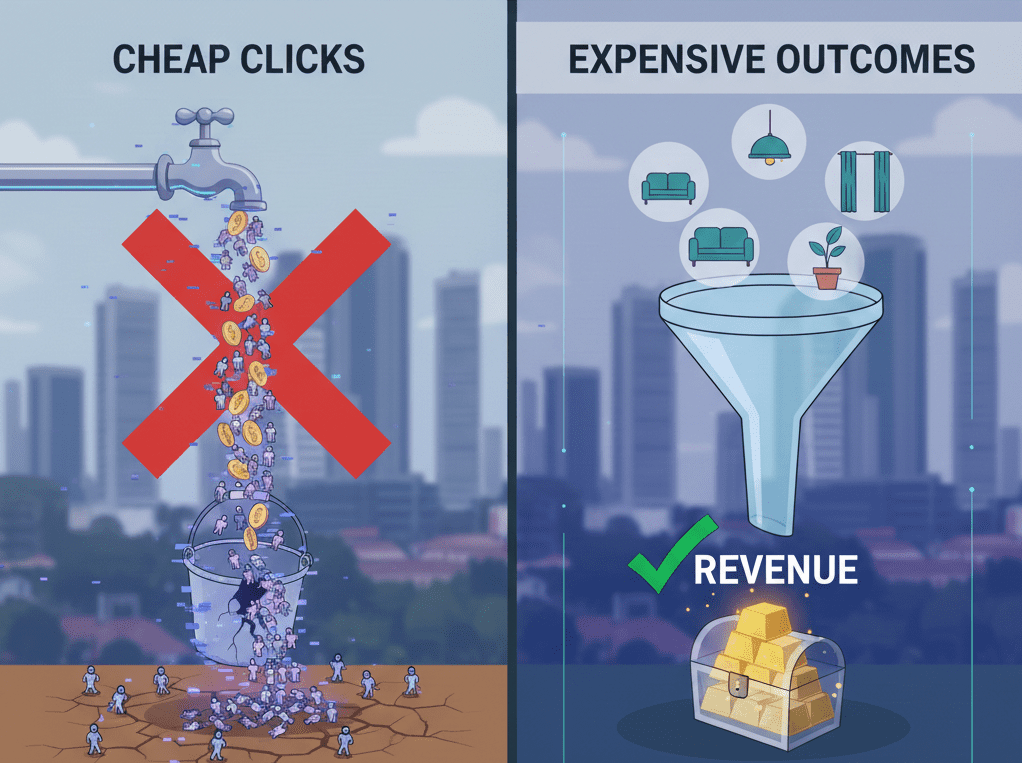
2) Optimising for the wrong objective (cheap clicks, expensive outcomes)
Platforms will give you exactly what you ask for. If you optimise for clicks, you’ll get clickers. If you optimise for messages, you’ll get people who like to ask questions. If you optimise for purchases, you’ll get more buyers (once enough data exists).
Common PJ example: “Traffic” campaigns for high-ticket items
We often see Google Display or Meta Traffic campaigns for custom wardrobes, renovation packages, or premium mattresses. The CPC looks great. The lead quality is poor. The sales team wastes time.
What to do instead
- For e-commerce: optimise for Purchase once your pixel has enough events; until then, optimise for Add to Cart or Initiate Checkout.
- For custom work (ID, curtains, carpentry): optimise for Qualified Lead, not just “Lead.” This means adding a short form with budget/timeline or using a message flow that filters.
- On Google Search: separate high-intent keywords (“custom curtains PJ price”, “sofa showroom PJ”) from research keywords (“types of curtains”). Bid and write ads differently.
3) Sending everyone to the homepage (and expecting them to self-convert)
Your homepage is usually built for browsing. Ads need pages built for decision-making. When a user clicks an ad about “Blackout Curtains Installation in PJ,” landing them on a general homepage creates friction and drop-off.
What we see
Meta Ads show a specific product set, but the click goes to a category page with no sizing guidance, no delivery timeline, and no clear “what happens next.” Conversion rate stays low, then the team blames the ad platform.
What to do instead
- Create one landing page per offer: curtains, sofa, dining set, ID consultation, etc.
- Repeat the same promise from the ad in the first screen (headline + image + price range or starting point).
- Add trust basics: delivery/installation coverage in PJ, warranty, materials, reviews, and clear contact options.
- For WhatsApp-first businesses: use a pre-filled message that includes product name and intent (so your team can reply faster).
4) Treating “leads” as the finish line (and ignoring follow-up speed)
In home and decor, many conversions happen after back-and-forth: dimensions, fabric choices, site visits, stock checks. If your follow-up is slow, your cost per lead might look fine, but cost per sale becomes painful.
Real scenario we’ve seen
A renovation firm runs Lead Forms on Meta. Leads come in during evenings and weekends. Replies happen the next day. By then, the prospect has contacted two other firms and moved on.
What to do instead
- Set a response time target (e.g., under 10 minutes during business hours).
- Use lead routing: assign leads by area (PJ sections), service type, or budget.
- Track lead-to-appointment rate and appointment-to-sale rate, not only CPL.
- Build a simple “next step” system: book a showroom visit, schedule measurement, or get a quote within 24 hours.
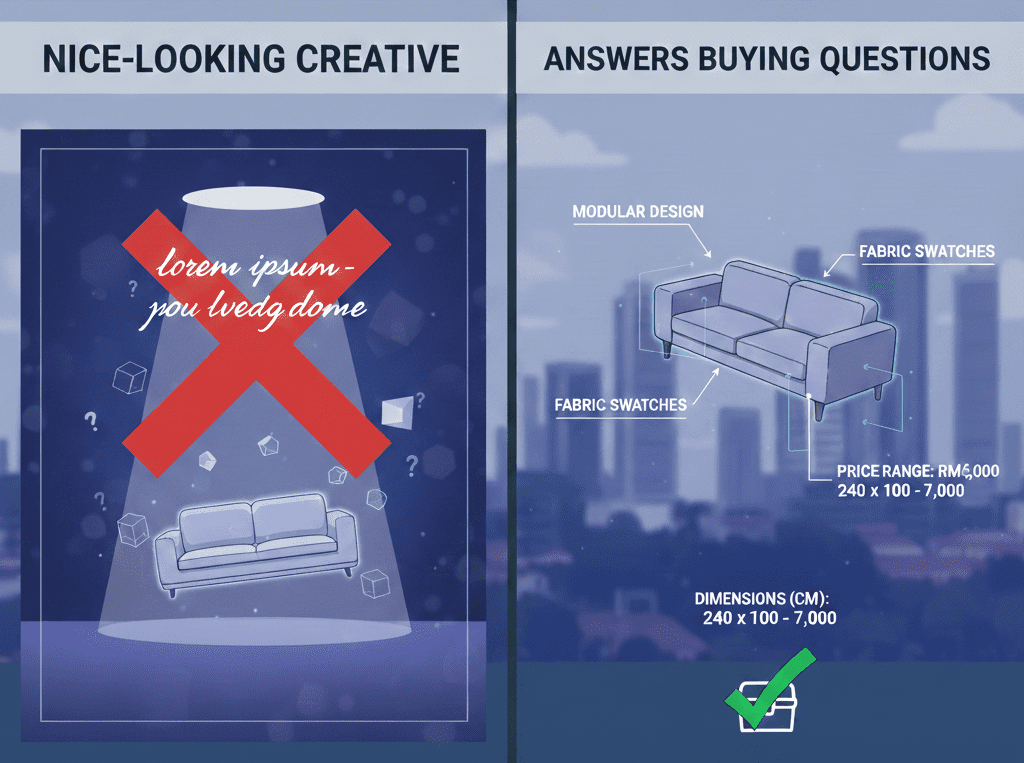
5) Using nice-looking creative that doesn’t answer buying questions
Home and decor ads often look beautiful but avoid specifics. That’s fine for awareness, but it can be expensive when you need sales. Buyers want clarity: price range, sizing, delivery time, materials, and what’s included.
What converts better in PJ campaigns
- Before/after installs with captions that explain constraints (small condo, low ceiling, odd angles).
- Short videos showing texture, firmness, or mechanism (sofa recliner, curtain track, cabinet hinge).
- Price anchors: “Starting from RM___” or “Typical range RM___–RM___” (reduces unqualified leads).
- Proof: reviews from PJ customers, showroom footage, and warranty terms in plain language.
6) Blending all products and audiences into one campaign (then learning nothing)
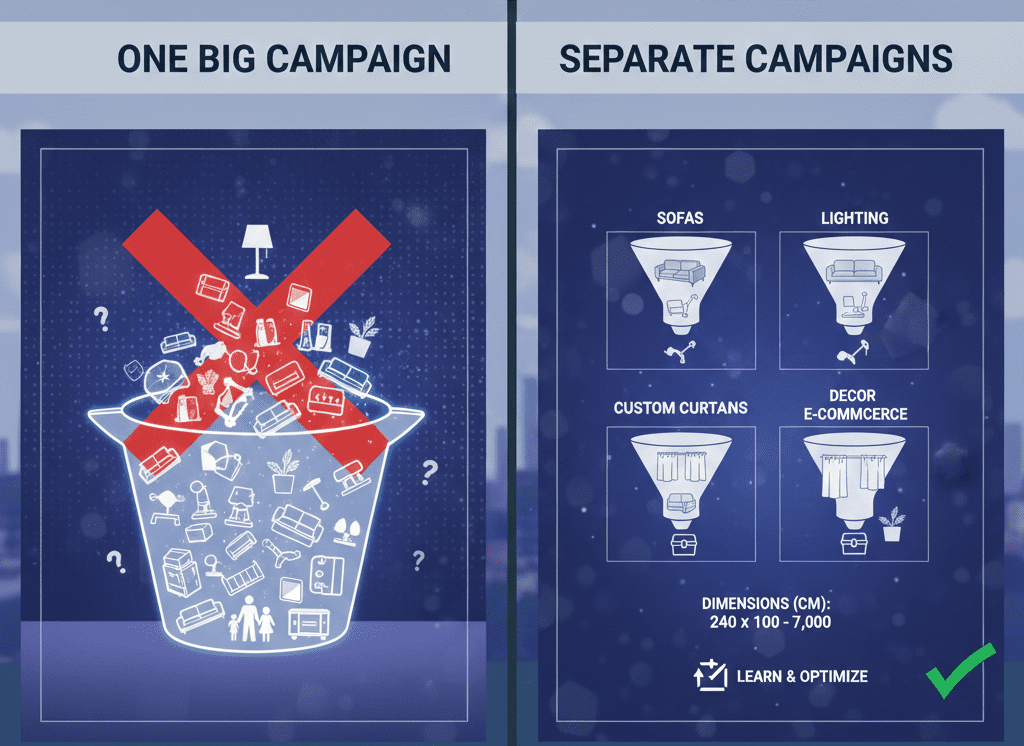
If you sell rugs, lighting, sofas, and custom carpentry, one campaign can’t tell you what’s driving results. You end up with mixed signals and unstable performance.
What to do instead
Structure campaigns so each one has a single job. This makes optimisation easier and reporting honest.
| Business type | Common mistake | Better structure | Primary metric |
|---|---|---|---|
| Furniture showroom | One campaign for all categories | Separate: sofa / dining / mattress | Store visit bookings or WhatsApp qualified chats |
| Custom curtains | Traffic to homepage | Landing page per curtain type + measurement CTA | Quote requests + appointment rate |
| Interior design | Lead forms with no filtering | Consultation offer + budget/timeline questions | Qualified lead rate + close rate |
| Decor e-commerce | Only prospecting, no retargeting | Prospecting + cart retargeting + past buyer upsell | MER (marketing efficiency ratio) + repeat purchase rate |
Conclusion: what to fix first (so spend turns into sales)
If you’re a PJ home and decor business, the fastest wins usually come from fixing leakage, not “finding a magic audience.” Start with tracking you trust, then align objectives to real outcomes, then tighten the path from ad to landing page to follow-up.
Prioritise in this order: measurement setup, campaign objectives, landing pages, lead handling speed, and only then creative volume. That sequence is how you improve ROAS without relying on luck.
If you’re working with a home & decor digital marketing agency in pj, ask them to show you (1) how conversions are tracked end-to-end, (2) what counts as a qualified lead, and (3) where the funnel drops. The answers will tell you whether results will be repeatable.
Frequently Asked Questions
Running ads without reliable tracking and then making budget decisions based on platform screenshots or “feel.” It usually leads to wasted spend and unclear ROI.
It depends on intent. Google Search often captures people already looking for a product or service, while Meta is strong for discovery and retargeting. Many PJ brands need both, but with clear roles and separate measurement.
Usually the campaign is optimised for the wrong action (like clicks), the offer is vague, or the form/message flow doesn’t filter by budget and timeline. Low CPL can hide high cost per sale.
Often yes. A simple landing page can pre-sell the offer, answer pricing and delivery questions, and reduce time-wasters before they message you. It also improves tracking.
For most PJ home and decor campaigns, you need enough data to see patterns, not just a few days of results. A practical minimum is one to two weeks with stable budget, unless tracking is broken or the offer is clearly mismatched.