If you run a home & decor brand in Petaling Jaya (PJ), you’ve probably been told you “need Meta” and “need Google” at the same time. The problem is budget is never unlimited, and the wrong split can leave you with lots of clicks but few sales.
Meta Ads (Facebook/Instagram) and Google Ads don’t behave the same. They attract different types of shoppers, at different moments, with different expectations. For home & decor, that matters because many purchases are visual, considered, and often delayed.
This guide is a decision comparison: when Meta wins, when Google wins, and how to choose based on what you sell, your price points, and your ability to track results.
- Meta is usually best for creating demand and filling your retargeting pool for higher-ticket decor.
- Google is usually best for capturing ready-to-buy intent, especially for specific items and urgent purchases.
- The “better” platform depends on your product type, margin, and tracking quality—not on trends.
First, the real difference: intent vs discovery
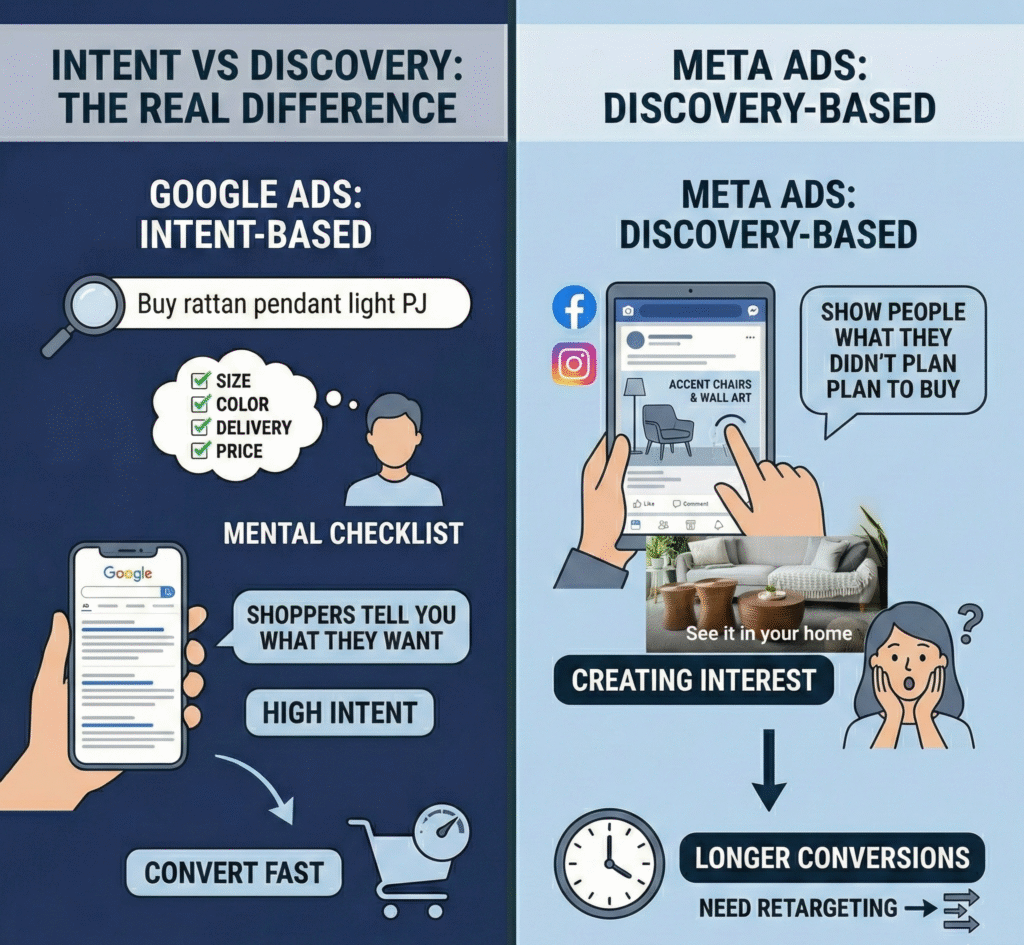
Google Ads: shoppers tell you what they want
Google Ads shows when someone searches a keyword like “buy rattan pendant light PJ” or “sofa cleaning service near me.” This is high intent, meaning the customer is actively looking for a solution.
For home & decor, Google is strong when the product is specific and the buyer already has a mental checklist (size, colour, delivery, price). If your site answers those quickly, Google traffic can convert fast.
Meta Ads: you show people what they didn’t plan to buy
Meta Ads appear in feeds and stories while people scroll. This is discovery, meaning you’re creating interest rather than catching an existing search.
Home & decor is naturally visual, so Meta can generate demand for items people didn’t wake up intending to buy—accent chairs, wall art, table lamps, curtains, even full room styling. The trade-off is that conversions often take longer and need follow-up (retargeting).
What “works better” depends on your PJ buying cycle
If your product is urgent or problem-led, Google usually wins
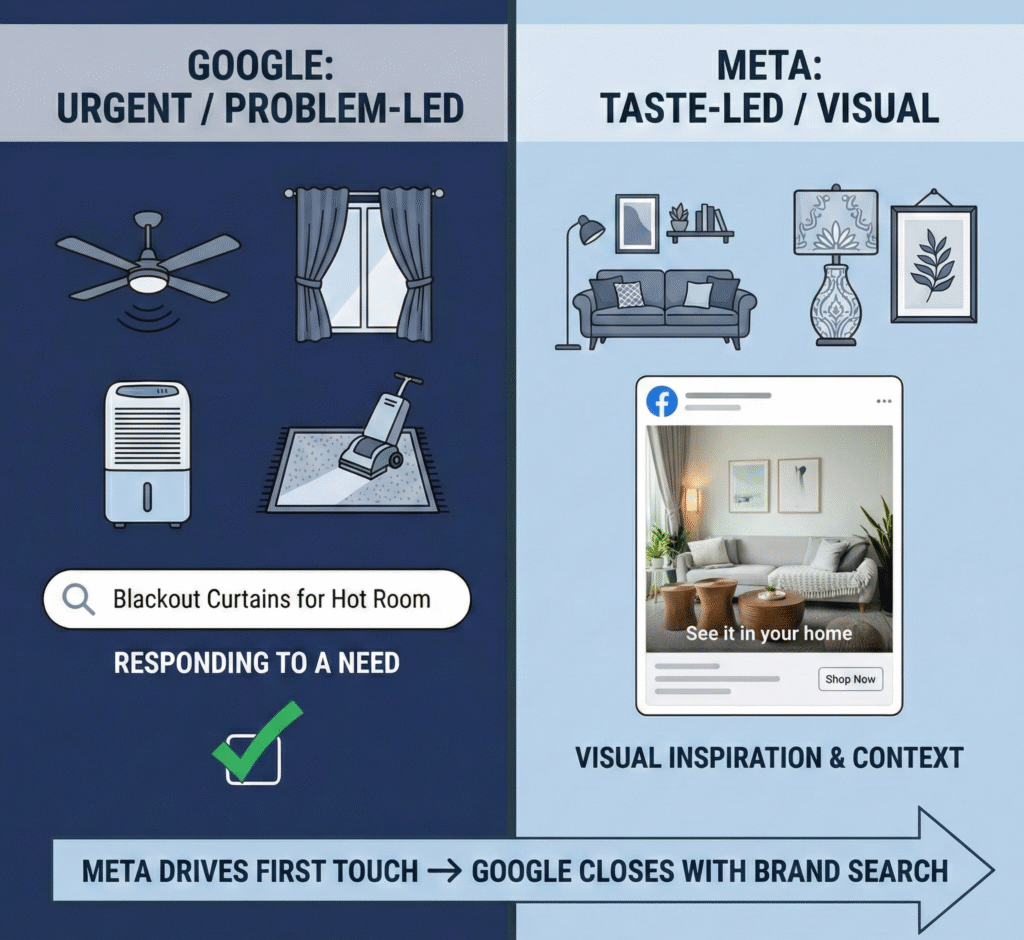
When someone needs something now, they search. Think: blackout curtains for a hot room, dehumidifier, replacement ceiling fan, rug cleaning, or “same-day delivery flowers” (not decor, but the behaviour is similar).
In these cases, Meta can still work, but it tends to be less efficient because you’re interrupting instead of responding to a need.
If your product is taste-led and visual, Meta usually wins
For style-driven purchases, customers want to see it in context: in a living room, under warm lighting, next to a sofa. Meta is built for this because you can lead with a strong visual and a simple offer.
In practice, we often see Meta drive a lot of “first touch” traffic for home & decor, then Google (brand search) closes later when customers search your brand name to confirm trust, reviews, and price.
Decision table: Meta Ads vs Google Ads for PJ home & decor
| Factor | Meta Ads (Facebook/Instagram) | Google Ads (Search/Shopping) |
|---|---|---|
| Best for | Discovery, visual storytelling, building demand | Capturing intent, specific product searches, urgent needs |
| Typical conversion speed | Slower (often needs retargeting) | Faster (if landing page matches search) |
| Creative requirement | High: lifestyle images, videos, UGC-style content | Medium: strong product feed, clear copy, good landing pages |
| Common failure mode | Pretty ads but weak offer and weak tracking | Paying for broad keywords with low buyer intent |
| Works best when | You have a clear angle (before/after, styling, bundles) | You have competitive pricing, delivery terms, and stock clarity |
| Measurement risk | Higher: attribution can be fuzzy if tracking is weak | Lower: search intent is clearer, easier to diagnose |
How to choose based on what you sell (practical scenarios)
Scenario A: You sell big-ticket furniture (sofas, beds, dining sets)
Meta usually does more heavy lifting early. People need to see designs, sizing, and room context. Expect more “browse now, buy later.” Your main job is to build a retargeting funnel: show lifestyle first, then testimonials, then a clear offer (free delivery, instalment plans, showroom appointment).
Google still matters, but mostly for brand search and high-intent terms like “solid wood dining table PJ” where the buyer already knows what they want.
Scenario B: You sell specific decor SKUs (lights, rugs, curtains, mirrors)
Google can outperform quickly if your product pages are clean and your keywords are tight. People search by item type, size, and style. If you run Google Shopping (product listings), it can be especially strong because shoppers compare visually and by price.
Meta works when you package items into looks (for example, “Japandi bedroom set under RMX”) and when you push bundles rather than single SKUs.
Scenario C: You run a showroom or do custom work (ID, carpentry, bespoke)
This is lead generation, not cart checkout. Meta often brings cheaper leads, but quality can swing wildly. Google leads tend to be fewer but more “ready,” because the person searched for the service.
The practical approach is: use Google for high-intent service keywords and Meta for retargeting and proof (project photos, reviews, process videos). If you can only pick one, choose based on whether you need volume (Meta) or readiness (Google).
Budget reality: what to run first when money is tight
If you have RM3k–RM8k/month total
Pick one platform to learn faster. Splitting too early often creates two weak campaigns instead of one strong one.
Choose Google first if you already see organic searches for your products, have clear bestsellers, and your website converts decently. Choose Meta first if your product needs visual explanation, your brand is new, or you’re launching a new collection.
If you have RM10k+/month total
Run both, but with clear roles: Meta for discovery and retargeting, Google for intent capture. The goal is not “more traffic.” The goal is cheaper qualified sessions and more completed purchases or booked appointments.
Tracking: why many PJ brands pick the wrong “winner”
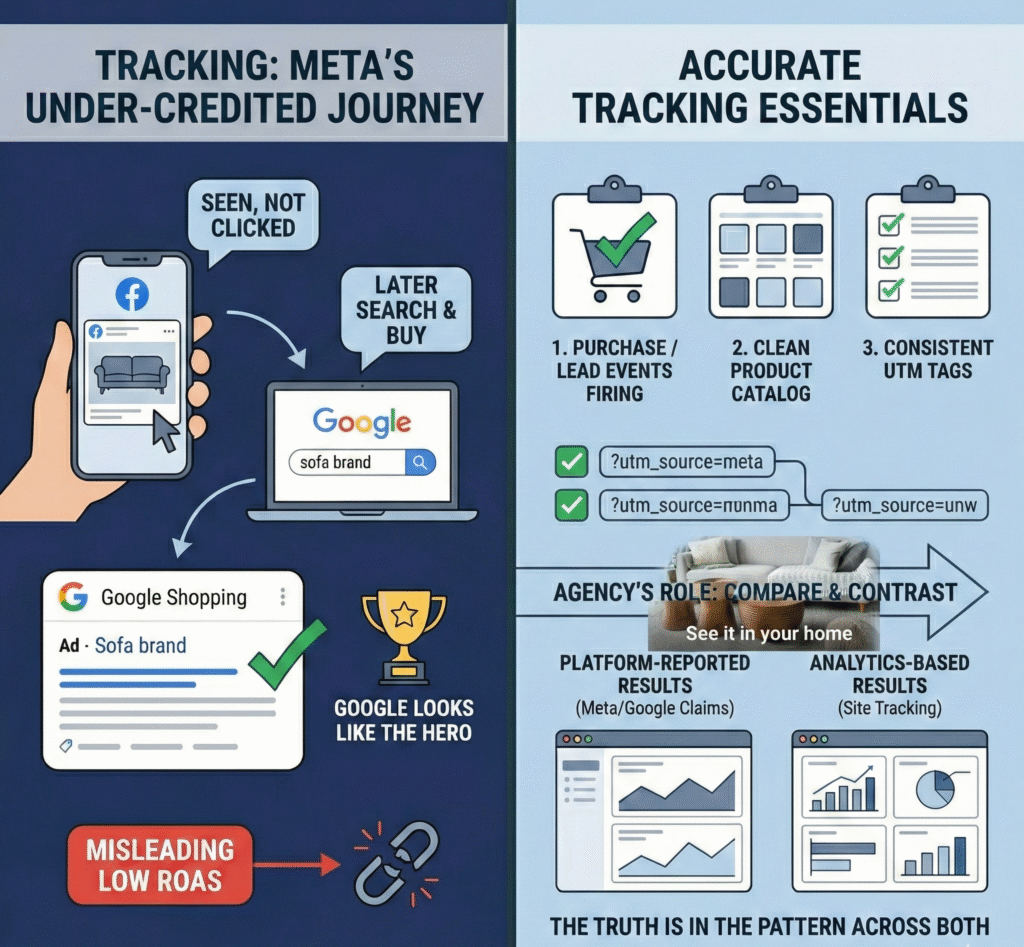
ROAS (return on ad spend) is the common scorecard, but it can mislead if tracking is incomplete. Meta often gets under-credited because people see an ad, don’t click, then later search on Google and buy. Google then looks like the hero.
At minimum, make sure your purchase or lead events fire correctly, your product catalogue is clean (for Shopping and Meta catalog ads), and you’re using consistent UTM tags (simple labels in links that tell you where sales came from).
If you’re working with a Home & decor digital marketing agency in pj, ask them to show you two views: platform-reported results (what Meta/Google claims) and analytics-based results (what your site tracking shows). The truth is usually in the pattern across both, not one screenshot.
Conclusion: the simplest way to decide
If you need customers who are already searching for a specific item or service in PJ, start with Google Ads and make your landing pages do the closing. If you need to create desire, show design context, and build trust over time, start with Meta Ads and commit to retargeting.
The best setup for many home & decor brands is not choosing a favourite platform. It’s assigning jobs: Meta fills the top of the funnel and warms people up, Google captures the bottom of the funnel when they’re ready to act.
Your next step: pick one hero product or one hero service, run one platform for 30 days with clean tracking, and judge it on qualified leads or profitable orders—not on clicks.
Frequently Asked Questions
If people aren’t searching for your brand yet, Meta Ads usually helps you get in front of the right audience faster. Google Ads can still work if you sell clearly defined items with strong search demand, but new brands often need discovery first.
No. ROAS can be distorted by tracking gaps and by how customers buy home & decor over several days or weeks. You should also look at lead quality, conversion rate, and whether repeat or higher-value orders increase.
Expect learning, not perfection. Google usually stabilises faster because intent is clearer, while Meta often needs time to find the right creative and audience signals. The first month should tell you what to scale, not guarantee peak profitability.
Not always. Many brands grow with one platform for a long time, as long as it matches their product and buying behaviour. Running both becomes more important when you want to scale without overpaying for the same audience repeatedly.
Ask how they will decide budget split, what tracking they will set up, what weekly metrics they will report, and how they will improve creative or keywords when performance drops. If they can’t explain trade-offs clearly, results will be inconsistent.