Home and decor buyers rarely see an ad today and purchase tomorrow. They compare styles, measure spaces, ask family, wait for paydays, and often visit a showroom before they commit.
That long decision cycle is where many campaigns break. The ads might be “working” on paper, but you get low-quality leads, messy follow-ups, and a ROAS that looks worse than reality because conversions happen weeks later.
This article is an educational explainer on what long decision cycles really mean in home & decor marketing, and how a home & decor digital marketing agency in pj should plan funnels, budgets, and measurement around that reality.
- Plan campaigns around weeks (not days) so you don’t cut winners too early
- Track micro-conversions to protect ROAS and improve lead quality
- Match channel roles (Meta, Google, TikTok) to how people actually decide
What a “long decision cycle” looks like in home & decor
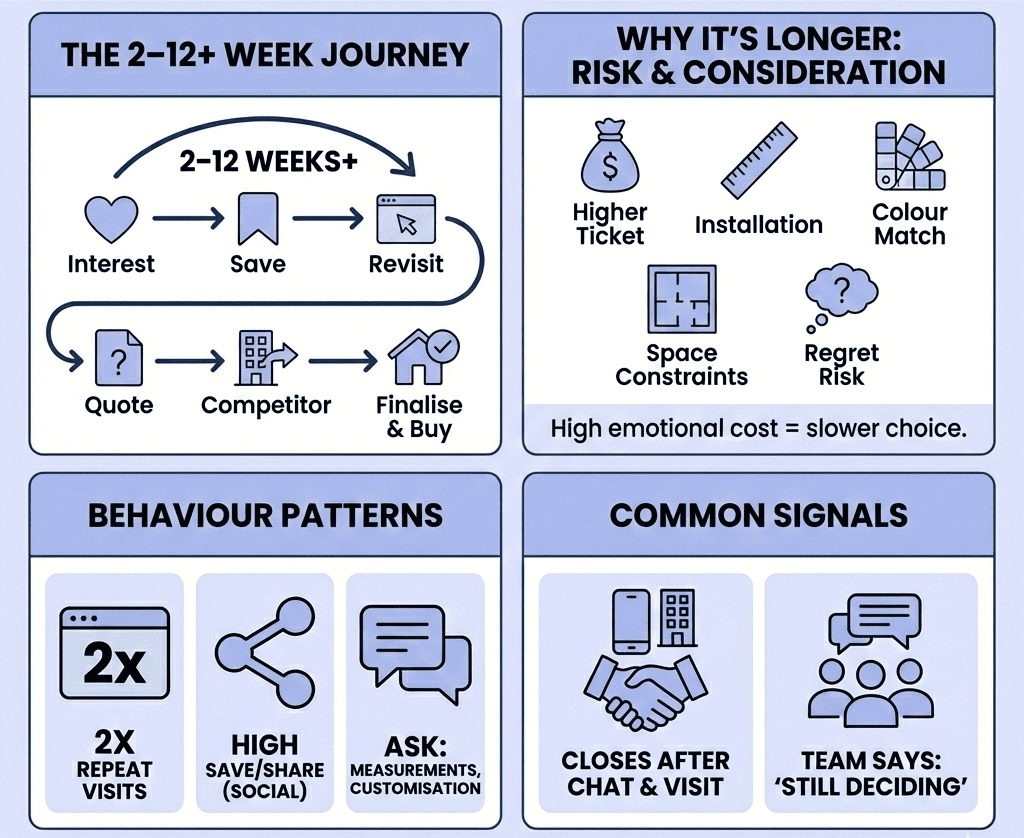
A decision cycle is the time between someone first showing interest and the moment they buy. In home & decor, that window is often 2–12 weeks, sometimes longer for renovation-related purchases.
In execution, you’ll see it in patterns like these: people save posts, revisit the website multiple times, request a quote, go quiet, then come back after they’ve visited a competitor or finalised measurements.
Why it’s longer than most e-commerce
Home & decor products are high-consideration. That simply means the buyer needs more confidence before spending. The reasons are practical: higher ticket sizes, installation concerns, colour matching, space constraints, and “will I regret this?” risk.
Even when the product is affordable, the emotional cost is high. Nobody wants the wrong sofa in their living room.
Common signals you’re in a long-cycle category
If you’re unsure whether your brand has a long cycle, check your behaviour data and sales process. These signals show up consistently in real accounts:
- Many repeat sessions per user before purchase
- High “save” and “share” activity on Meta or TikTok creatives
- Leads ask for measurements, material options, or customisation details
- Sales closes happen after WhatsApp conversations and showroom visits
- Sales team says “they’re still deciding” more than “they went cold”
How long decision cycles distort performance (and cause bad decisions)
Most teams judge ads too fast. They look at 3–7 day ROAS and make changes. In home & decor, that often leads to cutting the campaigns that are actually generating future revenue.
The “ROAS looks bad” problem
ROAS (return on ad spend) is revenue divided by ad spend. The problem is timing: if the revenue lands 21 days later, your dashboard today will under-report performance.
This is even worse when purchases happen offline (showroom) or via WhatsApp where tracking is incomplete. The ad still influenced the sale, but the platform can’t always prove it.
The “leads are junk” problem (when they’re actually unqualified)
Long cycles attract browsers. If your lead form or WhatsApp entry point is too easy, you’ll get lots of “how much?” messages with no intent or budget.
That’s not a platform problem. It’s usually an offer and filtering problem: you’re asking for a conversation before the buyer is ready.
The “we keep changing creatives” problem
Because results come later, teams panic and rotate creatives too quickly. That resets learning (the platform’s optimisation based on past conversion data) and makes performance even more unstable.
In practice, stability often beats constant “refreshing” in long-cycle categories.
What a realistic funnel looks like for home & decor
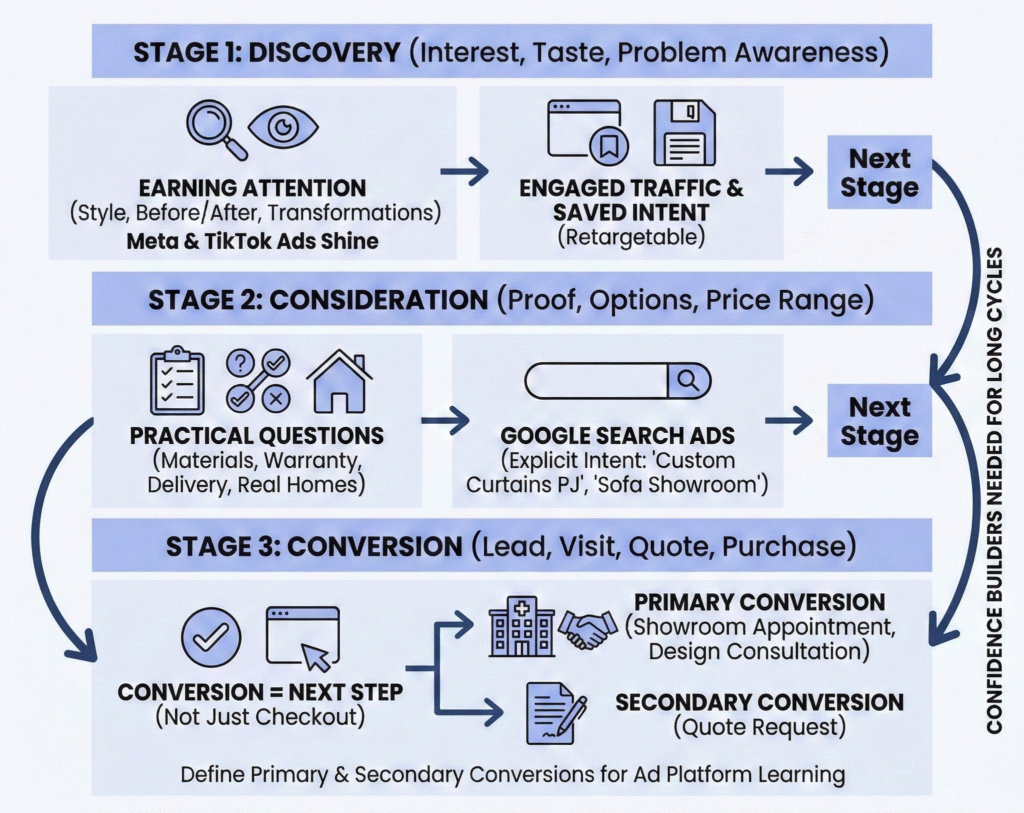
A funnel is simply the steps someone takes from first exposure to purchase. For long decision cycles, the funnel needs “confidence builders” between the first click and the final sale.
Stage 1: Discovery (interest, taste, problem awareness)
This is where Meta Ads and TikTok Ads often shine. You’re not selling immediately. You’re earning attention with style, before/after results, room transformations, and clear positioning.
Good outcome here is not “purchase.” It’s engaged traffic and saved intent that you can retarget.
Stage 2: Consideration (proof, options, price range)
This is where you answer practical questions. Think: materials, warranty, delivery timelines, installation, and real customer homes. If you hide these details, your sales team will pay the price later.
Google Search Ads are strong here because the intent is explicit: “custom curtains PJ,” “sofa showroom near me,” “wardrobe design price.”
Stage 3: Conversion (lead, visit, quote, purchase)
In home & decor, conversion is often a “next step,” not a checkout. That next step might be a showroom appointment, a design consultation, or a quote request.
The key is to define one primary conversion and one secondary conversion, so your ad platforms learn what matters without starving the funnel.
Measurement that fits long decision cycles (without lying to yourself)
Measurement is where most teams either over-trust platforms or give up entirely. A home & decor digital marketing agency in pj should do something more practical: track what’s trackable, and build a simple bridge to revenue.
Use micro-conversions to see progress early
A micro-conversion is a smaller action that signals intent before purchase. Examples: “viewed pricing page,” “downloaded catalogue,” “watched 75% of a video,” “used the store locator,” or “booked a visit.”
These don’t replace revenue. They prevent you from making short-term decisions that damage long-term sales.
Expect attribution gaps (and plan for them)
Attribution is how you assign credit for a sale. In home & decor, attribution breaks when people switch devices, visit in-store, or buy after WhatsApp conversations.
Rather than chasing perfect tracking, set up a simple process: tag leads by source, track showroom visits, and reconcile closed deals back to campaign periods weekly.
Judge performance in the right time window
If your average close time is 30 days, evaluating campaigns on a 7-day window will mislead you. Use a 30–60 day view for revenue, and a 7–14 day view for micro-conversions and lead quality.
| Metric | What it tells you | Best review window | Common mistake |
|---|---|---|---|
| ROAS (tracked) | Directly captured revenue from ads | 30–60 days | Cutting spend after 3–7 days |
| Cost per qualified lead | Whether you’re attracting the right buyers | 7–14 days | Optimising for cheap leads, not qualified leads |
| Showroom visit rate | Intent strength for offline-heavy brands | Weekly | Not recording visits by source |
| Quote-to-close rate | Sales effectiveness and lead fit | Monthly | Blaming ads for sales process issues |
| Repeat site visits | Consideration momentum | 7–21 days | Ignoring retargeting because “they didn’t buy” |
Channel roles: what each platform can and can’t do in long cycles
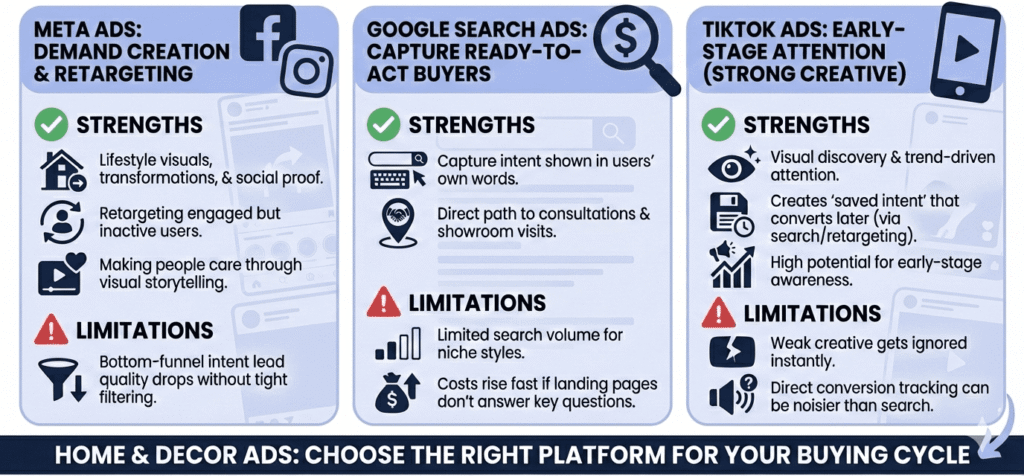
Long decision cycles work best when each channel has a clear job. When everything is forced to “close sales now,” performance usually becomes expensive and inconsistent.
Meta Ads: demand creation and retargeting
Meta is strong for making people care: lifestyle visuals, transformations, and social proof. It’s also strong for retargeting people who engaged but didn’t act.
Limitations: if you rely only on Meta for bottom-funnel intent, lead quality can drop unless your filtering is tight.
Google Search Ads: capture ready-to-act buyers
Search is where people show intent in their own words. It’s often the most direct path to consultations and showroom visits.
Limitations: search volume can be limited for niche styles, and costs rise fast if your landing pages don’t answer key questions.
TikTok Ads: early-stage attention (when your creative is strong)
TikTok can drive a lot of discovery for decor because it’s visual and trend-driven. It can also create “saved intent” that later converts through search or retargeting.
Limitations: weak creative gets ignored, and direct conversion tracking can be noisier than search.
Conclusion: how to operate profitably with long decision cycles
Long decision cycles are not a problem to “fix.” They’re a reality to plan around. The brands that win in home & decor are the ones that stay consistent long enough for demand to mature, while still measuring the right signals.
If you want ROI you can trust, prioritise three steps: define your real conversion (visit, quote, consult), track micro-conversions to avoid short-term cuts, and review revenue on a time window that matches how customers actually buy.
That’s the practical difference between running ads and running a growth system that a home & decor digital marketing agency in pj can manage confidently: fewer reactive changes, better lead quality, and clearer revenue outcomes.
Frequently Asked Questions
For many home and decor brands it ranges from 2 to 12 weeks, depending on ticket size, customisation, and whether a showroom visit or installation is involved.
Because many conversions happen later or offline, the platform may not connect the sale back to the ad click. You need longer reporting windows and a simple lead-to-sale reconciliation process.
Optimise for a primary “next step” conversion like booked consultations or showroom visits, and track micro-conversions like catalogue views or store locator usage to gauge momentum.
They usually play different roles: Meta builds interest and supports retargeting, while Google Search captures people who are actively looking and closer to taking action.
Add simple filtering before the chat starts, such as price ranges, key product options, and a clear call-to-action like booking a visit, so casual browsers don’t flood your sales team.