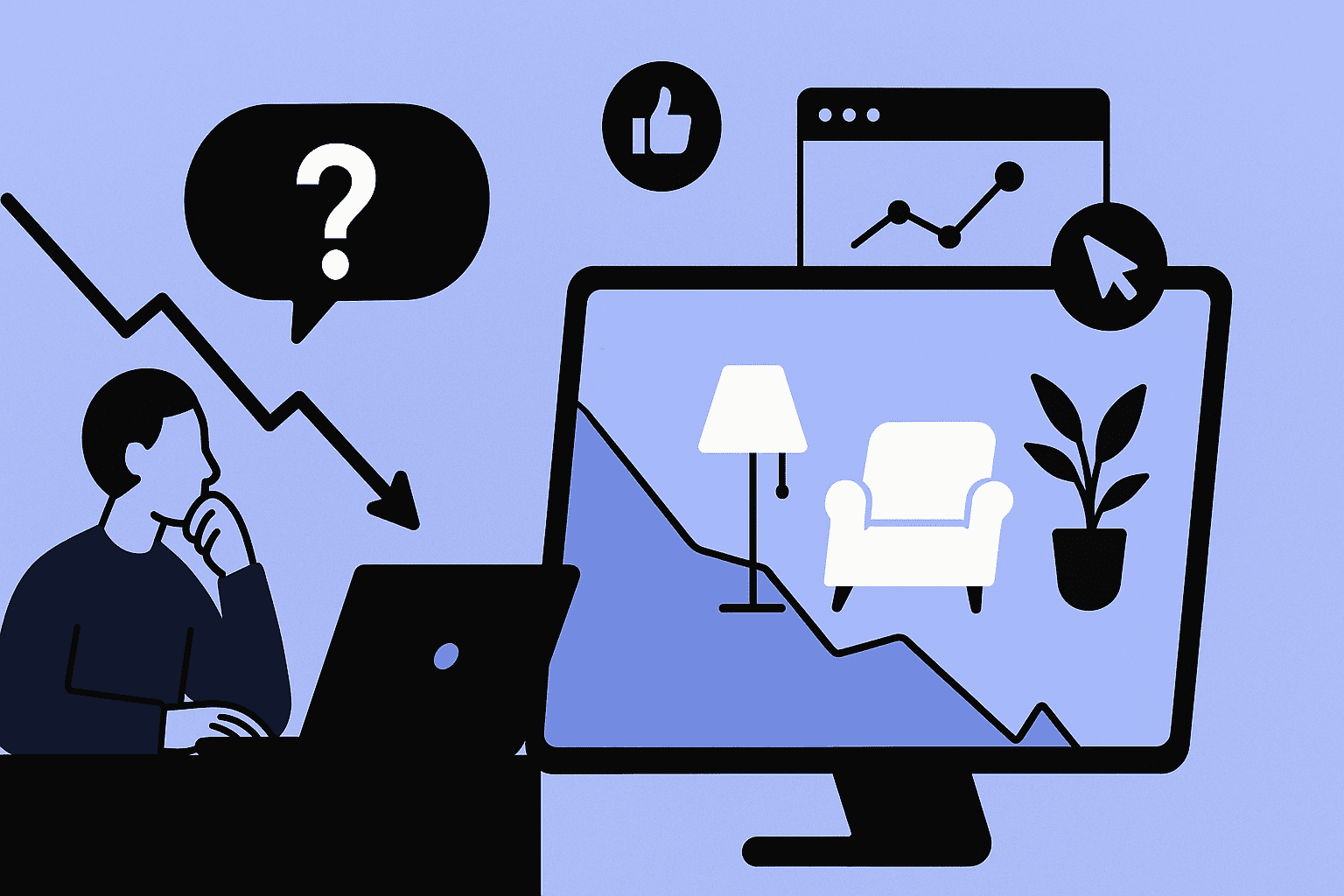
Home and decor brands don’t fail at marketing because the ads “look bad.” They fail because generic agencies run the same playbook they use for services, apps, or fast-moving consumer goods—and home & decor buying behaviour is different.
In practice, you see it as wasted spend on Meta Ads, low-quality traffic from Google Ads, and a funnel that looks “busy” but doesn’t produce consistent revenue. The agency reports clicks and reach, but you’re watching your stock sit.
This is why choosing a home & decor digital marketing agency in pj (not a generalist) often changes outcomes fast: the right team understands how people browse, compare, and delay purchases in this category—and they build campaigns around that reality.
- Generic agencies often optimise for clicks, not for product discovery and purchase intent.
- Home & decor needs stronger creative testing and merchandising, not just “better targeting.”
- Measurement must connect ads to revenue and margin, or ROAS will mislead you.
The core mismatch: home & decor is a “considered purchase” category
Most home & decor items are not impulse buys. Even when the price is affordable, buyers want to picture the product in their space, compare options, and get reassurance about size, material, delivery, and returns.
Generic agencies often treat it like a quick conversion product. They push “Buy now” too early, or they send cold traffic straight to product pages that don’t answer basic questions.
What this looks like in your numbers
You’ll often see a decent click-through rate (CTR) but weak add-to-cart and checkout rates. CTR is simply the percentage of people who click an ad. It can look “healthy” even when buyers aren’t ready to purchase.
Another common pattern: remarketing (ads shown again to past visitors) becomes your only profitable campaign. That’s a sign the top of the funnel isn’t building enough qualified demand.
Generic agencies struggle with creative because home & decor is visual proof, not persuasion
For home & decor, creative is not just design. It’s proof: scale, texture, use-case, and how it looks in real homes. Generic agencies often rely on polished studio shots and generic copy, then wonder why performance stalls.
What actually converts in home & decor ads
Across Meta Ads and TikTok Ads, the strongest performers are usually simple and specific: room context, before/after, close-ups of materials, and short videos that answer one question at a time.
Example: instead of “Premium sofa set,” a better angle is “See how this 3-seater fits in a 900 sq ft condo living room.” That reduces uncertainty, which is the real conversion blocker.
The testing volume is higher than most agencies expect
Home & decor needs more creative variations because each product has multiple “reasons to buy”: size, colour, style, durability, and delivery reliability. A generic agency may test 2–3 creatives per month. That’s rarely enough to find winners consistently.
When creative testing is too slow, the agency compensates by changing targeting or budgets. That creates noise and makes it hard to learn what’s truly working.
Merchandising and landing pages matter more than most ad teams admit
Many generic agencies stop at ads. But for home & decor, the website does heavy lifting. If the product page doesn’t help the buyer imagine the item at home, your ads are paying to create confusion.
Common on-site gaps that kill paid performance
These are the issues that typically show up when a generic agency runs traffic to a home & decor store:
- No clear size guidance (dimensions buried, no “fits in” examples)
- Weak delivery and installation clarity (especially for bulky items)
- Not enough lifestyle photos (only one angle or only studio shots)
- Collections not built for browsing (buyers want “Scandinavian living room” more than “Product SKU 123”)
A home & decor digital marketing agency in pj that’s used to this category will push for simple fixes that lift conversion rate without increasing ad spend.
Paid media setup: generic structures don’t map well to home & decor
Generic agencies often copy-paste account structures: one campaign for prospecting, one for retargeting, broad audiences, and a standard budget split. It can work in some categories, but home & decor needs more control over product themes and intent levels.
Google Ads: intent is not always obvious
Google Ads can be powerful for home & decor, but keyword intent is messy. “Modern coffee table” might be research, while “buy marble coffee table Malaysia” is closer to purchase. A generic agency may bid on broad terms that drive traffic but not sales.
They also often underuse Shopping feeds (product listings on Google). Feed quality matters: titles, attributes, and images. If your feed is weak, you pay more per click and convert less.
Meta Ads: broad targeting is fine, but only with the right signals
Meta Ads can find buyers even with broad targeting, but it needs clean signals: accurate pixel events, good product catalog setup, and consistent creative testing. If tracking is broken or events are misfiring, optimisation becomes guesswork.
Many generalists focus on “interest targeting” because it feels controllable. In home & decor, interests can be misleading; the real driver is whether your creative and offer match a buyer’s current project (moving, renovating, furnishing).
Measurement: ROAS can lie in home & decor if you ignore margins and delayed conversion
ROAS (return on ad spend) is revenue divided by ad spend. It’s useful, but in home & decor it can mislead if you don’t account for margin, shipping costs, discounts, and returns.
It can also mislead because buyers often convert days or weeks later. If your attribution window is too short (the time period you credit a sale to an ad), you’ll undercount what’s working and overreact.
What better reporting looks like
Instead of only reporting platform ROAS, a stronger approach ties together:
- Contribution margin (profit after product cost and variable costs)
- New vs returning customer revenue (so you don’t “buy” the same customers repeatedly)
- Funnel rates (view content → add to cart → checkout → purchase)
This is where a specialised home & decor digital marketing agency in pj typically has an edge: they know which numbers to trust and which ones to treat cautiously.
Quick comparison: generic agency vs home & decor specialist
| Area | Generic agency approach | Home & decor-focused approach |
|---|---|---|
| Creative | Polished visuals, limited variations | Room context, scale proof, fast testing cadence |
| Campaign structure | One-size-fits-all prospecting/retargeting | Built around collections, styles, price tiers, intent |
| Google Ads | Broad keywords, weak feed hygiene | Intent mapping, Shopping feed optimisation, negatives |
| Website | “Not our scope” | Product page improvements tied to ad learnings |
| Reporting | Platform ROAS and clicks | Margin-aware ROAS, funnel rates, delayed conversion |
Conclusion: what to prioritise if you’re choosing an agency
If you sell home & decor, the biggest risk with a generic agency isn’t bad intentions—it’s false confidence. The numbers can look fine while the business outcome stays flat.
Prioritise a team that can show real category execution: how they test creatives weekly, how they structure Google and Meta around browsing behaviour, and how they report performance using revenue and margin, not vanity metrics.
If you’re evaluating a home & decor digital marketing agency in pj, ask for examples of how they improved conversion rate on product pages, fixed tracking to reduce reporting confusion, and scaled spend without relying only on retargeting. That’s where ROI usually comes from in this category.
Frequently Asked Questions
Because home & decor buyers need visual proof, reassurance, and time to decide. Generic agencies often optimise for quick conversions and click metrics, which doesn’t match how people browse and purchase furniture and decor.
Meta Ads and Google Ads are usually the core because they cover discovery and intent. TikTok Ads can work well for visual storytelling, but only if you can produce enough real-life creative that shows products in use.
Ask how they handle creative testing volume, how they improve product pages based on ad data, how they set up tracking for accurate purchase events, and how they report performance using margin-aware metrics.
No. ROAS can ignore shipping costs, discounts, and returns, and it can undercount delayed purchases. You want reporting that connects spend to profit contribution and shows funnel conversion rates over time.
If most of your profitable sales come from retargeting while new customer campaigns lose money, it often means the agency isn’t building effective top-of-funnel discovery or the creative and landing pages aren’t reducing buyer uncertainty.