
If you’re considering hiring a performance marketing agency, you’re probably not looking for “more awareness.” You want predictable growth: more qualified leads, more purchases, and clearer visibility into what’s working.
The confusion comes from the word “performance.” Lots of agencies run ads. A performance marketing agency is supposed to be accountable for measurable outcomes, not just activity.
This article explains what a performance marketing agency actually does day to day, what deliverables you should expect, and where the limits are so you can make a clear decision.
- A performance marketing agency is responsible for measurable results, not just running ads.
- Good agencies manage the full loop: targeting, creative, landing pages, tracking, and optimisation.
- Your results depend on offer, margins, and data quality as much as the agency’s execution.
The core job: turn ad spend into measurable business outcomes
A performance marketing agency manages paid acquisition with a clear measurement plan. Paid acquisition means you pay platforms like Google Ads, Meta Ads, or TikTok Ads to show ads and drive actions (leads or purchases).
The “performance” part is the agreement that success is measured against specific metrics tied to revenue, not vague marketing goals.
What “performance” usually means in practice
Most teams track a small set of numbers that connect spend to outcomes:
- CAC (customer acquisition cost): how much you pay to get one customer.
- ROAS (return on ad spend): revenue divided by ad spend. Useful, but can be misleading if margins or repeat purchases matter.
- CPA (cost per acquisition/action): cost per lead, signup, or purchase, depending on your funnel.
- Conversion rate: the percentage of people who take the next step (click, signup, purchase).
A solid performance marketing agency will push you to choose the right “north star” metric for your business model, not just the easiest one to report.
What they actually do week to week (not just “manage campaigns”)
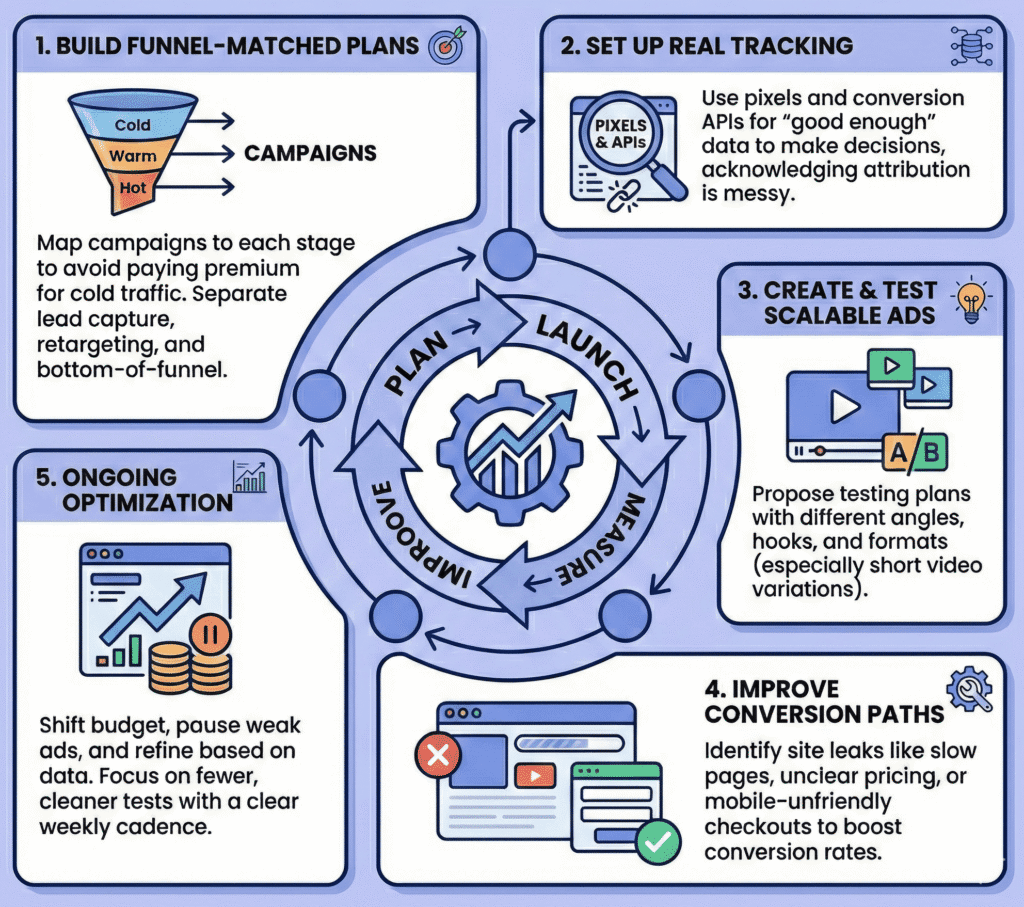
In execution, performance marketing is a loop: plan, launch, measure, learn, improve. The agency’s job is to run that loop faster and more accurately than an in-house generalist can.
1) Build a paid media plan that matches your funnel
Your funnel is the path from first click to revenue. A performance marketing agency maps campaigns to each stage so you’re not paying premium prices for cold traffic that isn’t ready.
Example: for lead generation, they might separate campaigns for lead capture, retargeting (ads to people who already visited), and “bottom-of-funnel” campaigns aimed at booked calls.
2) Set up tracking so results are real, not guessed
Tracking is how you know which ads caused which outcomes. This usually includes pixels (small tracking scripts), conversion APIs (server-side tracking to reduce data loss), and analytics setup.
In the real world, tracking is messy. iOS privacy changes, ad blockers, and cross-device behaviour mean you rarely get perfect attribution (credit for a conversion). A good performance marketing agency will be honest about this and still build a system that’s “good enough” to make decisions.
3) Create and test ads that can scale
Creative is the ad itself: the message, visuals, and offer. For most accounts, creative is the main lever for improving performance once basics are in place.
Expect an agency to propose a testing plan: different angles, different hooks, and different formats. On Meta and TikTok, this often means short video variations and multiple first-3-seconds openings.
4) Improve landing pages and conversion paths (or at least flag issues)
Many agencies stop at the click. Performance-focused teams pay attention to what happens after the click because ad costs rise fast when conversion rates are weak.
They may not build your site, but they should identify leaks: slow pages, unclear pricing, forms that ask for too much, or a checkout that breaks on mobile.
5) Ongoing optimisation and budget decisions
Optimisation means making changes based on data: shifting budget, pausing weak ads, adjusting targeting, and refining bids. It also includes deciding what not to do because every extra campaign adds noise and slows learning.
In practice, the best gains often come from fewer, cleaner tests and a clear weekly cadence rather than constant tinkering.
What deliverables you should expect (and what “good” looks like)
To avoid vague retainers, ask what you will receive each month and how decisions will be made.
| Area | What a performance marketing agency should deliver | What to watch for |
|---|---|---|
| Strategy | Channel plan tied to funnel stages and unit economics | Generic “we’ll test everything” with no prioritisation |
| Campaign setup | Clear account structure, naming, and conversion events | Messy structure that makes reporting impossible |
| Creative testing | Regular new concepts and a test roadmap | Only resizing old assets or running one ad forever |
| Tracking | Pixel/CAPI setup, analytics alignment, conversion definitions | Reporting only platform numbers with no cross-check |
| Reporting | Weekly insights + monthly summary tied to revenue outcomes | Dashboards with charts but no decisions or next steps |
| Optimisation | Documented changes and learnings from tests | “Optimised” as a black box with no explanation |
Where performance agencies add the most value (and where they don’t)
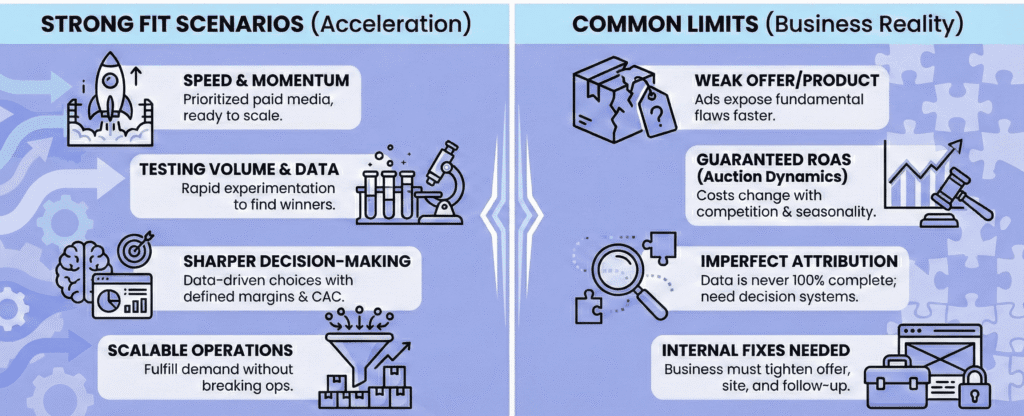
Performance marketing agencies are most valuable when paid media is already a priority and you need speed, testing volume, and sharper decision-making.
Strong fit scenarios
- You have a clear offer and can fulfil more demand without breaking operations.
- You know your rough margins and can define acceptable CAC.
- You can produce or approve creative quickly (delays kill momentum).
Common limits you should plan for
- No agency can fix a weak offer. If your pricing, product-market fit, or sales process is shaky, ads will expose that faster.
- No agency can guarantee ROAS. Platforms are auctions. Costs change with competition and seasonality.
- Attribution will never be perfect. You need a decision system that works even with incomplete data.
This is why the best performance marketing agency relationships feel like joint ownership: the agency runs the acquisition engine, and the business tightens the offer, site, and follow-up.
How to evaluate an agency’s work once they start
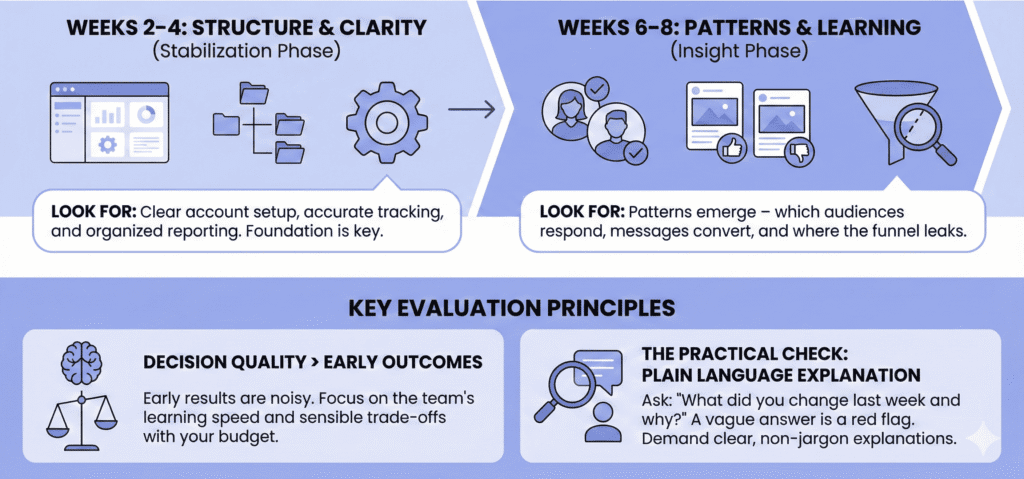
After the first 2–4 weeks, you should see structure and clarity even if results are still stabilising. After 6–8 weeks, you should see patterns: which audiences respond, which messages convert, and where the funnel leaks.
Look for decision quality, not just outcomes in the first month. Early results can be noisy. The question is whether the team is learning fast and making sensible trade-offs with your budget.
A practical check: ask them to explain, in plain language, what they changed last week and why. If the answer is vague, you’re not getting performance management—you’re getting platform babysitting.
Conclusion: what to expect from a performance marketing agency
A performance marketing agency should do more than “run ads.” They should connect spend to revenue outcomes, build reliable tracking, test creative methodically, and improve the funnel so conversions rise over time.
If you want ROI, start with clear unit economics, one or two primary channels, and a short list of conversion events that matter. Then judge the agency on whether they can run a tight testing and optimisation loop that improves lead quality or purchase volume without hiding behind confusing reports.
Frequently Asked Questions
A performance marketing agency is measured primarily on specific outcomes like leads, purchases, CAC, or ROAS. A general digital marketing agency may cover many activities, including content and branding, without being directly accountable to revenue-linked metrics.
Most commonly Google Ads and Meta Ads, and sometimes TikTok Ads depending on your audience and creative. The right channel depends on intent, price point, and how quickly you can convert a click into revenue.
Some accounts see early traction in the first few weeks, but reliable performance trends often take 6–8 weeks because you need enough data to compare tests and stabilise tracking and conversion rates.
You should provide clear margins or target CAC, fast feedback on creative, access to analytics and CRM where possible, and a strong follow-up process for leads. Without those, the agency can drive traffic but struggle to turn it into revenue.
Common models include a monthly retainer, a percentage of ad spend, or a hybrid of both. The best fit depends on how complex your account is and how much strategic and creative work is required beyond campaign management.