You’re not really choosing between two “types of marketing.” You’re choosing what you want to pay for: measurable growth outcomes, or broader marketing support that may include paid growth but isn’t built around it.
This decision matters because the wrong agency model usually fails in predictable ways. Either you get lots of activity (posts, emails, a new website) but unclear revenue impact, or you get aggressive ad spend without solid tracking and lead quality control.
Below is a practical decision guide to help you pick the right partner based on how your business makes money, what you need right now, and how you’ll measure success.
- Choose a performance marketing agency when you need accountable paid growth tied to revenue.
- Choose a digital marketing agency when you need multi-channel foundations and ongoing marketing operations.
- Make the decision based on your funnel, tracking maturity, and the speed you need results.
What a performance marketing agency actually does
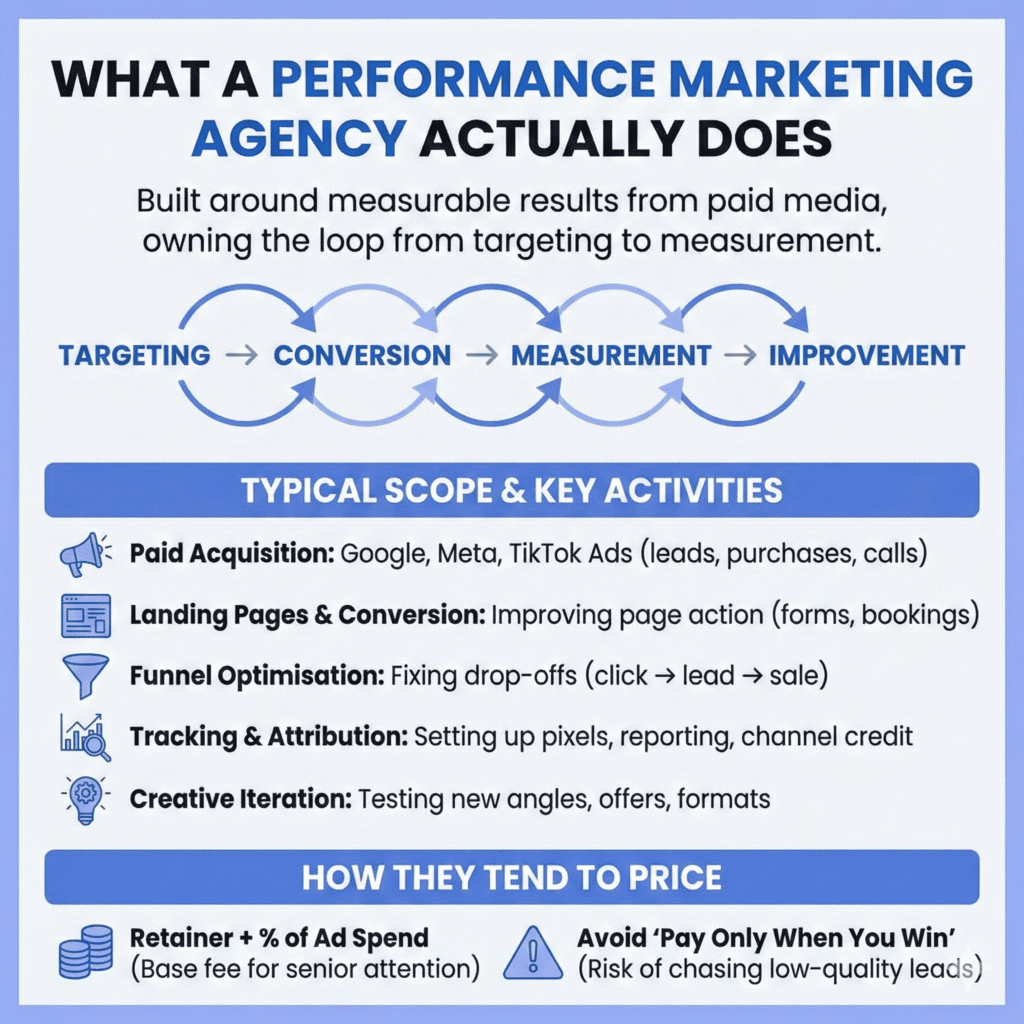
A performance marketing agency is built around measurable results, usually from paid media. “Paid media” means you pay platforms like Google, Meta, or TikTok to show ads, and the agency optimises for outcomes like leads, purchases, or booked calls.
The work is not just “running ads.” In strong teams, the agency owns the loop from targeting to conversion to measurement, then improves it week by week.
Typical scope
- Paid acquisition: Google Ads, Meta Ads, TikTok Ads, sometimes LinkedIn Ads depending on deal size.
- Landing pages and conversion rate: improving the page so more visitors take action (submit a form, buy, book).
- Funnel optimisation: fixing drop-offs between click → lead → qualified lead → sale.
- Tracking and attribution: setting up pixels, conversion events, and reporting so you can trust the numbers. “Attribution” is how you decide which channel drove the sale.
- Creative iteration: testing new ad angles, offers, and formats to avoid performance decay.
How they tend to price
Many use a monthly retainer plus a percentage of ad spend. Some add performance fees tied to targets, but in practice you still need a base fee because good optimisation takes time and senior attention.
If a deal sounds “pay only when you win,” read the fine print. It can push agencies to chase easy conversions (cheap leads, low-intent traffic) instead of revenue-quality outcomes.
What a digital marketing agency actually does
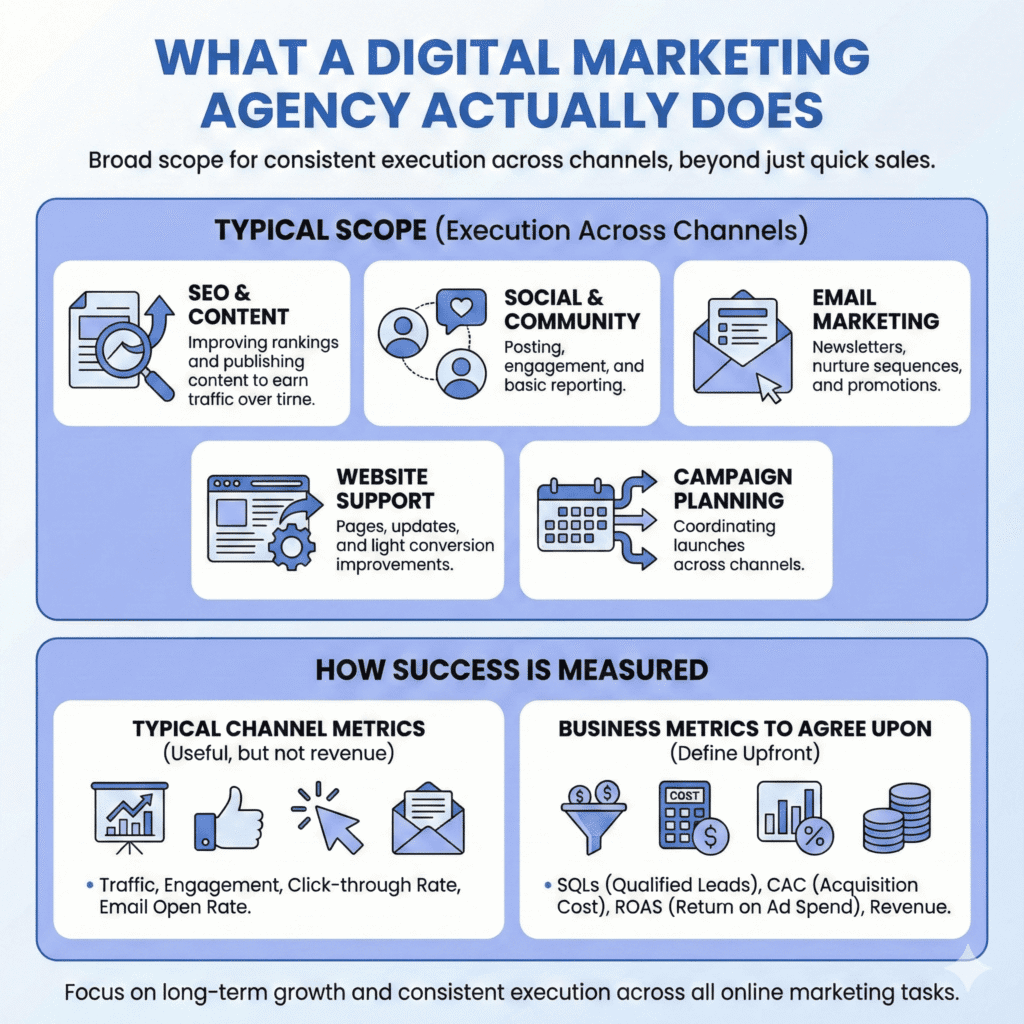
A digital marketing agency is broader. It may include paid ads, but it often covers the full set of online marketing tasks: content, social, email, SEO, website updates, branding, and sometimes design.
This model can be a better fit when your problem isn’t “we need more sales this month,” but “we need consistent marketing execution across channels.”
Typical scope
- SEO and content: improving rankings and publishing content to earn traffic over time.
- Social and community: posting, engagement, and basic reporting.
- Email marketing: newsletters, nurture sequences, and promotions.
- Website support: pages, updates, and light conversion improvements.
- Campaign planning: coordinating launches across channels.
How they tend to measure success
Digital agencies often report on channel metrics like traffic, engagement, click-through rate, and email open rate. Those are useful, but they are not the same as revenue or qualified pipeline.
If you hire this model, you’ll want to agree upfront on which business metrics matter (SQLs, CAC, ROAS, revenue) and how the agency contributes to them.
The simplest way to choose: what problem are you solving?
Most bad agency relationships start with a mismatch between the problem you have and the service model you bought.
If you need revenue growth you can measure month to month
Pick a performance marketing agency when paid acquisition is (or should be) a primary growth lever, and you need clear accountability for outcomes.
Typical scenarios: you have a proven offer, you can fulfil more demand, and you want to scale leads or purchases while keeping CAC (customer acquisition cost) under control.
If you need consistent marketing execution across many channels
Pick a digital marketing agency when your bottleneck is “we don’t ship marketing consistently.” This is common in small teams where the founder is still the marketing manager.
Typical scenarios: you’re rebuilding the website, establishing content, setting up email flows, and building a baseline presence before pushing spend harder.
Side-by-side comparison (what you’re really buying)
| Area | Performance marketing agency | Digital marketing agency |
|---|---|---|
| Primary goal | Measurable conversions and revenue | Broader digital presence and execution |
| Main channels | Google Ads, Meta Ads, TikTok Ads | SEO, content, social, email, web (may include ads) |
| Core outputs | Campaigns, landing pages, tracking, tests | Content, posts, emails, site updates, campaigns |
| Success metrics | ROAS, CAC, CPA, qualified leads, revenue | Traffic, engagement, rankings, email metrics (sometimes leads) |
| Time to impact | Often weeks (if tracking and offer are solid) | Often months (especially SEO/content) |
| Best for | Scaling a working funnel with accountability | Building marketing foundations and consistency |
What to ask before you sign (so you don’t buy the wrong model)
1) “How will you measure success in business terms?”
A performance marketing agency should talk comfortably about ROAS (return on ad spend), CAC, payback period, and lead quality. A digital marketing agency should still connect activity to pipeline, even if the path is longer.
If reporting stops at “impressions and clicks,” you’re going to be guessing about revenue impact.
2) “What will you change if results stall?”
Performance work requires iteration. Ask what they do when CPA rises: new creatives, new landing page, new offer framing, audience changes, or conversion tracking audit.
In real accounts, performance drops happen. The difference is whether the agency has a repeatable process to diagnose and fix it.
3) “Who owns tracking, and what’s included?”
Tracking is where many teams fail quietly. If your Meta pixel or Google conversion setup is wrong, you can spend heavily and optimise toward the wrong signal.
Ask whether they set up or audit: conversion events, UTMs (tags added to links to identify traffic sources), CRM integration, and offline conversion imports (sending closed-won revenue back to ad platforms).
4) “How will you protect lead quality?”
Cheap leads can be a trap. A good performance marketing agency will define what a qualified lead is, align it with your sales team, and optimise toward quality signals (not just form fills).
In execution, this often means: stronger forms, better landing page messaging, tighter targeting, and excluding low-intent placements when needed.
Common mismatches (and how they show up)
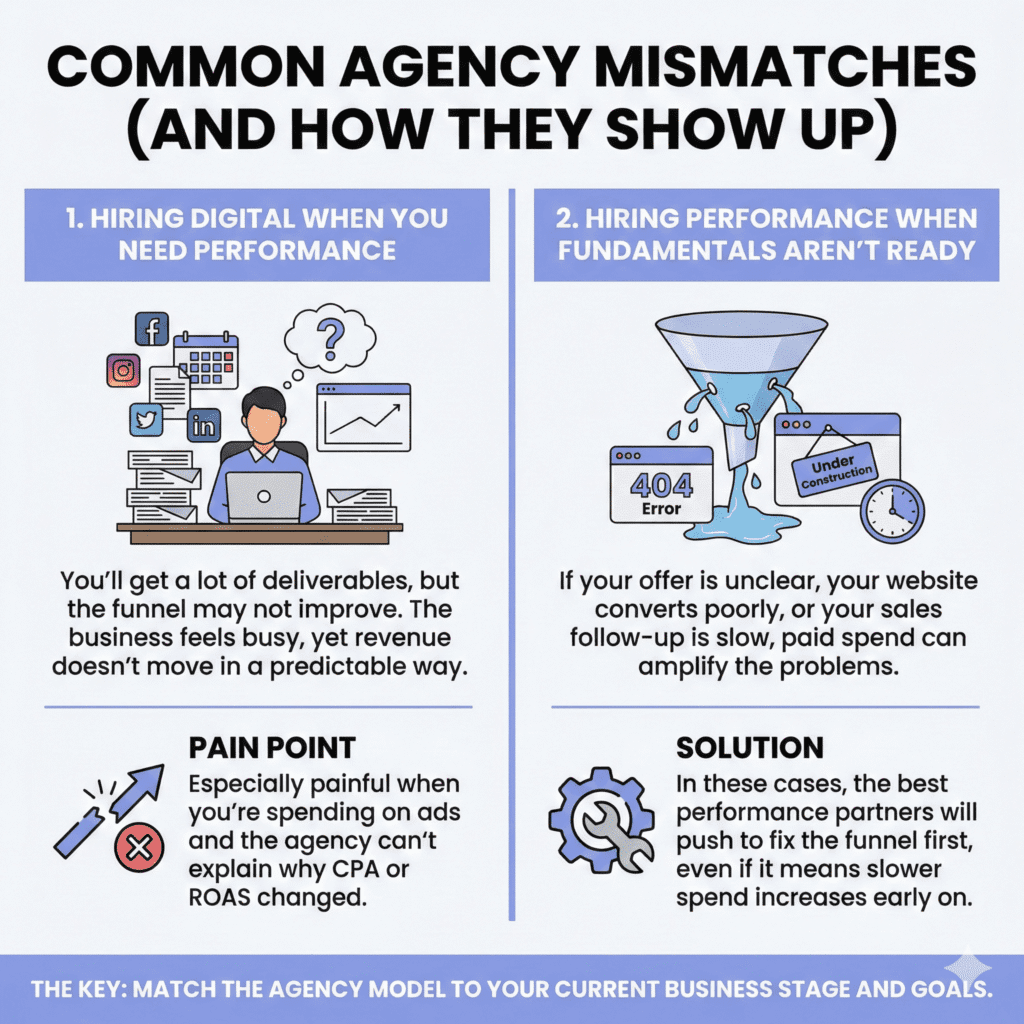
Hiring a digital marketing agency when you need performance
You’ll get a lot of deliverables, but the funnel may not improve. The business feels busy, yet revenue doesn’t move in a predictable way.
This is especially painful when you’re already spending on ads and the agency can’t explain why CPA or ROAS changed.
Hiring a performance marketing agency when the fundamentals aren’t ready
If your offer is unclear, your website converts poorly, or your sales follow-up is slow, paid spend can amplify the problems.
In these cases, the best performance partners will push to fix the funnel first, even if it means slower spend increases early on.
Conclusion: pick the agency model that matches your growth constraint
If your priority is accountable growth from paid channels, a performance marketing agency is usually the better fit. You’re hiring a team to manage spend, improve conversion behaviour, and report in revenue terms you can act on.
If your priority is building a consistent digital marketing engine across content, SEO, email, and web, a digital marketing agency can be the right move. Just make sure you define how that work supports pipeline, not just activity.
Next step: write down your current constraint (tracking, conversion rate, lead quality, volume, or consistency). Then choose the agency model that is designed to solve that constraint, and set success metrics before month one starts.
Frequently Asked Questions
Mostly, yes. The core is paid acquisition and optimisation, but strong teams also work on landing pages, conversion rate, and tracking because ads alone rarely fix a weak funnel.
Sometimes, but it depends on whether they have deep paid media and measurement capability. Many focus on broader marketing outputs, so you should confirm how they tie work to revenue and what they optimise weekly.
You should expect CPA, CAC, ROAS, conversion rate, and lead quality measures that match your sales process, such as qualified leads or booked meetings, not just clicks and impressions.
If you need predictable lead volume and you can define what a qualified lead is, a performance marketing agency is often the better fit. If you need to build trust and demand over time through content and SEO, a digital marketing agency may fit better.
Assuming tracking is correct and the offer is proven, you can usually see directional performance within 30 to 60 days. True efficiency gains often take longer because creative testing and funnel fixes compound over multiple cycles.