

If you run a home or decor business in PJ, you already know the hard part isn’t “getting traffic.” It’s getting the right people to enquire, visit your showroom, or buy—at a cost that still leaves margin.
Choosing a home & decor digital marketing agency in pj is tricky because many agencies can run ads, but fewer can handle the reality of your category: longer decision cycles, high intent questions, and customers who want to see proof (photos, reviews, past projects) before they commit.
This guide is a decision framework. Use it to shortlist agencies based on how they plan, measure, and improve revenue—not how polished their pitch deck looks.
- Choose an agency that can prove lead quality and conversion, not just clicks
- Prioritise tracking and funnel setup before scaling ad spend
- Pick a team that understands home & decor buying behaviour in PJ (showroom visits, WhatsApp, quotes)

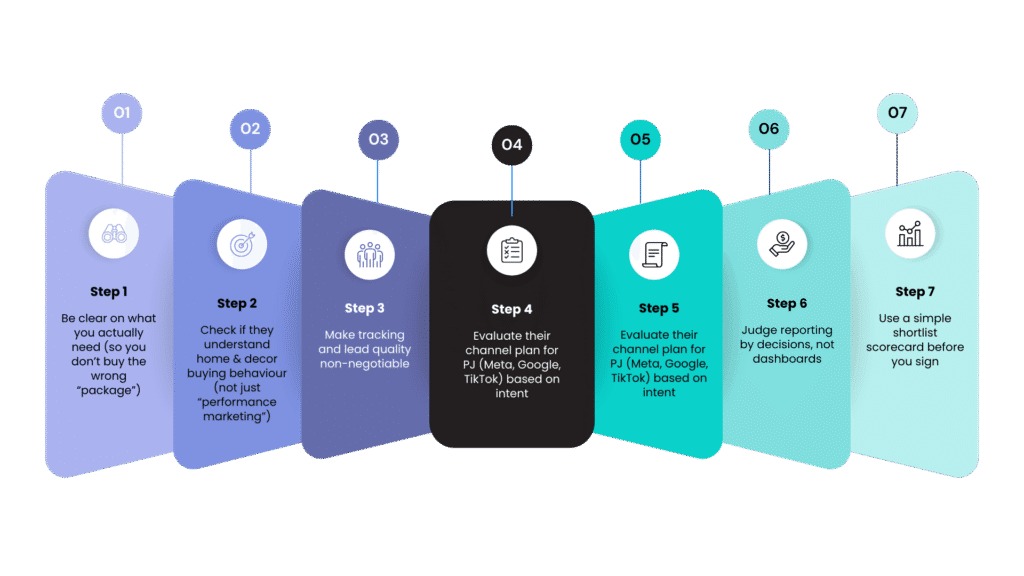
Step 1: Be clear on what you actually need (so you don’t buy the wrong “package”)
Before you talk to any agency, decide which outcome matters most in the next 90 days. Home & decor businesses often mix goals, then wonder why results are messy.
Common goals in PJ home & decor
- Qualified leads for custom work (ID, renovation, curtains, built-ins, landscaping)
- Showroom or site visits for higher-ticket items (tiles, lighting, furniture)
- Ecommerce sales for decor items with repeat purchases
Each goal needs a different funnel. A funnel is simply the path from ad → landing page → enquiry/purchase → follow-up. If an agency proposes one generic approach for all three, expect wasted spend.
What to prepare for agency conversations
- Your average order value or project value range
- Rough close rate (even a guess helps)
- Gross margin range (so ROAS targets are realistic)
- Your current bottleneck: not enough leads, poor lead quality, slow follow-up, weak website
Step 2: Check if they understand home & decor buying behaviour (not just “performance marketing”)
Home & decor customers rarely buy on the first click. They compare styles, ask partners, read reviews, and message for quotes. The agency should build around that reality.
Signals they “get” the category
- They ask how you qualify leads (budget, timeline, location, style)
- They talk about creative assets (before/after, walkthroughs, material close-ups) as a performance lever
- They mention WhatsApp or calls as primary conversion paths, not just web forms
- They plan for follow-up speed (many leads go cold in under 15 minutes)
If they only talk about CPM, impressions, or “going viral,” push back. Those can matter, but they don’t pay your rent.
Step 3: Make tracking and lead quality non-negotiable
Most wasted ad spend in home & decor comes from not knowing which leads turn into revenue. You don’t need perfect data, but you do need usable data.
Minimum tracking you should expect
Conversion tracking means your ad platforms can record key actions like form submits, WhatsApp clicks, calls, or purchases. If this isn’t set up properly, optimisation becomes guesswork.
UTM tagging is a simple label added to links so you can see where leads came from in Google Analytics or your CRM. It’s basic, but many teams skip it.
Questions to ask (and what good answers sound like)
- “How will you track WhatsApp leads?” Good answer includes click tracking, landing page events, and a way to match leads in a sheet/CRM.
- “How will you measure lead quality?” Good answer includes a lead scoring method (even manual at first) and reporting on qualified vs unqualified leads.
- “What’s your plan if leads increase but sales don’t?” Good answer includes diagnosing follow-up, offer clarity, landing page friction, and retargeting.
Step 4: Evaluate their channel plan for PJ (Meta, Google, TikTok) based on intent
Different channels capture different intent. A reliable home & decor digital marketing agency in pj should recommend channels based on your product and customer behaviour, not their internal preference.
| Channel | Best for in home & decor | What to watch out for |
|---|---|---|
| Google Ads (Search) | High-intent queries like “curtain supplier PJ,” “interior designer Petaling Jaya,” “custom cabinet PJ” | Wasted budget on broad keywords; weak landing pages that don’t answer pricing/timeline questions |
| Meta Ads (Facebook/Instagram) | Visual discovery and retargeting people who viewed projects, videos, or product pages | Pretty creatives with no clear next step; too much optimisation for cheap leads vs qualified leads |
| TikTok Ads | Top-of-funnel for trends, transformations, behind-the-scenes; can work if you have strong video | High views but weak intent; needs retargeting and a clear offer to convert |
A practical plan often combines Google Search for intent + Meta for retargeting and lead capture. TikTok can help if you can produce consistent, real footage (not stock clips).

Step 5: Review their process for creatives and landing pages (where most conversions are won)
For home & decor, creative is not decoration. It’s your proof. If the agency can’t help you produce and test creatives, you’ll hit a ceiling fast.
Creative tests that usually move results
- Before/after carousels with one clear promise (e.g., “3D design in 7 days”)
- Short walkthrough videos with pricing anchors (“Projects from RMXXk”)
- Testimonial creatives that include location and scope (“PJ condo kitchen remodel”)
Landing pages matter just as much. A landing page is the page people see after clicking an ad. For leads, it should answer: what you do, who it’s for, price range, timeline, and how to contact you.
Step 6: Judge reporting by decisions, not dashboards
Reports should help you decide what to do next week. If an agency sends charts without clear actions, you’re paying for noise.
What good reporting includes
- Cost per qualified lead (not just cost per lead)
- Lead-to-appointment rate or enquiry-to-quote rate
- Which creatives and offers produced the best downstream results
- Next actions: what they will pause, scale, and test
Also ask how often they review results. In active campaigns, weekly optimisation is normal. Monthly-only changes can be too slow for paid media.
Step 7: Use a simple shortlist scorecard before you sign
When two agencies sound similar, use a scorecard to force clarity. You’re not choosing “marketing.” You’re choosing a working relationship that touches revenue.
Shortlist scorecard (quick and practical)
- Can they explain their plan in plain language?
- Do they prioritise tracking and lead quality from day one?
- Do they show examples relevant to home & decor (not unrelated industries)?
- Do they ask tough questions about your sales process and margins?
- Do they commit to specific weekly actions, not vague “optimisation”?
If you feel pressured to sign quickly, treat that as a signal. Good agencies are confident enough to let you evaluate properly.
Conclusion: Choose the agency that protects your budget first, then grows it
The best home & decor digital marketing agency in pj won’t start by asking for a bigger budget. They’ll start by fixing measurement, tightening your funnel, and improving lead quality.
Your next step is simple: shortlist 2–3 agencies, ask the tracking and lead-quality questions above, and request a 90-day plan with clear weekly actions. If they can’t connect ad spend to qualified leads and sales outcomes, keep looking.
Frequently Asked Questions
Budget depends on your goal and margin, but you should plan for enough ad spend to get meaningful data plus an agency fee for setup and weekly optimisation. If the budget is too small, you’ll get random results and no clear learning.
Google Ads is usually stronger for high-intent searches, while Meta Ads is strong for visual discovery and retargeting. Many home & decor brands perform best with both, as long as tracking is set up properly.
Good leads match your service area, budget range, and timeline, and they respond to follow-up. Ask the agency to report qualified leads separately and to review lead notes or outcomes with your team weekly.
The first month should cover tracking setup, landing page or lead form improvements, initial creative testing, and a clear baseline report. You want a working funnel quickly, not weeks of planning with no campaigns live.
Red flags include avoiding questions about tracking, focusing only on impressions or clicks, promising guaranteed ROAS, and not asking about your sales process. If they can’t explain how they’ll improve lead quality, results will likely be unstable.
