


You know paid ads can drive growth, but the real question is who should run them: your in-house team or a performance marketing agency. The wrong choice usually doesn’t fail loudly. It fails quietly through wasted spend, weak lead quality, and reporting you can’t trust.
This decision is less about “agency vs internal” and more about what you need right now: speed, depth of expertise, reliable measurement, or tight day-to-day control. Most teams don’t have a marketing problem. They have an execution capacity problem.
Below is a practical way to decide, based on what typically breaks in Meta Ads, Google Ads, and TikTok Ads when ownership is unclear.
- Choose in-house when you need tight product context and fast cross-team coordination.
- Choose a performance marketing agency when you need proven execution, testing discipline, and stronger measurement.
- Whichever path you choose, judge it by lead quality, conversion rate, and tracked revenue—not activity.
What “performance marketing” actually means in practice
Performance marketing is paid marketing that is managed against measurable outcomes, usually leads, purchases, or revenue. The day-to-day work is not just “running ads.” It’s building a repeatable system: targeting, creative, landing pages, and tracking that ties spend to results.
A performance marketing agency typically brings specialists (media buyer, creative strategist, analyst) and a testing process. In-house teams often bring deeper product knowledge and faster access to sales, product, and customer support.
The decision comes down to which gaps are more expensive for you right now: missing expertise and process, or missing context and control.
The decision criteria that matter (and the ones that don’t)
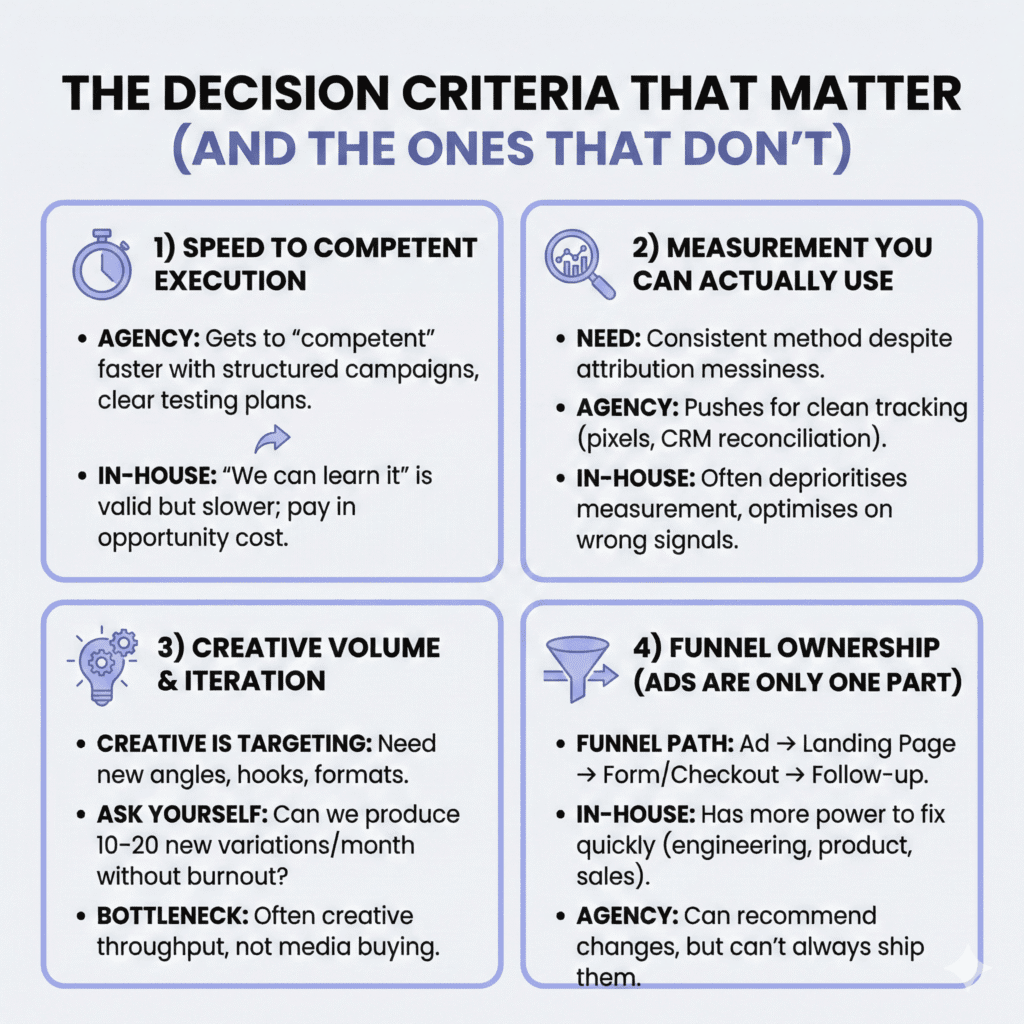
1) Speed to competent execution
If you’re currently under-spending because you don’t trust your setup, a performance marketing agency can get you to “competent” faster. That means campaigns structured correctly, conversion tracking working, and a clear weekly testing plan.
In-house can be fast too, but only if you already have someone who has managed meaningful budgets in your channel. “We can learn it” is valid, but it’s slower and you’ll pay in opportunity cost.
2) Measurement you can actually use
Most teams make decisions from platform dashboards that don’t match reality. Attribution is how you assign credit for a conversion (for example, whether Meta Ads or Google Ads “caused” a sale). It’s messy, but you still need a consistent method.
A good performance marketing agency will push for clean tracking: proper pixel/tag setup, conversion events you trust, and a way to reconcile ad platform numbers with your CRM or backend revenue.
In-house teams can do this well, but measurement work often gets deprioritised because it’s not “launching.” Then you end up optimising based on the wrong signals.
3) Creative volume and iteration
On Meta and TikTok especially, creative is the targeting now. If you can’t ship enough new angles, hooks, and formats, performance stalls even with perfect campaign structure.
In-house teams win when they can pull real customer language quickly: objections from sales calls, support tickets, product reviews. Agencies can win when they have a strong creative system and can produce and test consistently.
Ask yourself: can we produce 10–20 new ad variations per month without burning out the team? If not, your bottleneck isn’t media buying. It’s creative throughput.
4) Funnel ownership (ads are only one part)
Your funnel is the path from click to conversion: ad → landing page → form/checkout → follow-up. Performance drops when one step is weak, even if the ads look “good.”
In-house teams usually have more power to fix the funnel quickly because they can pull in engineering, product, or sales ops. Agencies can recommend changes, but they can’t always ship them.
If your site is slow, your offer is unclear, or your sales follow-up is inconsistent, hiring an agency won’t magically solve it. It can still help, but you’ll need internal ownership to act on insights.
Side-by-side comparison: in-house vs performance marketing agency
| Decision factor | In-house marketing | Performance marketing agency |
|---|---|---|
| Speed to launch | Fast if you already have an experienced operator; slow if you’re hiring and training | Often fast because the process and templates already exist |
| Channel expertise (Meta/Google/TikTok) | Depends on the individual; hard to cover all channels deeply with one hire | Usually stronger depth across channels and common failure modes |
| Measurement and tracking | Great if you have analytics skill in-house; otherwise becomes “best effort” | Often more disciplined, but quality varies—must be verified |
| Creative production | Best product context; can be slow if the team is stretched | Can produce/test at volume if they have a real creative pipeline |
| Funnel improvements | More control to implement landing page, offer, and CRM changes | Can diagnose and recommend; implementation may depend on you |
| Cost structure | Fixed salary costs; cheaper over time if output is high | Retainer + sometimes % of spend; can be efficient if it replaces multiple hires |
When in-house is the better call
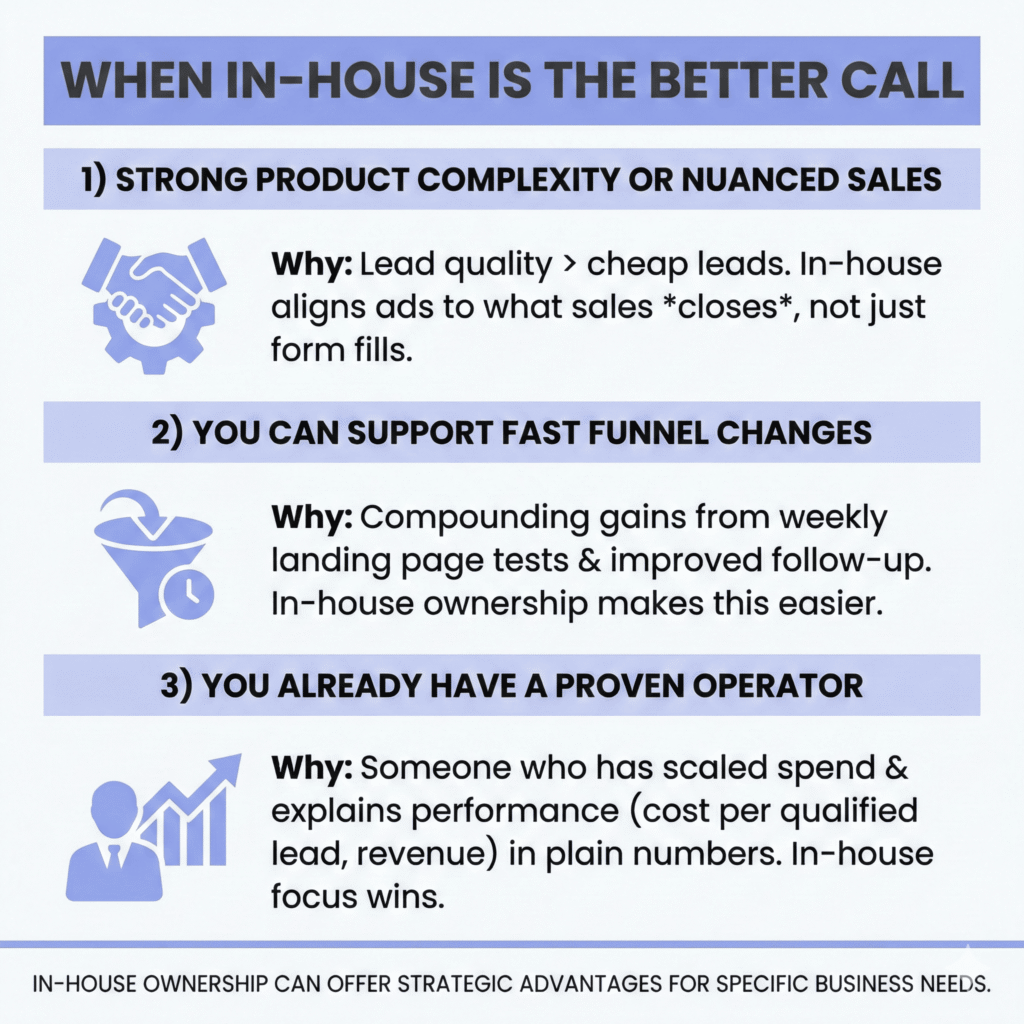
You have strong product complexity or a nuanced sales process
If your sales cycle is consultative, lead quality matters more than cheap leads. In-house teams can align ads to what sales can close, not just what generates form fills.
You can support fast funnel changes
If you can ship landing page tests weekly and improve your follow-up sequence, you’ll get compounding gains. In-house ownership makes this easier.
You already have a proven operator
If someone on your team has scaled spend responsibly and can explain performance in plain numbers (cost per qualified lead, conversion to opportunity, revenue), in-house can outperform an agency simply through focus.
When a performance marketing agency is the better call
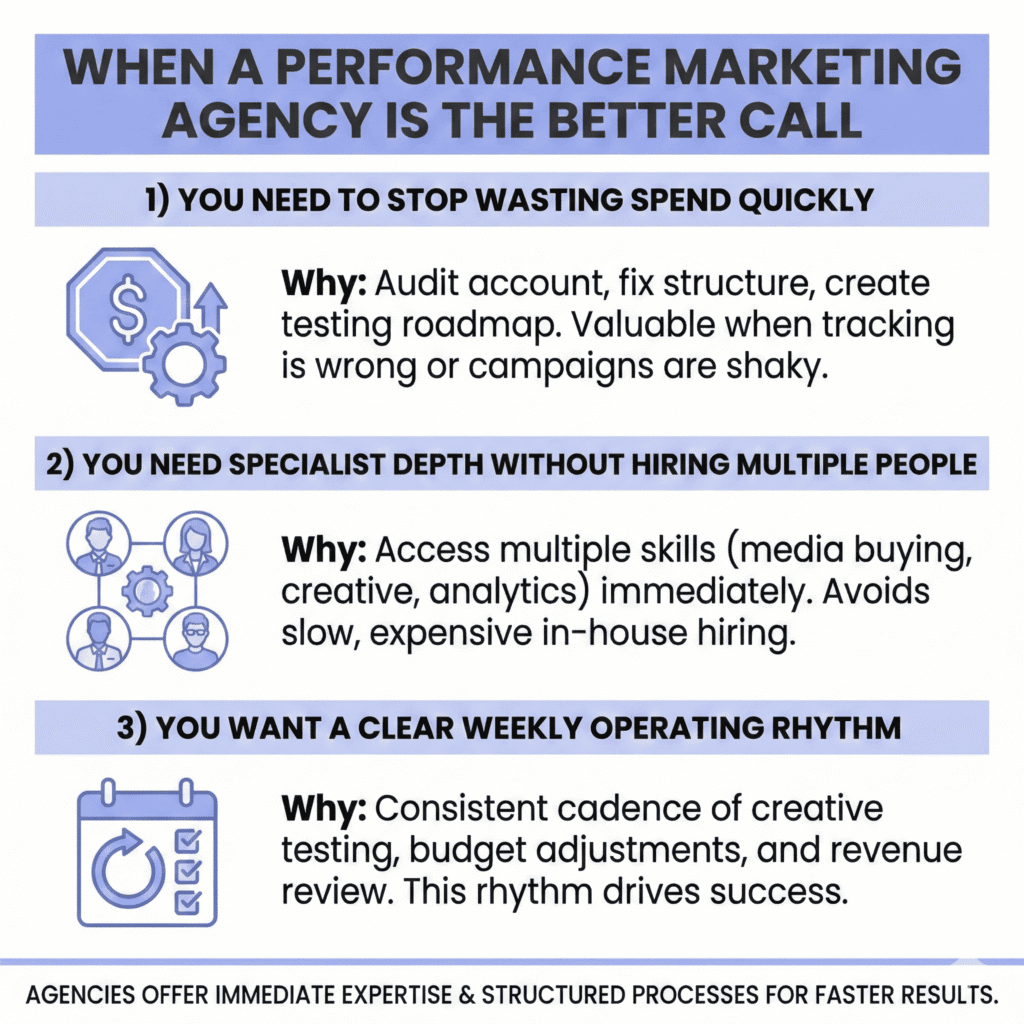
You need to stop wasting spend quickly
If you’re spending and results are inconsistent, a good performance marketing agency can audit the account, fix structural issues, and create a testing roadmap. This is especially valuable when you suspect tracking is wrong or campaigns are built on shaky assumptions.
You need specialist depth without hiring multiple people
To run paid well, you often need more than one skill: media buying, creative strategy, landing page testing, and analytics. Hiring all of that in-house is slow and expensive. An agency can cover gaps immediately.
You want a clear weekly operating rhythm
The biggest difference I see in successful accounts is not a secret tactic. It’s a consistent cadence: creative testing, budget adjustments, and review of what is driving revenue versus noise. Agencies that run this rhythm well are worth paying for.
How to make the decision in 30 minutes
Use this simple filter: what is your current bottleneck?
If your bottleneck is execution quality in the ad platforms (structure, testing, tracking), lean toward a performance marketing agency.
If your bottleneck is funnel control and internal coordination (landing pages, pricing, sales follow-up), lean toward in-house.
If you’re not sure, look at your last 60 days. If you can’t answer “what did we test, what did we learn, and what did we change,” you don’t have a marketing strategy problem. You have an operating system problem.
Conclusion: pick the model that protects ROI
Don’t choose based on preference. Choose based on which option gets you to reliable, measurable growth with the least risk.
If you hire in-house, prioritise one experienced owner who can run Meta Ads or Google Ads end-to-end and partner tightly with whoever owns the website and CRM. If you hire a performance marketing agency, insist on clear tracking, a weekly testing plan, and reporting tied to qualified leads and revenue—not impressions.
Your next step is simple: write down your target ROAS or cost per qualified lead, confirm how it will be measured, and pick the team that can hit it with consistent execution.
Frequently Asked Questions
No. It can make sense at smaller budgets if the agency is fixing expensive mistakes, improving tracking, or increasing conversion rate. The key is whether their fee is justified by measurable lift in qualified leads or revenue.
Expect account and tracking cleanup, a clear testing plan, and early creative and landing page recommendations. You may see performance volatility while they reset structure and collect clean data.
Yes, but be clear on ownership. A common setup is in-house owning brand, website, and CRM, while the agency owns paid media execution and testing. Confusion here often leads to slow decisions and weaker results.
Judge it by business outcomes: cost per qualified lead, lead-to-close rate, and tracked revenue versus spend. If reporting can’t connect spend to pipeline or sales, you don’t have enough visibility to call it good.
If they can’t explain how they will measure success in your business terms, or they avoid talking about tracking limitations, expect reporting that looks positive while revenue stays flat.
