

If you’re spending on ads and can’t confidently answer “what did we get back?”, you’re already dealing with performance marketing problems.
A performance marketing agency is a partner you hire to grow measurable results from paid channels. “Performance” means the work is judged by outcomes you can track, like qualified leads, purchases, or revenue—not by activity, impressions, or vague brand lift.
The goal is simple: turn ad spend into predictable growth, with clear reporting and ongoing optimisation (making changes based on what the data shows).
- A performance marketing agency is accountable to measurable outcomes like leads, purchases, and revenue.
- It runs a repeatable system: tracking → testing → optimisation → scaling.
- The right agency improves funnel performance, not just ad clicks.
What a performance marketing agency actually is
A performance marketing agency plans, runs, and improves paid campaigns where results are trackable. Most commonly, that means platforms like Google Ads, Meta Ads (Facebook/Instagram), TikTok Ads, and sometimes LinkedIn Ads.
The agency’s job is not “to run ads” in the abstract. It’s to manage the full path from spend to result: who you target, what you say, where you send traffic, how you measure outcomes, and what you change week to week.
How “performance” is defined in practice
Performance depends on your business model, but it always ties to a number that matters. Examples include cost per lead (CPL), cost per acquisition (CPA), return on ad spend (ROAS), and contribution margin.
ROAS means revenue divided by ad spend. It’s useful, but it can mislead if your margins are thin or if you sell on long sales cycles. A good performance marketing agency will talk about profit and payback period, not just ROAS.
What a performance marketing agency does day to day
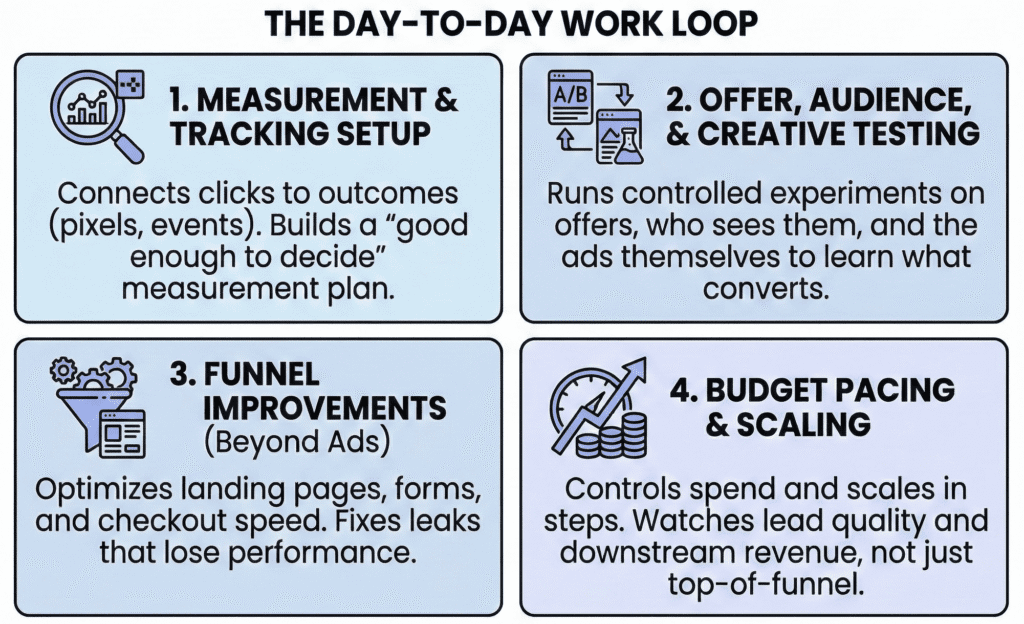
Most founders picture ad creation and targeting. That’s only part of it. The work is a loop: measure what’s happening, test changes, keep what works, and cut what doesn’t.
1) Measurement and tracking setup
Tracking is how you connect an ad click to a real outcome. This usually involves pixels (small tracking scripts), conversion events (like “lead submitted” or “purchase”), and analytics tools.
In real accounts, tracking is rarely perfect. Cookies get blocked, attribution windows vary, and leads may convert offline. A strong agency will set expectations early and build a “good enough to decide” measurement plan.
2) Offer, audience, and creative testing
Testing means running controlled experiments to learn what drives conversions. The agency tests offers (what you’re promising), audiences (who sees it), and creative (the ad itself).
For example, if Meta Ads are getting cheap leads but sales rejects them, the test might be a stricter message, a higher-intent landing page, or a different lead form that filters better.
3) Funnel improvements (not just ads)
A funnel is the steps from first click to revenue. If the landing page loads slowly, the form is confusing, or your checkout fails on mobile, you’ll “lose” performance no matter how good the ads are.
Many performance marketing agencies will advise on landing pages, lead routing, and follow-up speed because those directly affect conversion rate (the percent of people who take the next step).
4) Budget pacing and scaling
Pacing means controlling spend so you don’t blow the budget early or starve campaigns that are working. Scaling means increasing spend while keeping efficiency stable.
In practice, scaling is where teams get hurt. Doubling budget often changes who the platform reaches and can raise CPA. A good agency scales in steps and watches lead quality and downstream revenue, not just top-of-funnel metrics.
How a performance marketing agency gets paid (and what that signals)
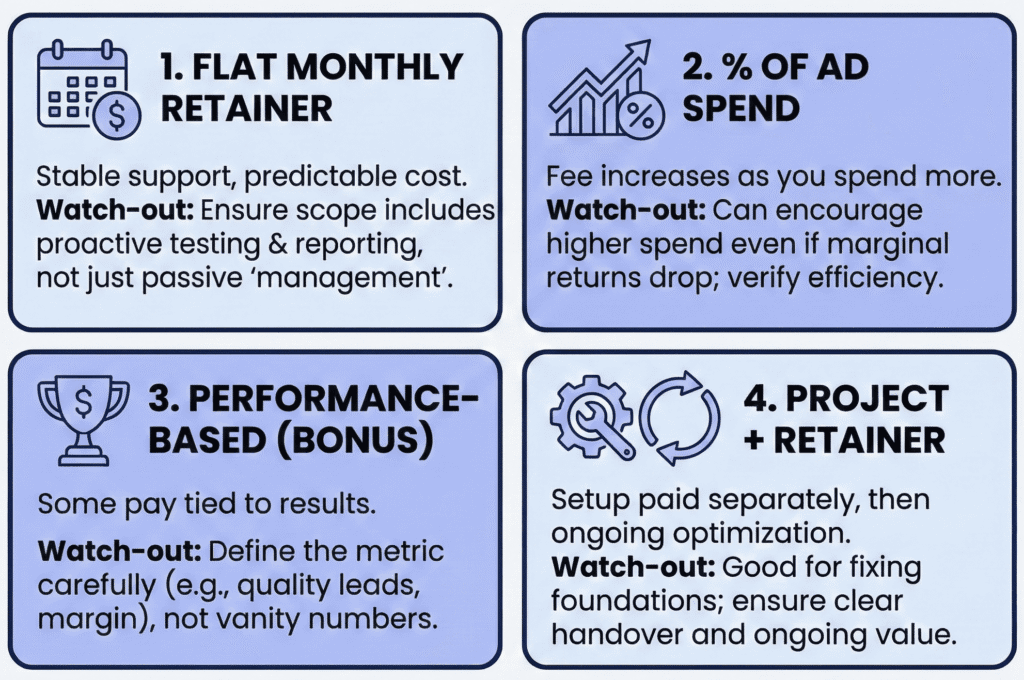
Payment models shape behaviour. If you want a partner that acts like an owner, the incentives need to match the outcome you care about.
| Pricing model | What it usually means | Watch-outs |
|---|---|---|
| Flat monthly retainer | Stable support, predictable cost | Make sure scope includes testing and reporting, not just “management” |
| % of ad spend | Fee increases as you spend more | Can encourage higher spend even if marginal returns drop |
| Performance-based (bonus) | Some pay tied to results | Define the metric carefully (quality leads, revenue, margin), not vanity numbers |
| Project + retainer | Setup work paid separately, then ongoing optimisation | Good for fixing tracking/landing pages first; ensure handover is clear |
If an agency proposes “pay us only on ROAS” for a business with refunds, long sales cycles, or offline revenue, be cautious. That often leads to cherry-picking easy conversions or ignoring lead quality.
What to expect in the first 30–90 days
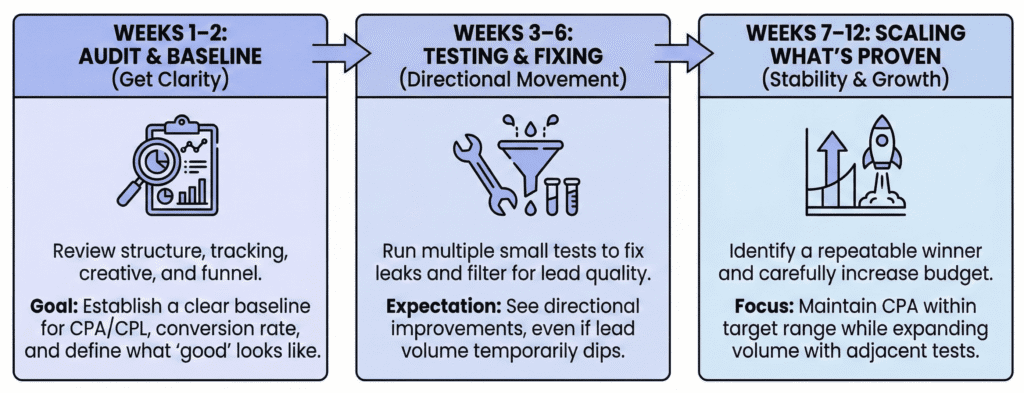
Founders often expect immediate profitable scale. A more realistic expectation is: clarity first, then improvements, then scaling.
Weeks 1–2: audit and baseline
The agency should review your account structure, tracking, creative history, and funnel. You should end this phase with a clear baseline: current CPA/CPL, conversion rate, and what “good” looks like.
Weeks 3–6: testing and fixing obvious leaks
This is where you see directional movement. Expect multiple small tests rather than one big “rebrand” of your ads. If lead quality is an issue, you should see changes aimed at filtering and intent, even if lead volume dips.
Weeks 7–12: scaling what’s proven
Once there’s a repeatable winner (audience + message + landing page path), the agency increases budget carefully and expands into adjacent tests. The focus should be stability: keeping CPA within a target range while volume grows.
How to tell if an agency is truly “performance” (not just paid media)
Many teams can launch campaigns. Fewer can build a system that improves month after month.
Signs you’re dealing with a real performance marketing agency
- They start with measurement. They ask how revenue is tracked, what counts as a qualified lead, and how sales feedback is captured.
- They talk about trade-offs. For example, “We can lower CPL, but lead quality may drop—here’s how we’ll manage that.”
- They show their testing plan. Not “we’ll optimise,” but what they will test first and why.
- They report in business terms. Pipeline, revenue, payback period, and margin—not just clicks and impressions.
Red flags to watch for
- They avoid specifics on tracking. If they can’t explain attribution (how credit is assigned to channels) in plain language, you’ll struggle to trust the numbers.
- They promise guaranteed results. Platforms change, competitors react, and performance fluctuates. Honest agencies set ranges and decision rules.
- They optimise for the wrong metric. Cheap leads that never close are not performance.
Conclusion
A performance marketing agency is a partner focused on measurable growth from paid channels, with accountability to outcomes like qualified leads, purchases, and revenue.
If you’re evaluating one, prioritise three things: clean tracking you can trust, a clear testing plan for the next 30 days, and reporting that ties ad spend to real business results. That’s how you protect ROI and avoid paying for “busy work.”
Frequently Asked Questions
A performance marketing agency is judged primarily on measurable outcomes from paid campaigns, like CPA, ROAS, and revenue. A general marketing agency may focus more broadly on brand, content, or design without tight attribution to results.
They mainly manage paid acquisition, but strong agencies also influence landing pages, offers, and follow-up because those directly impact conversion rates and revenue. If they ignore the funnel after the click, performance usually stalls.
Ask how conversions are tracked, what attribution model is used, and whether results match your backend data (CRM, payments, or sales records). A trustworthy agency will reconcile platform numbers with real revenue and explain gaps.
Use a small set tied to business outcomes: CPA or CPL with a clear definition of “qualified,” conversion rate through the funnel, and revenue or contribution margin from paid traffic. The right metrics depend on whether you sell self-serve or through sales.
Hire when you have a proven offer and can track conversions reliably, but you lack time or in-house skill to run consistent testing and optimisation. If your tracking is broken or your offer is unproven, expect the first phase to be setup and learning, not rapid scaling.
