"Claude runs my ads." It keeps appearing in LinkedIn posts and marketing threads as if it is something to be proud of. It is not. It might be the most expensive mistake you are making with your ad account.
To be clear: AI tools are genuinely useful in digital advertising. At Marvant, we use AI across campaign research, creative production, SEO, workflow automation, and content generation every day. But there is a significant difference between using AI to support a media buyer and handing your entire ad account to an AI and walking away.
What AI Cannot Do in a Live Ad Account
AI is a large language model. It is brilliant at language. It processes patterns in data and generates outputs based on those patterns. What it has never done — and cannot do — is operate inside the lived context of a running campaign.
AI has never sat through a 0.8x morning. It has not watched a winner fatigue in real time, or felt the difference between a pause that saves money and a pause that kills an ad set that was about to recover.
That distinction matters enormously. Media buying involves constant judgment calls that exist at the boundary of data and context — and that boundary is exactly where AI falls short.
| Task | AI | Human media buyer |
|---|---|---|
| Generate 20 headline variations in 30 seconds | ✓ Excellent | Slow |
| Summarise performance data across campaigns | ✓ Excellent | Time-consuming |
| Flag statistical anomalies in ad spend | ✓ Good | Can miss if not checking |
| Decide whether to pause a fatiguing ad set | ✗ Risky | ✓ Core skill |
| Read Meta's GEM model shifting creative distribution | ✗ Cannot | ✓ Experienced buyers know this |
| Understand that a client's sales team is slow this week | ✗ No context | ✓ Part of weekly client check-in |
| Decide budget reallocation based on business goals | ✗ No authority | ✓ Requires business judgment |
| Respond when a promotion changes mid-campaign | ✗ Not aware | ✓ Immediate response |
The tasks AI performs well are tasks with clear parameters and measurable outputs. The tasks that actually determine campaign profitability — when to scale, when to pause, how to respond to client context, how to read platform signals — require judgment that no LLM currently has.
Real ExampleWhy the RM55 CPL Ad Should Not Have Been Paused
Here is exactly what this looks like in practice. We fed a client's Meta Ads performance data into Claude and asked for a full analysis — what is working, what is not, and what optimisations to make.
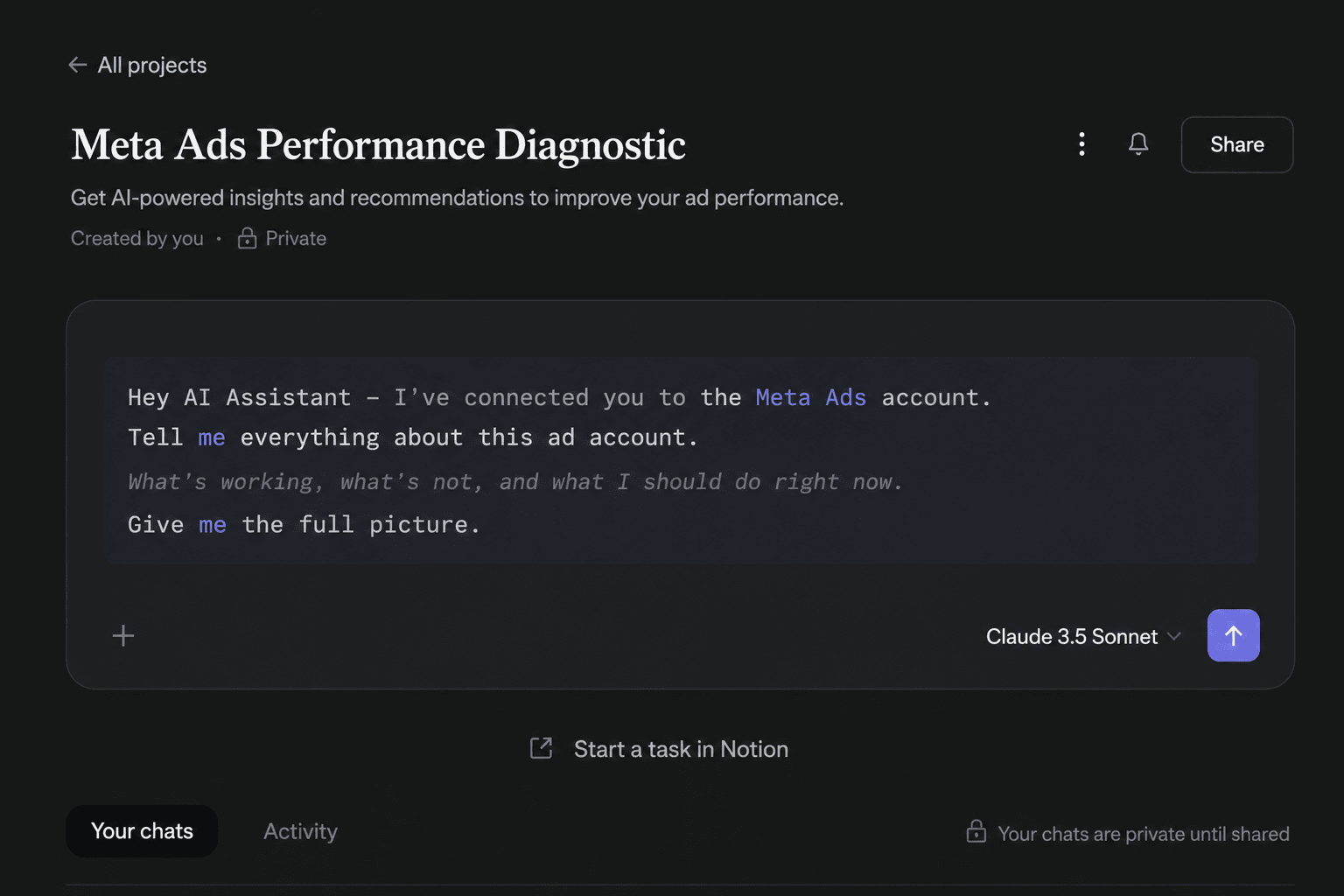
Claude's response was structured, thorough, and looked entirely reasonable. It flagged Lead Ad — Before (Image) as the worst-performing ad in the account, citing a CPL of RM55 — well above the account average. Its recommendation was clear: pause it immediately and reallocate the budget to lower CPL ads.
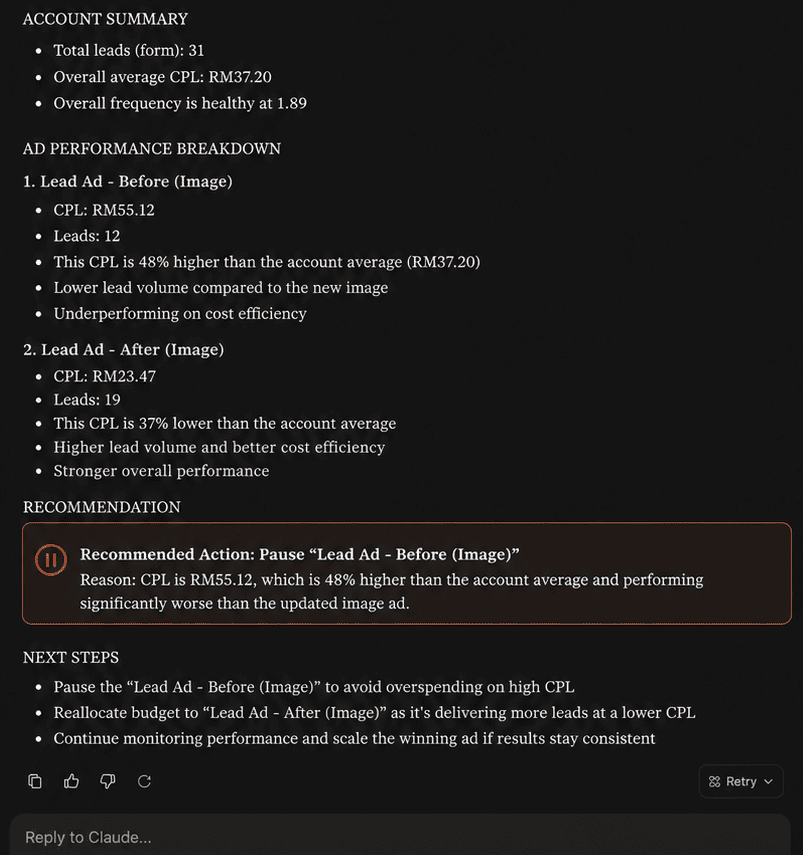
On the surface, that recommendation is logical. RM55 CPL is high. Any automated system — or anyone looking only at platform data — would reach the same conclusion.
But here is what Claude did not know.
When our media buyer cross-referenced the same ad against our working sheet — which tracks not just Meta's reported CPL but the full funnel down to reply rate, qualification, and cost per booked appointment — the picture looked completely different.

Lead Ad — Before (Image) had the lowest cost per appointment in the entire account. The leads it generated were fewer — but they replied, they qualified, and they booked. The cheaper CPL ads were producing high volumes of leads that went cold at the first reply.
Claude looked at CPL and drew the obvious conclusion. Our media buyer looked at CPL (appointment) and drew the correct one. Pausing that ad would have cut off the only creative in the account that was actually converting leads into consultations.
This is not a failure of AI. It is a reminder that AI can only reason about the data you show it — and Meta's dashboard alone is never the full picture.
Where the Misconception Comes From
The "AI runs my ads" claim usually comes from one of three places:
Source 1Confusing AI-generated output with AI decision-making
An AI tool writes the ad copy. The human still sets the targeting, approves the budget, monitors performance, and makes every strategic call. Calling this "AI running your ads" is like saying your calculator runs your business because it did the maths.
Source 2Using automated rules and calling them AI
Meta's own platform has had automated rules for years — pause if CPA exceeds X, increase budget if ROAS hits Y. These are not AI. They are conditional logic. Useful, but not capable of reading context or adapting to anything outside their programmed conditions.
Source 3Genuinely handing the account to an AI and hoping for the best
This is the dangerous version. A business owner, trying to reduce costs or move faster, gives an AI tool access to their ad account and lets it execute changes without human review. This is not innovation. This is negligence with a budget attached.
AI-Assisted vs AI-Autonomous: What the Right Model Looks Like
AI generates the ads, sets the audiences, adjusts the budgets, pauses underperformers, and scales winners — all without a human reviewing or approving decisions.
The risk: AI has no context about your business, your sales process, your stock availability, your promotion calendar, or the 15 other factors that should influence every campaign decision.
The result: Budget wasted on decisions that look correct on paper but are wrong in context.
AI surfaces insights, generates creative options, flags anomalies, and produces diagnostic reports. A human media buyer reviews every recommendation, applies context, and approves every material change.
The advantage: You get AI's speed and pattern-recognition without sacrificing the judgment that actually determines whether campaigns are profitable.
The result: Faster execution, more consistent output, better decisions.
The best way to describe this: AI is a co-pilot. A co-pilot with access to every SOP ever written, who never gets tired, and who can read a full account's data in seconds. But a co-pilot is not the pilot. A human approves every material call.
How Marvant Actually Uses AI in Campaigns
At Marvant, our AI-powered approach is built on a clear principle: AI handles execution speed, humans handle judgment. Here is what that looks like across a real campaign.
| Campaign Task | How AI Helps | What the Human Does |
|---|---|---|
| Creative production | AI tools generate image and video variants at scale (Sora, Gemini, JiMeng AI) | Strategist selects, rejects, and briefs the direction |
| Ad copy | AI drafts headline and body copy options based on brand brief | Media buyer reviews tone, brand fit, and platform appropriateness |
| Performance diagnosis | AI analyses account data and produces a structured diagnostic report with recommendations | Media buyer validates against client context before acting |
| Audience research | AI surfaces interest clusters, competitor positioning, and keyword patterns | Buyer applies industry knowledge to select and refine targeting |
| Workflow automation | n8n-powered automations handle scheduling, reporting, and routine notifications | All outputs reviewed before client delivery |
| Budget decisions | AI flags opportunities and risks based on data | Human approves every budget change — always |
This is not a different service for enterprise clients. This is how every campaign at Marvant works — for home and decor brands, renovation companies, e-commerce brands, and B2B businesses alike. You can read more about this approach in our guide to AI-powered performance marketing.
Why This Matters for Your Ad Account Specifically
If you are a Malaysian business owner running Meta Ads, Google Ads, or TikTok Ads — either in-house or through an agency — there are three questions worth asking about your current setup:
- Who is actually making decisions in your account? Is a human reviewing and approving changes, or is everything running on automated rules and AI outputs?
- Does your agency understand your business context? AI cannot know that your showroom is closed this week, your best salesperson is on leave, or that you are running a Raya promotion. Your agency should.
- Are you measuring the right things? AI-driven campaigns optimise for the signal you give them. If you are tracking form submissions but not lead quality, AI will get you more form submissions — many of which will be useless.
The question is not "can AI run my ads?" The real question is: "Is there a human in my campaign who understands my business well enough to make good decisions when the data is ambiguous?"
If the answer is no, AI cannot fix that. It will just make the wrong decisions faster.
Not Sure If Your Account Is Set Up Right?
Marvant offers a structured Meta Ads audit that reviews your campaign setup, tracking, creative strategy, audience targeting, and lead quality — and tells you exactly what to fix. No fluff, no sales pitch.
Final Thoughts
AI is one of the most powerful tools available to digital marketers right now. We use it every day — for creative production, SEO, content automation, campaign diagnostics, and workflow efficiency. It genuinely makes our work faster and more consistent.
But the claim that AI can replace human media buyers is still wrong in 2026. It confuses speed with judgment, output with strategy, and automation with intelligence.
The agencies — and businesses — that get the best results from AI are the ones that use it to execute faster while keeping strategy, context, and accountability firmly in human hands.
"Claude runs my ads" is not a flex. It is a sign that no one is actually minding the account. For more on what responsible AI-assisted marketing looks like, see our Meta Ads agency services and performance marketing approach.
Frequently Asked Questions
Want a Campaign That Combines AI Speed With Human Judgment?
Marvant runs Meta, Google, and TikTok campaigns where AI handles execution and humans handle strategy — so you get the best of both without the risks of fully autonomous media buying.