ChatGPT Ads and Meta Ads aren't trying to solve the same problem. Meta's targeting presents your ad to potential customers regardless, based on their demographics and interests. ChatGPT works in an entirely different way. People employ it exclusively to receive answers to questions, and it is at this moment that your ad pops up as it is relevant to the research they are currently making. One platform reaches your audience before a search even takes place. The other shows up during the process of search.
How Each Platform Works
Meta Ads are distributed across Facebook, Instagram, Messenger, and the Audience Network. In accordance with demographic data, the location of your customers, interests, or your customer list, you choose your target audience, and your ads appear on these platforms while your audience is engaged in their daily activities. Watching a Reel on Instagram, scrolling the news feed, chatting with friends on Messenger. Your audience is not in search of your products at this stage. That is the very reason why it works well for Meta.
ChatGPT Ads work in an absolutely opposite way. OpenAI finds out what questions people ask and gives them a sponsored answer. A person types a question, maybe they are comparing different pieces of software, considering what features to look for in a provider, or working out whether a product is worth the price. They're already in research mode. The ad doesn't interrupt anything. It fits into what they're already doing.
Meta Ads reach people before they know they need your product. ChatGPT Ads reach them while they're actively working out whether to buy it. These aren't two versions of the same thing. They're two different moments in the same customer journey.
Platform Comparison: Side by Side
Targeting: Audience Data vs Conversation Context
Meta audience targeting works because the target is a person. You can create your audience based on age, geolocation, interests, occupation, life events, and purchase behaviour. You can create custom audiences from your own customers and find other people just like them. You can retarget everyone who visited your website, viewed your video, or interacted with your page. Meta has developed its audience targeting for years and has accumulated an abundance of this data.
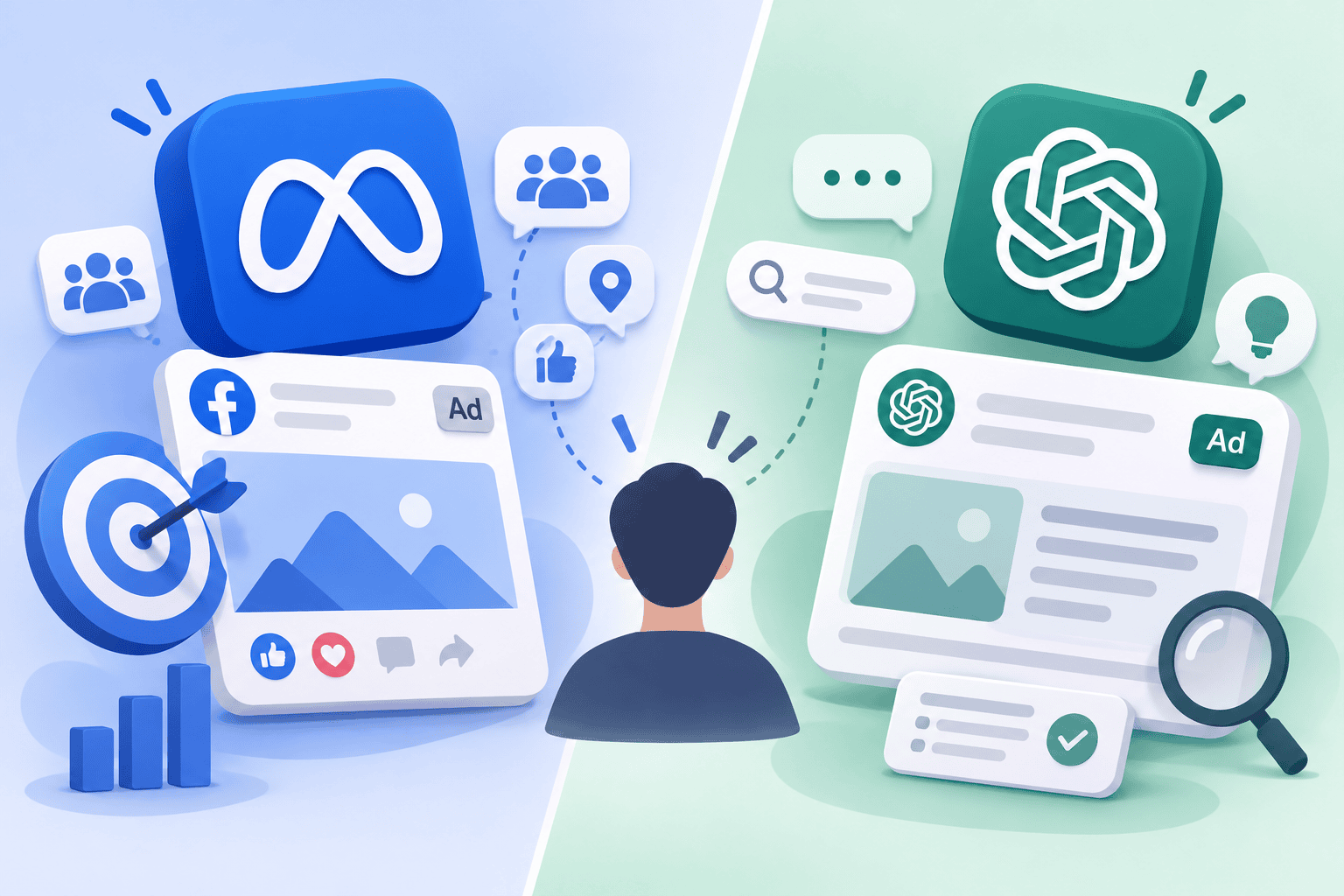
ChatGPT Ads are nothing like that. There's no audience pool, no interests, no lookalikes. OpenAI analyses the conversation itself: the subject matter, the language used, the stage of the thought process. If ChatGPT is discussing rental property management, landlord software, and means of communicating with tenants, an ad for property management software certainly fits into that context. Not because they've been tagged with a landlord label in any database, but because their interaction made this quite evident.
Meta Ads give you information about who to target. ChatGPT Ads give insight into what someone is currently struggling to understand. Each of those signals matters equally. They just give different answers about the same person.
Formats and Creative Needs for Ads
Meta Ads are all about visuals. In a mere two seconds, you should be able to get the viewer's attention, which can be done using an image or video. Formats available include single image, video, carousel, Reels, Stories, and collections. Every Meta advertising campaign starts with one question: what will make the viewer stop and look?
ChatGPT Ads is a whole new way of looking at creativity. There is no visual at all. Nothing moving and no catchy opening image to attract attention. What works here is the ad appearing as an organic part of the research being carried out: accurate, authentic, and helpful in decision-making. If your ad feels like an interruption of the discussion, it does not fit in. But if it feels like advice given by a knowledgeable person, it belongs there.
Funnel Position and Use Cases
Meta Ads perform very effectively at each of the extremes of the funnel. On one side, they build awareness among a large, clearly defined audience who aren't actively looking to buy. Your brand is in front of them while the category is still forming in their mind. Later, when that same person visits your website and leaves without purchasing, Meta retargets them. That's one of the most effective forms of re-engagement in online advertising.
ChatGPT Ads fall in the middle, in an area Meta can't reach. At this stage, the problem is identified and the attempts to find ways to solve it begin. People compare products, study their features, and determine what information matters. This is the stage of forming opinions and creating shortlists. To be effective here, a brand needs to offer really valuable content.
For most considered purchases, using both is the right call. Meta creates awareness at the beginning and re-engages the customer at the end. ChatGPT Ads do all the work in the middle, when the consumer is researching but isn't ready to make a purchase yet. Together, both channels cover the whole funnel.
Measurement and Attribution
The measurement system for Meta Ads is well developed and has been built throughout more than a decade. By using the Meta Pixel and Conversion API, you can connect the actions taken by your site visitors with the ads that triggered them. It's possible to track purchases, leads, and subscriptions, attribute conversions within your custom attribution window, build audiences from your best-converting users, and measure cost per result at the ad level.
When it comes to ChatGPT Ads, the measurement journey is only beginning. OpenAI offers impression and engagement metrics, but there's still no direct way to track conversions resulting from a sponsored result within ChatGPT. This shouldn't become an obstacle. It should define a new approach. Keep an eye on your branded searches, direct traffic, and assisted conversions in addition to the platform's native metrics. Those signals often tell the real story of how much influence it's having, even when last-click attribution doesn't credit it.
The measurement gap on ChatGPT Ads is a reason to move early, not to hold back. Brands that start now will have months of conversion data by the time the platform's attribution matures and costs rise. The brands with the most history will have the lowest cost per result when it counts.
When to Use Each Platform
Use Meta Ads when your product appeals to a broad customer base and is best delivered visually rather than through searching. Additionally, use them when you need to reach out to your warmed-up customers once again. Products for e-commerce, lifestyle, local services, and direct response all come naturally to Meta Ads. When your customer base can be found using demographics, interests, and behaviour, you're in luck with Meta Ads.
Use ChatGPT Ads when the consumer needs information before making their decision to purchase. Complex products, B2B, high-value purchases, and introducing new categories fit that bill nicely. These are people who don't come looking for you by name. They need a solution to a problem or a question answered. You'll be in a much stronger position before the others even have a chance to speak up.
Use both when you have a sales cycle that includes research in between awareness and purchase, which describes most purchases. Use Meta Ads to make sure people know your name from the very beginning and bring them back in when they get closer to the decision point. Use ChatGPT Ads to influence their thinking and decision-making in between. If you need help working out the right mix, our performance marketing team can help.
Running Ads Across Multiple Platforms?
Most brands run Meta, Google, and ChatGPT Ads as separate experiments and wonder why the results don't add up. Marvant manages them as a connected strategy, each platform doing the job it's actually built for. If you want to work out which combination makes sense for your product and budget, start with a conversation.
Talk to Marvant