
The short answer: no, ChatGPT Ads does not use keywords. There are no keyword lists, no match types, no Quality Score tied to search terms. Instead, the platform uses context hints: plain-language descriptions of the consumer situation you want to reach. If you are coming from Google Ads, the entire mental model needs to shift before you can use the platform effectively.
Why ChatGPT Ads Has No Keyword System
Google Ads was built around search queries. A user types something into a search box, and the platform matches that typed string against advertiser keyword bids. The fundamental unit is the word or phrase as written.
ChatGPT is not a search engine. Users do not put keywords, but they engage in conversation. Based on the working paper published by the NBER in 2025, about 49% of all ChatGPT messages are "asking" messages. The user asks a question, compares different options, and evaluates their possibilities. For example, one research chat concerning the selection of the CRM system for a small business may involve from 8 to 12 message exchanges. First of all, the consumer asks, reads the answer, further questions the point of the answer, considers a specific point, makes a comparison, and selects the final list of short options. There is no such query that could match a keyword.
The platform considers this context and attempts to match it against advertiser-specified context hints. The matching is semantic since it analyzes the similarity of meaning and context in the context hint and the current conversation, not the usage of specific words in the conversation. More precisely, the exact-match buying of keywords in ChatGPT Ads is impossible. The context hints are not keywords and cannot ensure any message or topic placement.
A keyword lets Google know which word the consumer uses, while a context clue helps ChatGPT understand the scenario of the consumer. Google goes for text, ChatGPT for intent through conversation.
Comparing Google Ads and ChatGPT Ads: The Difference in Targeting
The two are at completely different stages in the consumer journey and function differently as well. Understanding their strengths and weaknesses will give you an idea about how much budget should go into each.
| Feature | Google Ads | ChatGPT Ads |
|---|---|---|
| Targeting input | Keywords: words or phrases the user typed | Context hints: plain-language descriptions of consumer situation and intent |
| Match types | Broad, Phrase, Exact. Controls how loosely the keyword matches the query | None. The platform interprets the hint semantically, with no match type settings |
| Negative control | Negative keywords block specific terms from triggering your ads | No negative keywords. Control comes from precision in the hint description and audience exclusion lists |
| Quality signal | Quality Score based on CTR, ad relevance, and landing page experience relative to the keyword | Relevance score based on alignment between context hint, ad creative, and landing page |
| Consumer moment | Active search. The consumer typed a query to find something specific | Active research. The consumer is mid-conversation, processing information and forming a decision |
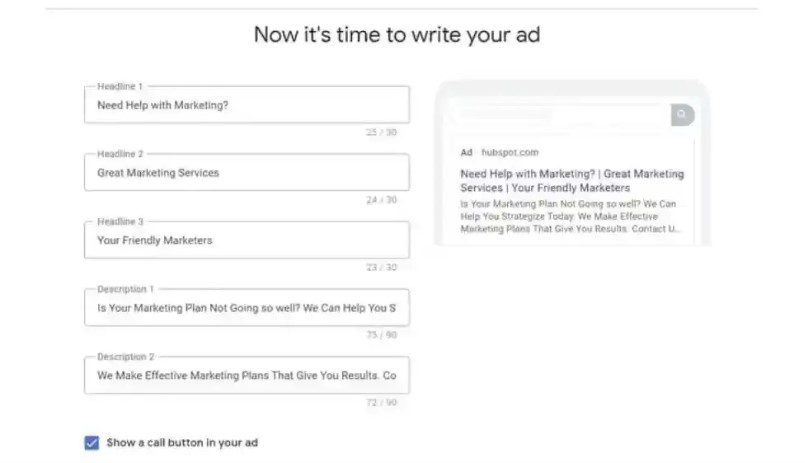
| Ad format | Headline, description lines, sitelinks. Text-based with visual extensions | Sponsored text response: headline and body copy only, clearly labelled, no images or video |
| Bidding | CPC or target CPA. Bid on the keyword or outcome | CPM (Reach objective) or CPC (Clicks objective); Maximize clicks and Maximize conversions also available. OpenAI suggests a starting max CPC of $3 to $5 |
| Auction | Per-query. Each search triggers an auction | Relevance-weighted, second-price auction evaluated against the current conversation state; not a per-query trigger |
What a Context Hint Actually Is
Context Hint is a description of a certain situation offered by the advertiser that is associated with an advertisement at the level of the ad group and helps the platform recognize what conversations are related to the ad. Context hint is not a keyword, nor topic category or interest. It is rather a description of a particular consumer situation: who the consumer is, what problem he/she faces and what question he/she asks.
The platform analyzes context hint and determines if it is about the current conversation. If yes, then the ad will be served to the consumer, if not, then it will not.
Structure of a context hint
A good context hint usually includes four parts, but it is not necessary to mention all four of them:
The hint does not need to contain the names of your products or brand. It describes the consumer, not the advertiser.
Context hint examples across industries
A small business owner with 5 to 20 staff evaluating CRM options for the first time. They are comparing two or three platforms on price, ease of setup, and whether the system can handle both sales pipeline tracking and basic email follow-ups without requiring a dedicated IT person to manage it.
This is an indication of a first-time buyer in the comparison stage of the product. This indicates that the creative will focus on user-friendly features as well as price rather than other technical specifications.
A homeowner planning a kitchen renovation who is researching the difference between custom cabinet makers and modular kitchen suppliers. They want to understand the price gap, the lead time difference, and what they give up in terms of quality or flexibility by choosing the more affordable option.
This is an indication of a consumer in the research phase in a highly considered purchase decision. In such cases, creative should address trade-offs rather than focusing on brand names.
A female consumer aged between 35 and 45 years conducting research about non-invasive face lifting procedures. The individual wants information regarding longevity of effects, recovery process visibility as well as cost implications of a complete series of treatments.
Specific consumer situation, specific comparison set, specific purchase decision factors. Tight context hint with minimal irrelevant placements.
How to Convert Google Ads Keyword Research Into Context Hints
Your existing Google Ads keyword research is not wasted, but it cannot be imported directly. The conversion process requires translating keywords, which are text strings representing intent, into context hints, which are descriptions of the situation behind that intent.
It makes sense to go backward from the keywords that work the best for you. For each keyword set, you need to understand: who is the consumer who types it, and which kind of conversation they really want to have? This will give you a context hint.
| Google Ads Keyword | What the Consumer Actually Wants | ChatGPT Ads Context Hint Direction |
|---|---|---|
| best CRM for small business | A recommendation which will suit their budget and won't be complicated | Small business owner who compares CRM for the first time in terms of ease of use, cost and ability to handle pipelines and email follow-ups |
| meta ads agency malaysia | Short list of agencies to check before sending requests for proposals | Business owner or marketer who lives in Malaysia, checks Meta Ads agencies and evaluates them by the experience in their niche, reporting transparency and real scope of work per month |
| cost of hifu face treatment in malaysia | Realistic pricing range and factors affecting price across clinics | A consumer searching for information on HIFU face treatment in Malaysia, interested in the cost range, the number of sessions required, the factors affecting the difference in price between different clinics, and required credentials from providers |
| ecommerce shipping cost reduction | How to do so without changing the whole logistics system | An owner of an e-commerce business, with order volumes between 200 and 1,000 per month, searching for information on the ways to reduce their order fulfilment and last mile shipping costs through 3PL comparisons and courier negotiation and packaging optimization techniques |
| software for project management in an agency | Software that suits agency workflow | A business owner or agency operations manager searching for a suitable project management software that allows managing multiple client projects at once, assigning tasks to different employees, and time tracking |
A keyword tells you what the consumer typed. A context hint explains who typed it, what situation they were in, and what answer they were actually looking for. Every strong context hint can be reverse-engineered into several keywords, but a keyword alone never tells the full story.
What Replaces Negative Keywords
One of the first questions from Google Ads practitioners is: if there are no negative keywords, how do I stop my ads serving on irrelevant conversations?
The answer is hint precision. In Google Ads, negative keywords exist because broad and phrase match types pull in unrelated queries. You add negatives reactively to block the queries you do not want. In ChatGPT Ads, you prevent irrelevant placements proactively by writing a context hint that is specific enough to describe only the consumer situation you want.
A broad hint such as "someone interested in marketing software" would match a huge number of conversations that might have little or nothing to do with your product. On the other hand, a precise hint such as "marketing manager at a B2B business with 50 to 200 employees, looking into marketing automation software to replace manual emails, analyzing the ease of integration with CRMs and cost per contact" will match far fewer conversations that will all be highly relevant.
The second control mechanism is audience targeting and exclusion. ChatGPT Ads allows for the following three targeting options at this time: geography, platform (iOS, Android, or web apps) and customer lists. The latter option requires 25,000+ matched users. You can leverage this feature both for audience targeting and exclusion of existing customers or active users in your prospecting campaigns. This is functionally similar to customer list exclusions in Google Ads.
Characteristics of a Good Context Hint
The platform analyses alignment between the context hint, the ad creative and the landing page. The best possible relevancy scores and delivery come from precise context hints matched with relevant creatives and landing pages which address the very same consumer situations.
One Context Hint per Ad Group: Building Your Ad Groups for Best Results
An ad group in ChatGPT Ads consists of one context hint. Thus, it is the ad group, not the whole campaign, that is the precision targeting tool. It means that the ad group structure becomes even more important for ChatGPT Ads as compared to Google Ads.
Google Ads offers the ability to use multiple match types and negative keywords from one ad group, resulting in many options that can later be narrowed down. For ChatGPT Ads, each ad group will reflect one consumer situation. If there is a need to target five consumer situations, there will be five ad groups created, each of which will have its own context hint, creative, and landing page.
Example campaign structure: digital marketing agency
| Ad Group | Consumer Situation | Creative Angle | Landing Page |
|---|---|---|---|
01 First-time Meta Ads buyer |
A business owner who is running Meta Ads independently for the first time, using a budget of MYR 3,000 to 5,000 per month and getting poor results and trying to decide whether they should hire an agency or manage the account themselves | What an agency can do that a business owner running their own ads cannot, and how the transfer works | Meta Ads agency page Case studies from similar spend levels |
02 Agency switcher |
A marketing manager who has been with their current Meta Ads agency for 12 months and is not satisfied with reporting transparency or lead quality, now comparing alternative agencies | What should change when you switch agencies and what to look for in the evaluation process | Meta Ads agency page Reporting methodology and client testimonials |
03 Google Ads first-timer |
A home improvement business owner who has only run Meta Ads and is now asking whether Google Ads would reach customers who are actively searching for their service rather than browsing social media | How Google Ads and Meta Ads reach different moments in the purchase journey and when adding Google Ads makes sense | Google Ads agency page Home and decor industry focus |
04 SEO enquiry |
A business owner who has been told by their web developer that they need SEO but does not understand what it involves, how long it takes to show results, or how to evaluate whether an SEO agency is doing a good job | What SEO actually involves at the campaign level and what a realistic 6-month result looks like for a business of their type | SEO agency page Process explanation and realistic timeline |
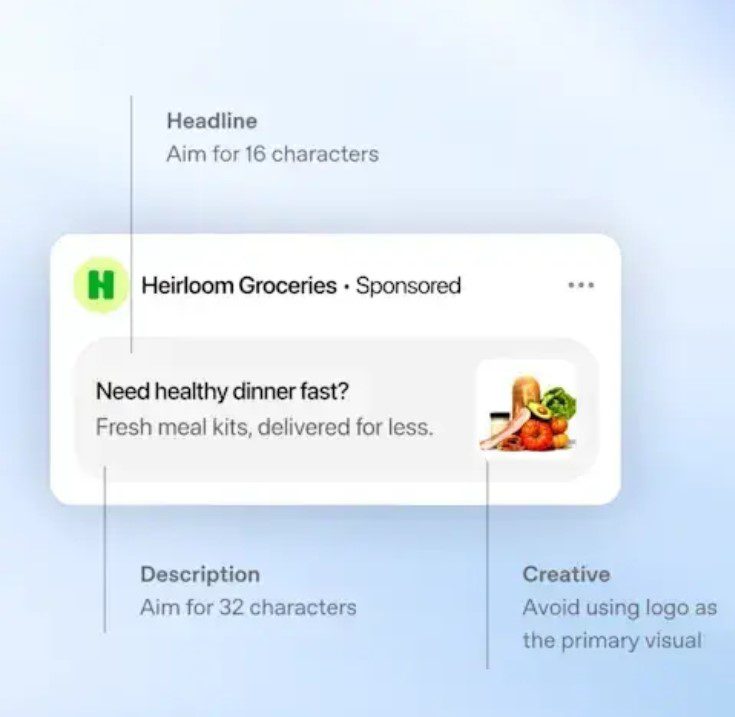
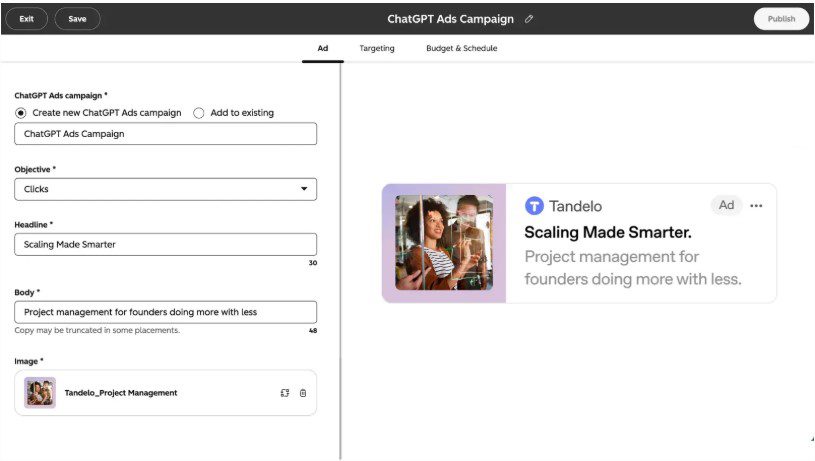
When writing the ad creative for each ad group, the character limits are tight. Headlines are capped at 50 characters, with OpenAI recommending 16 to 24 characters for best display. Body copy is capped at 100 characters, with a recommended range of 32 to 48 characters. This means each creative must make one clear claim tied directly to the consumer situation in the context hint. There is no space for a secondary message. The landing page must be mobile-friendly, publicly accessible, and address the same consumer situation described in the hint. Misalignment between headline, body, and landing page is scored negatively by the platform's relevance system.
Your Keyword Research Is Still Useful
Switching from Google Ads to ChatGPT Ads does not make keyword research obsolete. It changes what you use it for.
In Google Ads, keyword research produces a list of terms to bid on directly. In ChatGPT Ads, keyword research surfaces the consumer intents you need to describe in your context hints. High-volume, high-intent keywords tell you which consumer situations are common enough to warrant their own ad group. Keyword clusters tell you how to group similar situations together.
The practical workflow looks like this:
- 1Pull your top 20 to 30 keywords by conversion from Google Ads or your keyword research tool. Group them by intent cluster, not by topic category.
- 2For each cluster, write one sentence describing the consumer who would type those keywords. What situation are they in? What are they trying to decide?
- 3Expand that sentence into a 2 to 4 sentence context hint that adds the consumer's awareness level, their key purchase concern, and the type of answer they are looking for.
- 4Map each context hint to one ad group, one creative direction, and one landing page. All three must address the same consumer situation.
- 5Review placement relevance signals after 2 to 4 weeks. If delivery is broad or irrelevant, the hint needs to be more specific. If delivery is too narrow and reach is low, the consumer situation described may be too rare for ChatGPT conversations to surface consistently.
Frequently Asked Questions
Sources referenced in this article:
OpenAI: Testing Ads in ChatGPT (2026)
HubSpot: ChatGPT Ads vs Google Search Ads: Key Differences (2026)
NBER Working Paper: The Nature of ChatGPT Conversations (2025)
Strike Social: The Complete List of ChatGPT Ad Specs (2026)
Build ChatGPT Ads Campaigns That Actually Match the Right Conversations
Marvant builds and manages ChatGPT Ads campaigns from context hint strategy through to landing page alignment and conversion tracking.