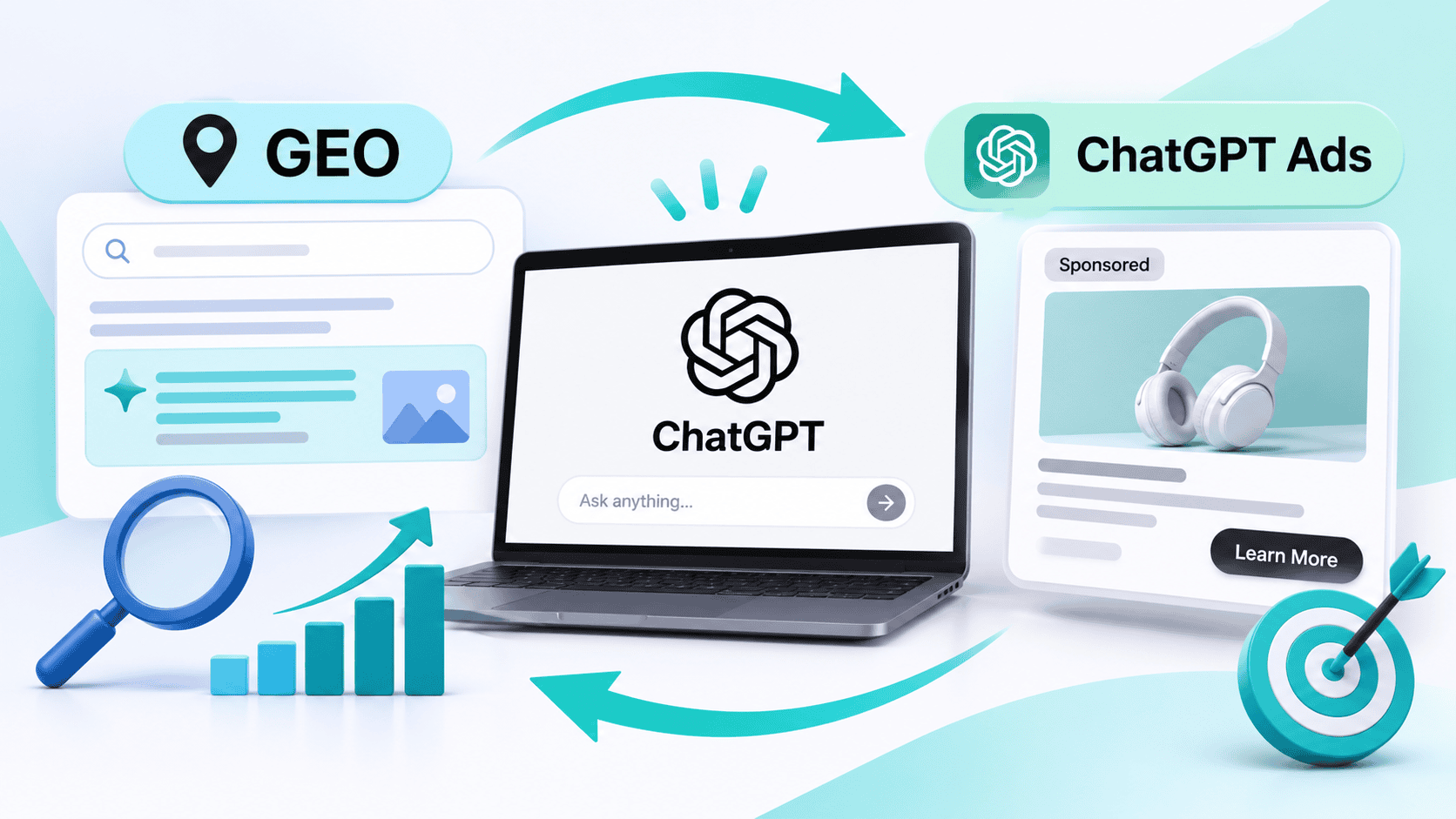
We are often asked if we should use GEO or ChatGPT Ads. The answer is no to both. It is important to understand that GEO ensures your brand appears in the answer to a user's query in ChatGPT. Whereas ChatGPT Ads provide an opportunity to advertise next to the answer. These are two completely different things and will not be successful if confused.
What is GEO?
Every time a user asks for information in ChatGPT, it pulls together all the information it can find about your brand (from your site, reviews and third party) to provide an answer. GEO ensures you have the right amount of information to be used by ChatGPT.
However, the majority of brands fail at this step. If you aren't providing information on your service pages about what your services are, who your target audience is, what regions you operate in and what makes you better than anyone else offering something similar, there will be nothing for the model to learn. If you're a moving company and you don't mention anything about cross country moves on your site, don't be surprised if ChatGPT doesn't recommend you for this. This is an issue with your content not the AI.
You also need to be consistent. If you are describing your service differently on your home page, service page and reviews on Google, the model will have conflicting information and therefore will not recommend you. If you're lucky it won't recommend you at all. If you're unlucky it will provide a summary of your brand that wouldn't even pass your own tests. Ensuring you have everything consistent across all pages is what GEO is.
If you have a good foundation in place, PR, reviews and industry media will help to support the story the AI is telling about you. However, if you don't have a good foundation on site, it won't help.
What are ChatGPT Ads?
ChatGPT Ads are an advert that will appear in a live chat. When someone is planning a holiday, looking for accounting software or considering a list of potential suppliers, an advert will appear next to the AI recommendation. This advert will be labelled as a sponsored advert.
Most people don't realise that this advert will have no impact on the recommendations. Brands can pay for ChatGPT Ads for every question but still get organic recommendations to their competitors. Recommendations are based on evidence. The advert will not impact the AI's recommendations.
This is where advertising can really help you. It can help you reach people when they are at a high intent stage of their journey. Whilst you may not have the GEO in place to be part of the organic recommendations, you can use the adverts to reach them. Someone who is searching on ChatGPT about how to compare property management software is a very valuable person to reach.
If you are using ChatGPT Ads without any GEO in place, it is akin to running Google Ads without any landing pages. You will get the clicks but without anything meaningful to back it up, you won't get anything from the visit. If you don't have much organic evidence, you are not only wasting your money but paying to get someone into a conversation where the AI is recommending your competitors.
GEO vs ChatGPT Ads: Side by Side
How to Measure GEO
It is not possible to measure GEO by running one prompt once. The responses can vary depending on how the question is worded, the context and when the model was last updated. Therefore, you won't learn much from one result. What you're really trying to understand is your visibility.
A realistic way to understand this is by creating a list of 20 to 40 questions that your buyers would type into ChatGPT when researching your category. Run these consistently for 1 to 2 weeks. Ensure you are using the same model and settings. Once you've got your results, look at the following.
Are you visible? If you're not visible for most of the questions, you don't have enough evidence. Are you accurate? If you are visible but the AI is not saying the right things about you, this is usually due to conflicting or missing information on your site. Are you competitive? If you're not appearing in the top positions, for example you're 5th out of 6, this can be an issue.
Each of these issues will indicate a specific problem. If you're not visible for a particular topic, you don't have the content. If you're inaccurate, the model is likely pulling information from an unclear or outdated page. If you're consistently losing to one competitor, they have filled a gap in the evidence.
The Right Sequence: GEO Before Ads
Order is more important than most brands realise. Using an advert will get someone into a conversation but the conversation will be based on the organic evidence. If you don't have much evidence, the AI will recommend your competitor and you won't be mentioned at all. You've essentially paid to get someone into a conversation that is working against you.
What will work is ensuring your offer is well described on your site. Ensure you have information about what you do, who you work with, where you operate, your proof points and why you're a better choice. Ensure these pages are crawlable and you haven't accidentally blocked them. Run a prompt panel to understand where you're at before spending any money. Once you have this in place, use paid to get you into conversations where you're not appearing in the organic.
This isn't saying you should wait until you have done all of your GEO before running adverts. But that you should ensure you have something solid to land on.
If you're a local plumber looking to run ChatGPT Ads for emergency repairs, ensure you have information on how quickly you respond, what areas you cover, what your licensing looks like and if you're available outside of hours. If you're missing any of this or it's unclear, you'll get the click but the person will be in a conversation where ChatGPT has nothing to say about you. Once you have sorted the evidence, you'll have somewhere good to send them.
Attribution Across Both Channels
To be honest, neither will provide clean attribution. It's important to know this before you start spending 3 months trying to make it work.
Someone finds your brand in a ChatGPT conversation. They don't click anything and close the tab. They think about it for a day or two and search for your brand. This will be attributed as a branded search. GEO and ChatGPT Ads will get zero credit. This is nothing new and is the same issue with upper funnel channels. What you can do is track how much branded search you are getting, direct traffic and assisted conversions. Once these start to move in the right direction whilst your campaign is running, you know you're having an impact.
GEO will be even harder to attribute. The organic recommendations won't always provide clean referral traffic. The most useful signals you'll get are how much branded search you're getting, direct traffic and what people say when you ask them how they found you (onboarding forms, intake surveys and sales calls). Whilst this is soft data, it is much more honest than trying to fit GEO into an attribution model.
When to Prioritise GEO, When to Prioritise Ads
Use GEO if you're not appearing in any of the answers to the questions your buyers are asking, you're not being described accurately or you're losing to a competitor when your product is genuinely better. Or if you're launching something new and need to build a foundation.
Use ChatGPT Ads if you have a decent foundation of organic evidence and want to speed things up. Or if your competitors with a better GEO are gaining consideration stage buyers. Or if something is time sensitive and you can't wait months for organic evidence. Or if you want to test which conversation contexts are converting.
Use both if your buyers research before making a decision (most things once you pass a certain price point or complexity). GEO will get you into the organic recommendations and ChatGPT Ads will get you in front of people in conversations where you're not appearing. If you'd like help understanding what the right balance is for you, our GEO team and ChatGPT Ads team work together as one.
Building Your AI Visibility Strategy?
Most brands will run GEO and ChatGPT Ads as separate experiments and wonder why they're not working. Those that are getting results are using them as part of a joined up system. This is how we build it at Marvant. If you'd like to understand where to start and what the right balance is for your business, have a chat.
Talk to Marvant