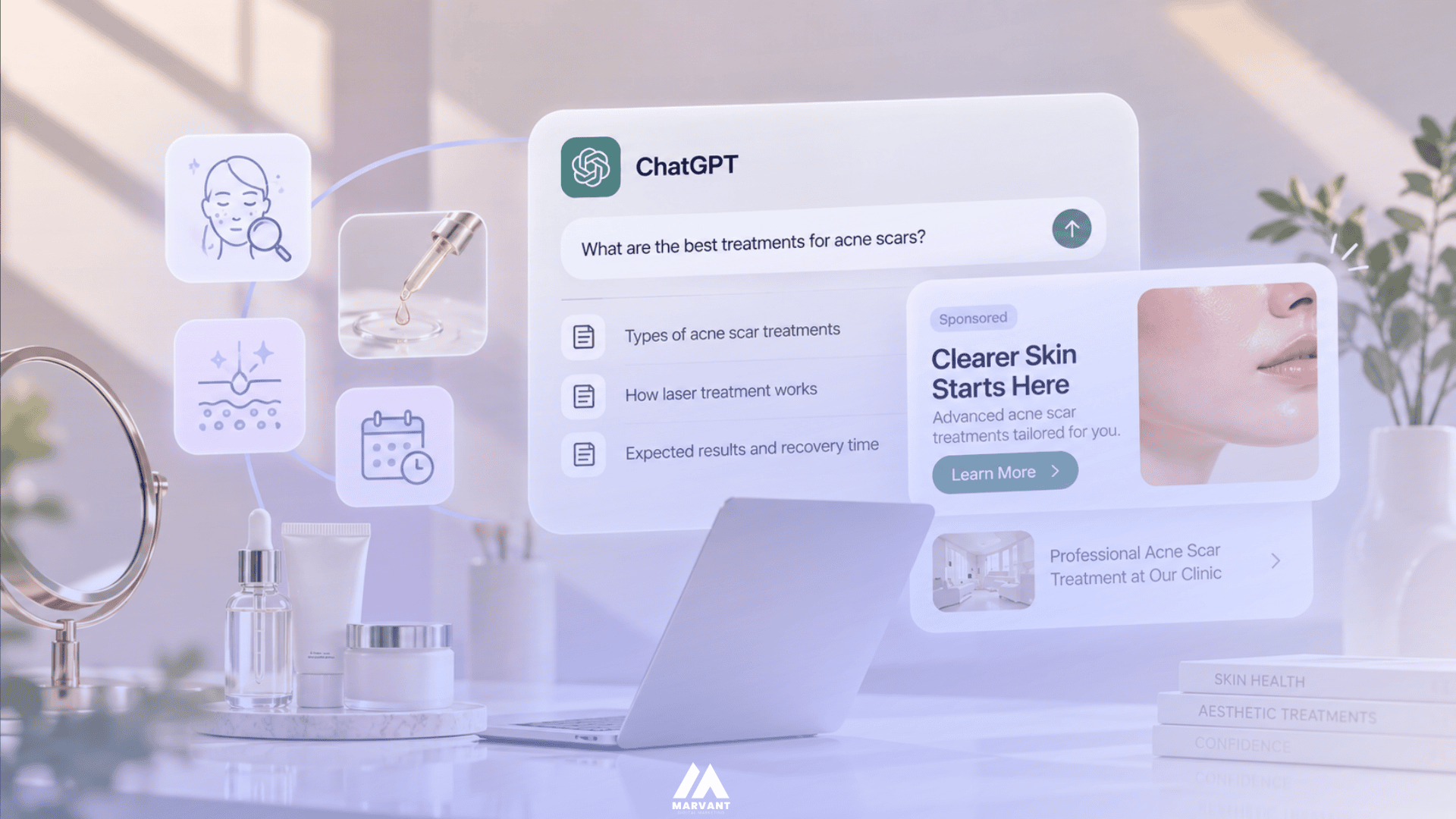
Decisions on beauty and aesthetic treatments are not taken lightly. Before scheduling appointments such as a Botox appointment, a Pico laser treatment, or Cryolipolysis, the client will spend days asking in-depth questions about the procedure, associated pain levels, downtime required, results expected, and costs involved. More and more of this kind of research takes place within the ChatGPT interface today. ChatGPT Ads places your clinic within that conversation when the client is shaping their treatment choice and considering which clinic to book with.
How Beauty and Aesthetic Research Actually Happens Inside ChatGPT
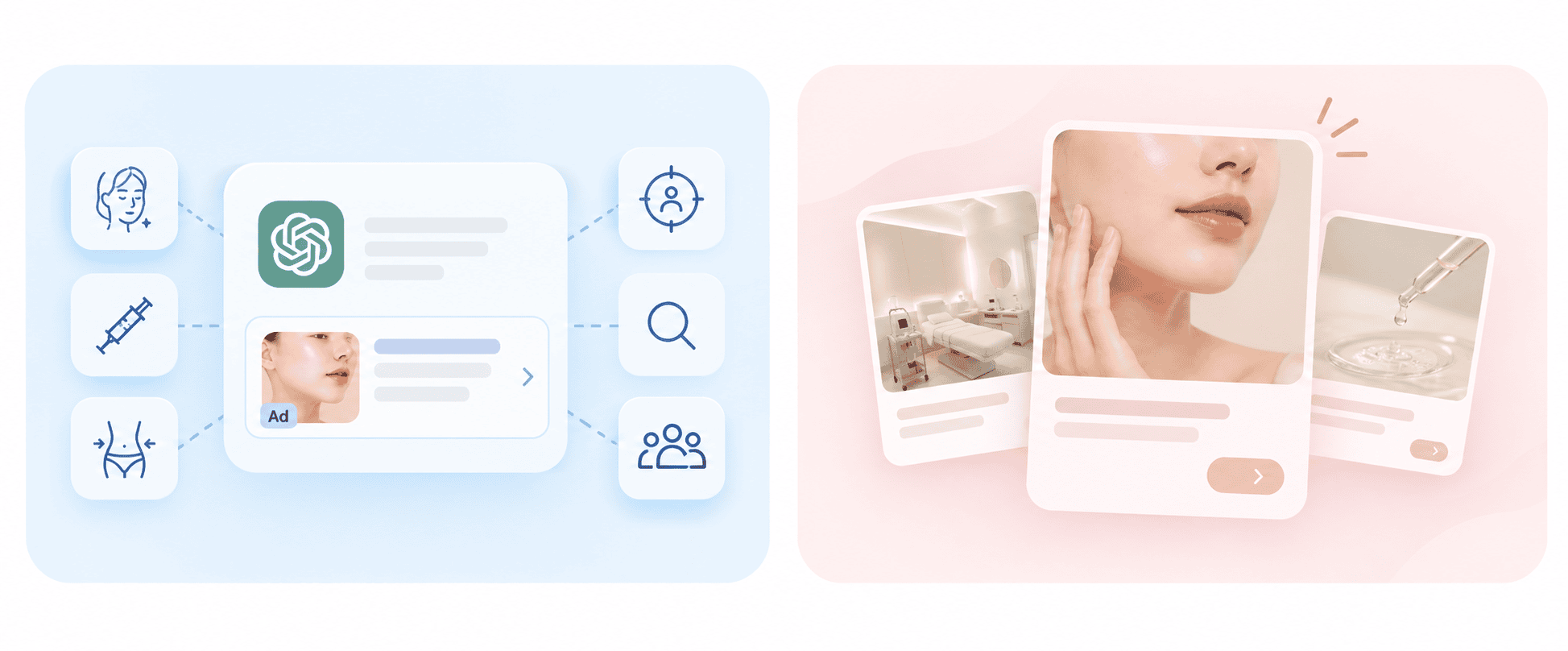
Research for a future aesthetic treatment by a potential client inside ChatGPT is radically different from what happens on Google. While the client uses Google and searches, scans, clicks, and repeats, the process on ChatGPT takes place in one conversation where the client moves from a broader question to a specific treatment option over minutes or hours.
This conversation-based process is what sets ChatGPT Ads apart from other marketing options. At the point where the customer has engaged in five or six exchanges about the treatment in question, ChatGPT will have a clear understanding of the consumer's concern, cost considerations, risk factors, and readiness to book an appointment. This information is precisely what informs the sponsored response matching process on the platform.
Here is what a real treatment research conversation looks like, and where the advertising opportunity sits inside it:
Ad Group Blueprints for Beauty and Aesthetic ChatGPT Campaigns
ChatGPT Ads operates on the basis of context hints rather than keywords. You do not bid on the terms consumers enter when searching. Rather, you describe a scenario with your consumer in mind, and the system tries to match the context hint against suitable conversations.
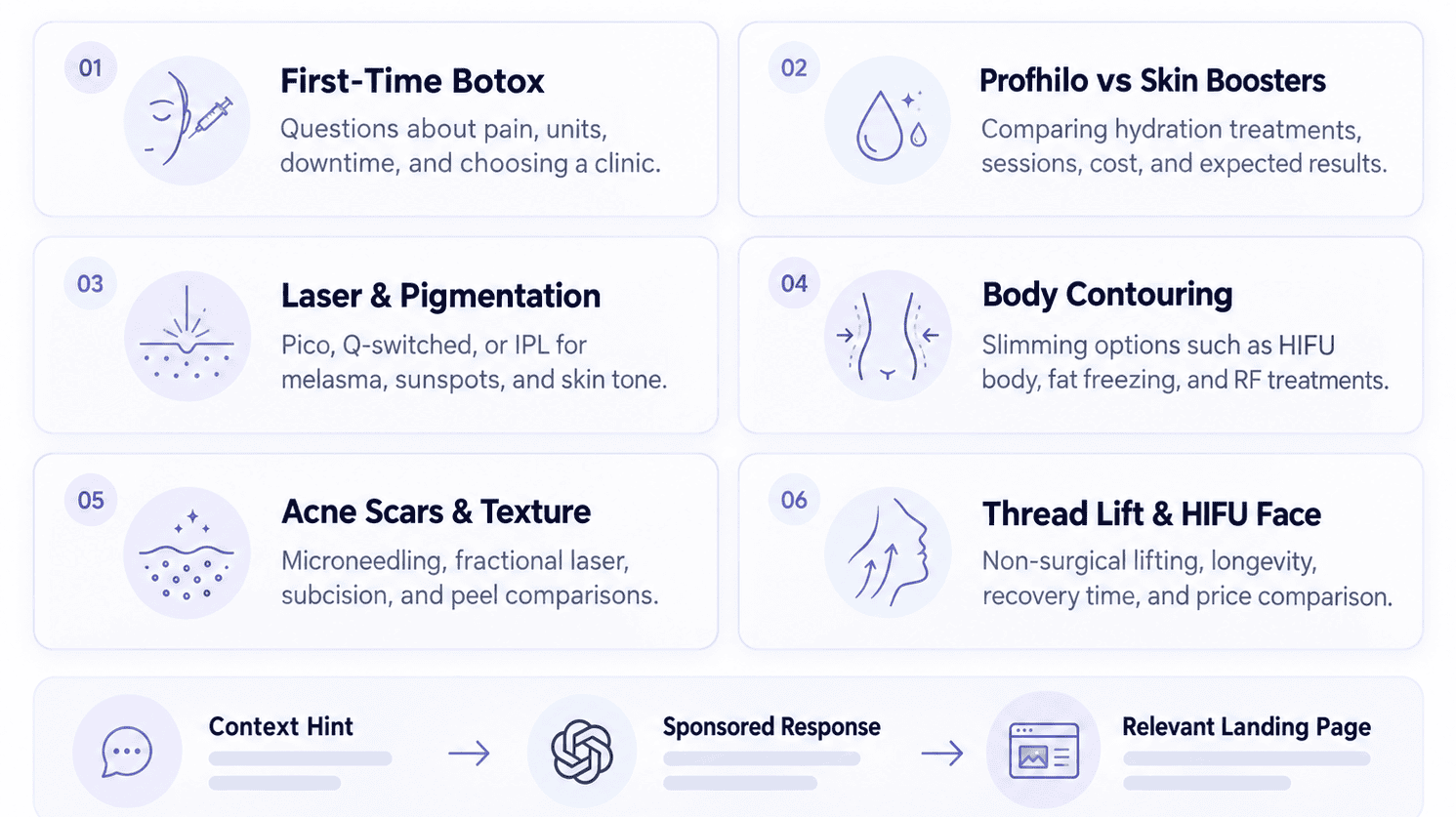
In case of beauty and aesthetics products, each treatment requires a separate ad group with its own unique context hint, as the conversation around Pico laser treatment and that about thread lifts is completely different.
The following blueprints provide context hints to be used, the consumer intention behind, suggested ad headline angle and landing page requirements.
Analysis of 13 live beauty and personal care ads across 10 advertisers in the Sprites.ai ChatGPT Ads Library (September 2026) shows two dominant patterns. Price-led bundle offers with a specific price point (such as "explore 3 fragrances for ₹599") perform well when the consumer prompt includes a clear budget and comparison request. Curiosity-driven headlines with embedded social proof (such as "Don't Buy This. Unless You Want Compliments" backed by "loved by 10,000+ men" in the body) work at the consideration stage when the consumer is close to a decision.
The library also shows a costly mismatch pattern: several non-fragrance ads (lip balm, facewash, skin cleanser) were served against fragrance-specific prompts. This is a direct result of vague context hints. A hint that describes the category broadly rather than the specific consumer situation produces irrelevant placements, and budget spent on conversations your treatment cannot answer is unrecoverable.
Writing Ad Creative That Fits a Research Conversation
ChatGPT Ads runs as sponsored text responses: a headline and body copy that appear as a clearly labelled sponsored message inside the conversation. There are no images, no video, and no carousels at this stage. For beauty and aesthetic brands, this format is an advantage rather than a limitation: it forces you to write copy that answers the consumer's actual question, which is exactly what earns trust at the research stage.
The most important thing to understand about the format is that the consumer has been in a multi-exchange research conversation before they see your ad. They are not scrolling passively through a feed. They are focused, informed, and evaluating information critically. Copy written for a Meta feed (emotional, visual, aspirational) does not land in this context. Copy that delivers a specific clinical insight or answers a comparison question directly will.
What Works and What Does Not
Creative Tone by Consumer Type
The right creative tone shifts depending on where the consumer is in their treatment journey and how much they already know. Applying the wrong tone to the wrong audience wastes the click and damages the clinic's perceived credibility.
| Consumer Type | Where They Are in the Journey | Right Creative Tone | What to Avoid |
|---|---|---|---|
| First-time aesthetic client | Gathering basic information; high anxiety about safety and looking unnatural | Reassuring and educational. Address safety and what to expect before talking about results. Explain the procedure step by step. Frame the consultation as a low-commitment starting point. | Assuming they know clinical terminology. Price-led creative before trust is built. Pushing a booking before answering their concerns. |
| Experienced aesthetic consumer | Comparing clinics or technologies for a treatment they already know; evaluating expertise | Technical and results-oriented. Mention the exact technology name (Allergan Botox, Teosyal filler, Picoway vs Picosure), doctor's credentials and years of specialisation, and time needed per session. They compare your clinic's expertise to other clinics. | Over-explaining things they already know. General "natural looking results" statements without any details. Not mentioning the difference in terms of doctor's qualifications and technology, which are unique features. |
| Value-conscious first-timer | Actively comparing prices among clinics; trying to find out what is the real cost of treatment | Transparent and cost-specific. Provide realistic total treatment cost rather than per session. Explain what is covered. Clarify whether the price you mention is an entry point price or full treatment plan price. Acknowledge that some treatments require more than one session to be effective. | Ambiguous price-related statements without sufficient context. Not admitting multi-session requirement. Overstating the visible effects from one low-cost session. |
| Medical aesthetic client | Deciding between medical aesthetic clinic and beauty salon; needs credibility in terms of medicine | Credential-led and clinical. Name the specific qualification rather than only "our doctors". | Anything that reads like a promotional beauty ad rather than a medical practice. Lifestyle imagery references in copy. Emotional language over clinical precision. |
Landing Pages That Match the Treatment Research Conversation
ChatGPT Ads scores relevance based on alignment between your context hint, your ad creative, and the landing page the ad links to. All three must address the same specific treatment concern. An ad about Profhilo that links to a general facial treatments page will receive a lower relevance score, a higher cost per click, and a worse conversion rate than one that links to a dedicated Profhilo page that answers exactly the questions the consumer was researching.
If your clinic website does not yet have dedicated treatment pages at this level of detail, building them is the most important preparation step before allocating budget to ChatGPT Ads. The landing page is where the conversion happens.
| Ad Group Theme | Required Landing Page | Non-Negotiable Page Elements |
|---|---|---|
| First-time Botox | Guide page on Botox treatment | What is Botox treatment? What regions can be treated with Botox? The injection process step-by-step. How long does it take (usually between 3 to 6 months). Quantity of units needed for different regions. Price range. Doctor qualification. Booking appointment call to action. |
| Profhilo and skin booster comparison | Comparison guide of Profhilo with other treatments | Hyaluronic acid filler vs Profhilo vs Polynucleotide boosters; recommended treatment for certain types of concern; number of sessions required for different types of treatment; prices comparison; what you should expect from every session. |
| Laser pigmentation treatment | Guide to laser pigmentation treatment | Principles of operation of Q-switched laser, Pico laser, and IPL; technology suitable depending on your pigmentation and skin color; how many sessions would be required to get good results; what should you expect during each procedure (redness); post-procedure care; price per one procedure. |
| Body contouring and slimming | Comparison page for body treatments | HIFU body treatment vs Cryolipolysis vs Radiofrequency body treatment depending on the area of application and need; which technologies make it possible to reduce fat and tighten skin; result of one procedure; total cost of the full course of treatment; period of maintenance. |
| Acne scar treatment | Guide to acne scar treatment depending on the type of scar | Rolling scars, boxcar scars, and ice pick scars; fractional laser vs microneedling RF; subcision vs subcision comparison; realistic time to see the results within 3 to 6 months; steps of procedure; investment in the whole course; post-procedure experience. |
| Thread lift vs HIFU face | Non-surgical lifting comparison page | Thread lift mechanism and how threads anchor and lift tissue vs HIFU's focused ultrasound at the SMAS layer; longevity comparison (thread lift 12 to 18 months vs HIFU face 12 to 24 months); recovery difference (thread lift 3 to 5 days mild swelling vs HIFU minimal downtime); number of sessions needed for each; realistic price range for both at a medical aesthetic clinic in Malaysia; which candidate profile suits each treatment; doctor credential required for thread lift procedure. |
Audience Targeting for Aesthetic Clinics on ChatGPT Ads
ChatGPT Ads does not offer demographic targeting. You cannot target by age, gender, income, or interest category the way Meta Ads does. Targeting comes from two sources: the context signals in the conversation matched against your context hints, and first-party custom audiences uploaded from your own clinic data. Aesthetic clinics with multi-year client databases are well positioned to use both.
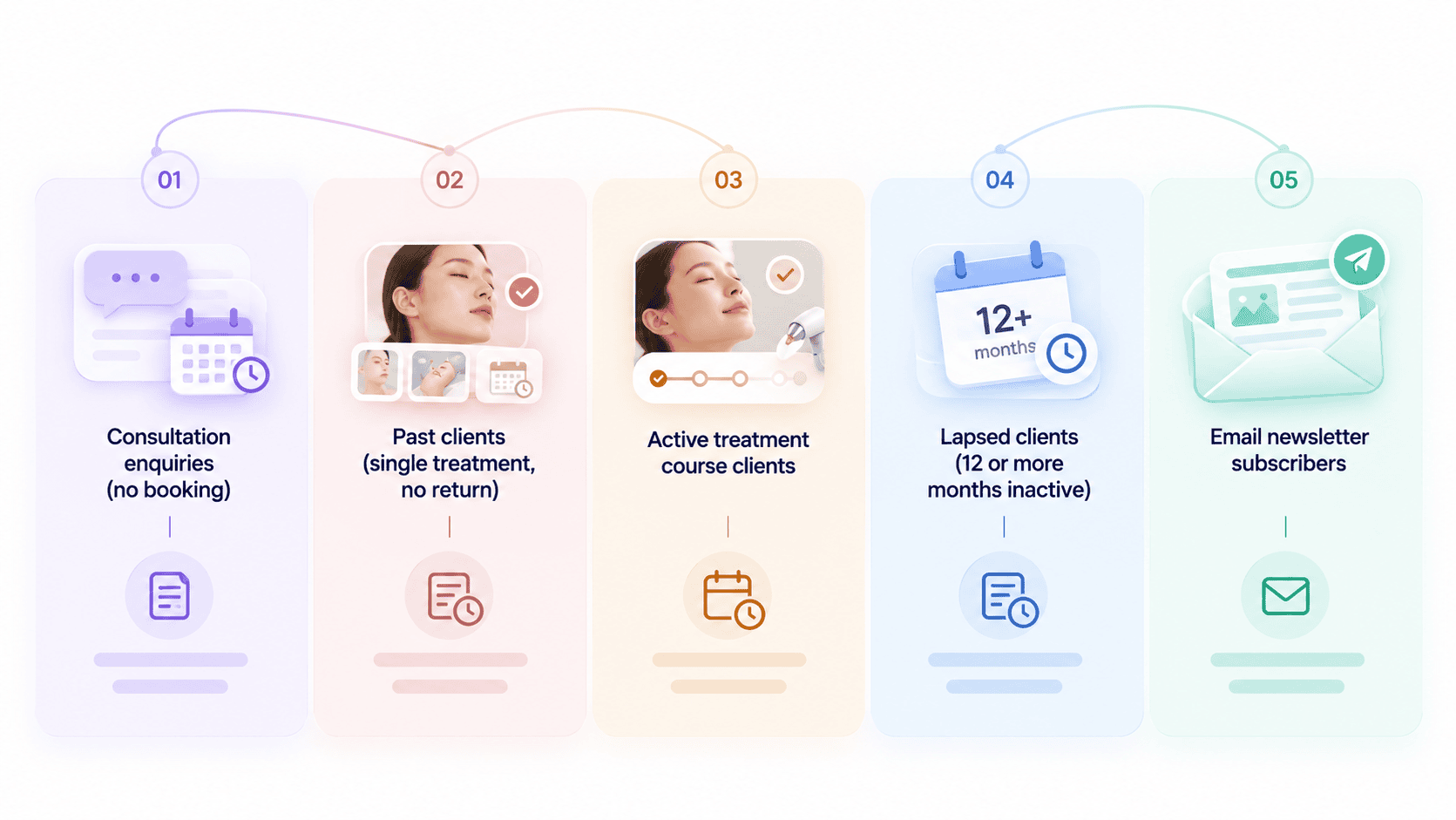
Custom Audience Applications for Aesthetic Clinics
| Audience Type | Data Source | Recommended Campaign Use |
|---|---|---|
| Consultation enquiries (no booking) | CRM or booking system enquiry records | Retarget with the specific treatment information they enquired about, or a limited-availability consultation offer. This audience has shown intent but did not convert. A research-stage ad that answers the question they asked can re-engage them before they book elsewhere. |
| Past clients (single treatment, no return) | Treatment history records | Target clients who completed one treatment but did not return for maintenance or a complementary treatment. Creative should focus on what happens at the 6 or 12 month mark for their specific treatment, and what the next step typically looks like for clients at that stage. |
| Active treatment course clients | Ongoing booking records | Exclude from prospecting campaigns entirely. Optionally, use for upsell messaging about complementary treatments relevant to what they are currently undergoing, such as a skin booster for clients mid-way through a laser course. |
| Lapsed clients (12 or more months inactive) | CRM records with no booking in last 12 months | Win-back campaign focused on new technologies or treatments added to the clinic's menu since their last visit. Frame the message around what has changed, not a generic "we miss you" approach. |
| Email newsletter subscribers | Email marketing platform subscriber export | Warm audience for treatment education campaigns. Typically higher intent than cold context-only targeting because they have an existing relationship with the clinic's content. Useful for promoting new treatment launches or seasonal campaigns. |
ChatGPT Ads and Meta Ads: Where Each Platform Belongs
The most common question from beauty and aesthetic brands evaluating ChatGPT Ads is whether it replaces their Meta spend. It does not. Meta Ads and ChatGPT Ads reach the same potential client at completely different moments and through different mechanisms. Running both creates a presence at every stage of the decision journey, from first exposure to active research to clinic selection.
| Capability | ChatGPT Ads | Meta Ads |
|---|---|---|
| How targeting works | Conversation context matched to context hints; first-party custom audiences for retargeting and exclusion | Demographics, interests, behaviours, lookalike audiences, and pixel-based retargeting of website visitors and engagement audiences |
| Best use in the purchase journey | Active treatment research: the consumer is already in a specific treatment conversation and is comparing options or looking for a clinic | Discovery and awareness before research begins; retargeting after the consumer has visited the website or engaged with clinic content |
| Ad format | Sponsored text response inside the conversation thread: headline and body copy only, clearly labelled as sponsored | Image, video, carousel, story, and reel formats; visual-first, designed for passive feed scrolling |
| Creative strength | Specific, informational copy that answers a treatment question directly and positions the clinic as the expert source | Visual lifestyle, transformation, and emotional aspiration content: before and after results, clinic environment, client testimonials within policy limits |
| Before-and-after content | Not applicable; the format is text only | Restricted under Meta's health and beauty advertising policies; possible within compliance limits but requires careful policy management |
| Compliance sensitivity | High: medical outcome claims, specific result guarantees, and prescription treatment pricing all have restrictions | High: Meta also restricts before-and-after imagery, medical outcome claims, and content that implies a specific result |
| Retargeting capability | Custom audience lists only: no pixel tracking, no engagement retargeting, no video view retargeting | Full pixel-based retargeting including page visitors, video viewers, post engagers, and lookalike audiences built from any of these |
The recommended split for established aesthetic clinics is to use Meta Ads for brand building, visual treatment content, and pixel retargeting of website visitors, while allocating 10 to 20% of digital budget to ChatGPT Ads to capture consumers who are actively researching your treatment category but have not yet visited your clinic's website. This fills a gap that neither Google Ads nor Meta currently covers.
Compliance for Beauty and Aesthetic ChatGPT Ads in Malaysia
Aesthetic medicine advertising in Malaysia falls under the Medical Advertisement Act 1956, enforced by the Ministry of Health. ChatGPT Ads creative for any clinic offering medical aesthetic treatments must be reviewed against these restrictions before going live. The four areas most likely to create compliance issues in beauty and aesthetic campaigns are:
- Specific outcome claims are prohibited. Phrases such as "eliminate your wrinkles in one session", "permanently remove fat", or "guaranteed results within 3 treatments" breach the Act. Replace these with process descriptions and typical experience language: "most clients see visible softening of forehead lines within 10 to 14 days of their first treatment."
- Prescription treatment pricing requires careful handling. Botulinum toxin and certain dermal fillers are prescription-only products. Advertising a specific per-unit or per-session price for these in ad copy carries regulatory risk. General price ranges for consultation packages or combined treatment plans are typically safer than per-unit pricing published directly in ad creative.
- Before-and-after content does not apply to the ad unit but affects landing pages. ChatGPT Ads is a text-only format, so no before-and-after images appear in the ad itself. However, if your ad links to a landing page containing before-and-after imagery, that page must comply with Malaysian advertising standards independently. Compliance at the ad level does not protect a non-compliant landing page.
- Credential claims must be accurate and verifiable. If your ad copy or linked landing page references doctor qualifications, specialist status, years of aesthetic practice, or specific training credentials, these must be accurate. Misrepresenting medical qualifications is a regulatory breach that extends well beyond advertising compliance into professional accountability.
The safest and most effective approach for aesthetic clinic ad creative is to write copy that describes what the treatment involves and what the typical client experience is, rather than what result the consumer will achieve. "Pico laser delivers energy in trillionths of a second, targeting melanin clusters with less thermal damage to surrounding skin than Q-switched technology" is compliant and informative. "Removes your dark spots in 3 sessions" is not. Consumers in an active research conversation value accurate clinical information over promotional promises; compliance and performance point in the same direction.
Pre-Launch Checklist for Beauty and Aesthetic ChatGPT Ads
Work through every item before allocating budget. The most common failure point is misalignment between the context hint, the ad creative, and the landing page. A consumer researching Pico laser who is served a generic skincare ad and lands on a clinic homepage will not convert, and the result will incorrectly suggest that the channel does not work for aesthetic brands when the issue is structural rather than platform-related.
- 1Build one ad group per treatment category. Botox, fillers, laser, body contouring, and thread lift each attract a different consumer with different research questions. Grouping them produces context hints too broad to match accurately.
- 2Write context hints that describe the consumer, not the clinic. Each hint should name who the consumer is, which treatment concern they are researching, and what specific questions they are currently asking. No clinic name, no promotional language in the hint itself.
- 3Lead ad creative with a clinical detail or specific number. Session count, results duration in months, downtime in days, or the mechanism that differentiates one technology from another. Vague aspirational claims do not hold up in a research conversation context.
- 4Match every ad group to a dedicated treatment landing page. The page must address the specific concern described in the context hint. A general services page or homepage will score lower for relevance and convert worse regardless of how good the ad creative is.
- 5Review all creative against the Medical Advertisement Act 1956 before launch. Outcome guarantees, prescription treatment pricing, and credential claims all require checking. Build compliance review into the campaign setup process, not as an afterthought after the campaign is already live.
- 6Upload your exclusion list before any spend begins. At minimum, exclude current active clients from prospecting campaigns. Even a list of a few hundred active clients prevents budget waste and avoids serving research-stage ads to people already in your treatment programme.
- 7Set up conversion tracking on a meaningful action. Consultation booking, WhatsApp enquiry click, or contact form submission. Page visits alone will not tell you whether the targeting is reaching consumers who become actual clients.
- 8Start budget at 10 to 15% of total digital spend and review lead quality at four weeks. Assess whether enquiries from ChatGPT Ads are converting into consultations, not just whether clicks are being generated. A high click rate with no bookings points to a landing page or consultation process issue, not a channel problem.
Frequently Asked Questions
Sources referenced in this article:
Single Grain — ChatGPT Ads: What Marketers Need to Know (2026)
OpenAI — Testing Ads in ChatGPT (2026)
Sprites.ai — ChatGPT Ads Library: Beauty & Personal Care (September 2026)
Launch ChatGPT Ads for Your Beauty or Aesthetic Brand
Marvant builds and manages ChatGPT Ads campaigns for beauty and aesthetic clinics, from writing treatment-specific context hints and building compliant landing pages to conversion tracking and campaign optimisation. Talk to our team or explore our performance marketing services to get started.