How Car Buyers Research Today
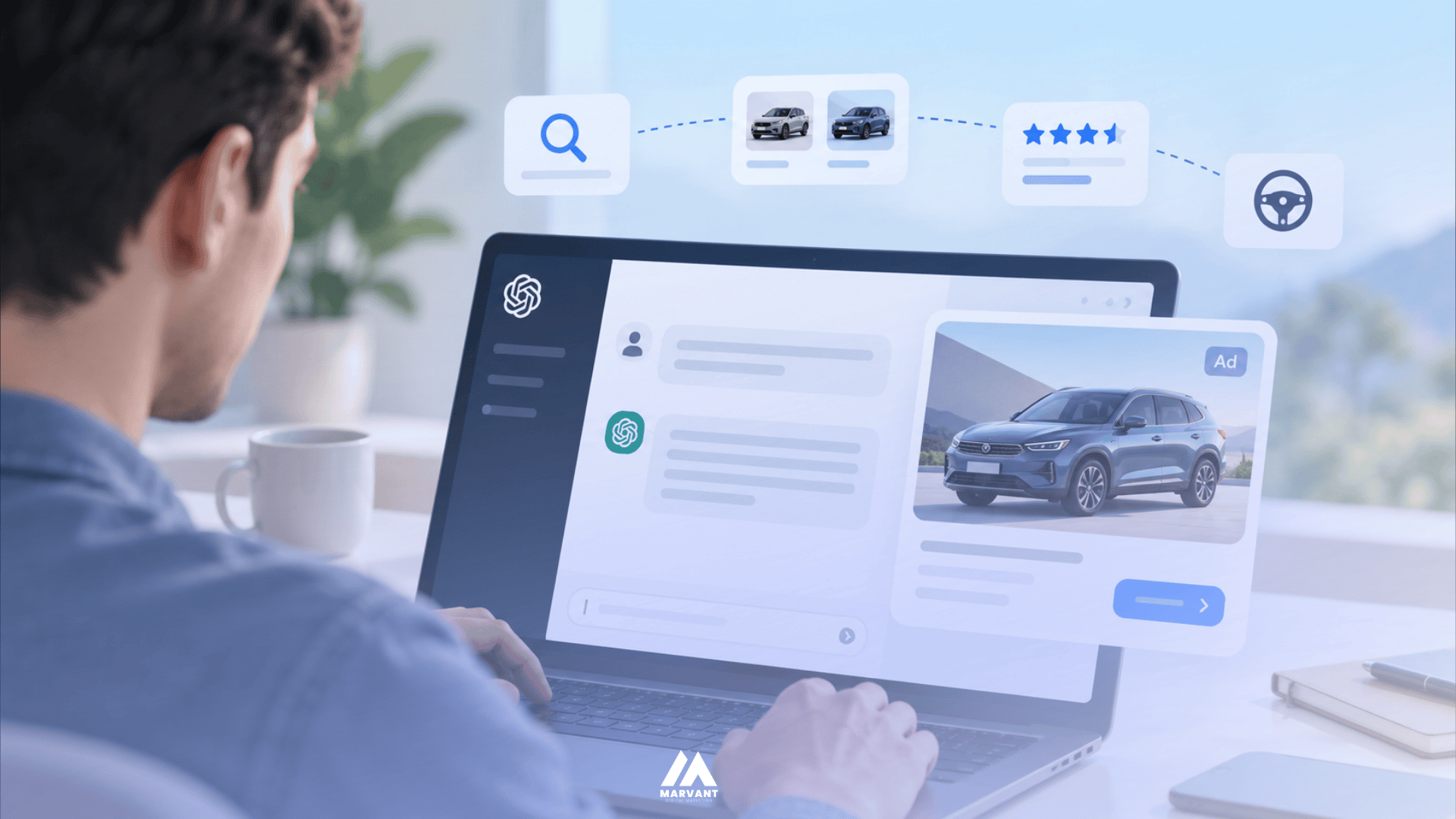
As far as the automotive purchase process has always been rather lengthy, what really matters is not the length of it but the way it goes now. While before a buyer could spend several hours surfing through various tabs and comparing models on their official websites, discussing cars on forums, and watching videos, they may have shifted all this information gathering into one ChatGPT dialogue.
They may ask questions such as: "What is the mileage rate for the Proton X70 and the Honda CR-V?" or "Do you buy a hybrid car in Malaysia given the price of the petrol per gallon?" or "How much will be your monthly instalment in case you purchase a car worth RM120,000 with 10% down payment?" These are not instant searches but rather indicate intentions and budget. According to research by Single Grain, on average, the purchase of a single vehicle takes several weeks, dozens of questions comparing various models, and many financial calculations, and that 82% of people prefer to get answers from a robot rather than from a human representative.
This is precisely how ChatGPT Ads work. Unlike Google Ads, in which a customer is stopped in their tracks once and after a single search query, ChatGPT Ads are able to engage with a customer who is already in a discussion on the platform, and the context of their problems is known to it. A customer who is talking about their family's preferences, cargo space, and mileage for five or more messages is much more of a lead than just a single search term.
The Three Stages Where ChatGPT Ads Can Intervene
Automotive buyers do not move through a single buying moment. They move through distinct stages, each with a different mindset and a different type of question. ChatGPT Ads can be targeted to reach buyers at any of these stages by writing context hints that describe the buyer's situation at that specific point.
Automotive advertisers typically concentrate all their budget on Stage 03 due to high intent. While the chance to win over a customer via ChatGPT Ads lies in Stage 02, model comparison and shortlisting. CMe Automotive, currently testing ChatGPT Ads live in various UK dealerships, sees the platform precisely as an early-stage customer engagement opportunity, while Google Ads and Google Vehicle Ads still perform better later in the journey when buyers start looking for stock.
Writing Context Hints for Automotive Ad Groups
Context hints are the single most important element of a ChatGPT Ads campaign. They are plain-language descriptions written at the ad group level that tell the platform which conversations your ad should appear in. The platform reads them semantically, not as a keyword list.
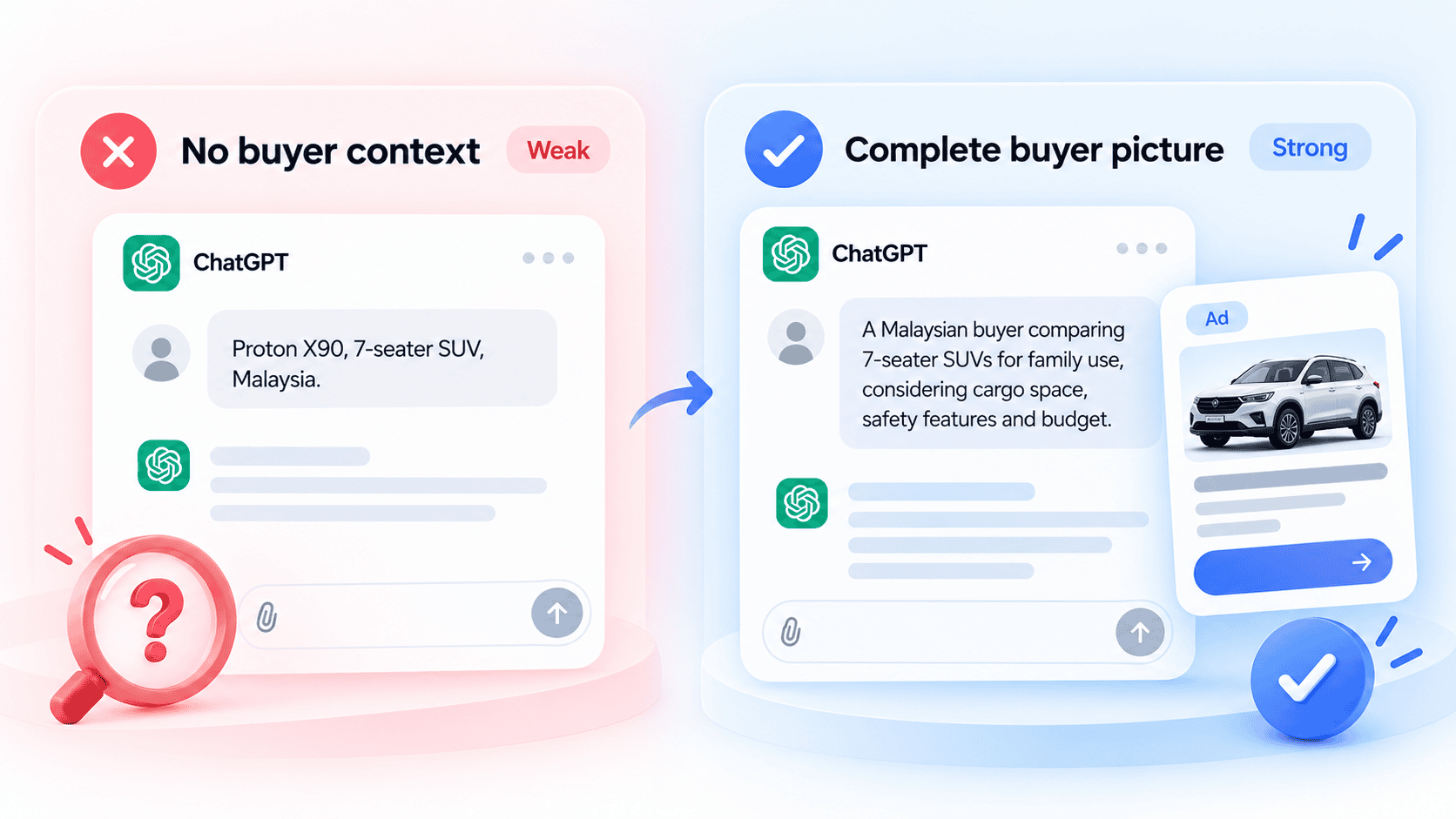
For automotive, this means describing the buyer's situation in the same language they would use when talking to a knowledgeable friend. The hint should explain who the buyer is, what they are trying to decide, and what moment in their journey they are at.
Weak
Strong
Automotive Context Hint Examples by Ad Group
Each ad group should carry a single theme. Here are example context hints mapped to the buyer situations that matter most for automotive in Malaysia:
The above ad groups target different mindsets of buyers. Placing all these ad groups into one results in misleading information as the algorithm will not be able to tell the difference between a first-time and an upgrade buyer within the same context, creative, and landing page. Therefore, it's better to split them right from the start.
Writing Ad Creative for Automotive ChatGPT Campaigns
Currently, ChatGPT Ads are run in the form of sponsored text messages: a short title and a body text of the response, which is presented as a sponsored message within the conversation thread, clearly separated from the ChatGPT answer generated by the algorithm. There are no images, no video, and no carousel format in place. The platform is evolving rapidly: initial ad units had a title, a description, and a link. Within weeks of launch, OpenAI added audience uploads, conversion event tracking, and product feed support, with automotive stock feed integrations already in development. For automotive, the current text format requires a specific creative approach.
The creative must function as a continuation of the buyer's research, not as an interruption. A buyer who has been asking about SUV fuel economy for several exchanges does not want to be told to "visit our showroom today". They want information that moves their decision forward.
Headline: Test Drive the New Proton X90 Today
Body: Experience the all-new Proton X90. Book a test drive at your nearest showroom and enjoy exclusive launch offers. Limited time only.
Treats the conversation like a search ad. No connection to what the buyer was asking. High chance of being ignored or rated irrelevant.
Headline: How the X90 Compares on Fuel and Space for Malaysian Families
Body: The X90 averages 8.5L per 100km combined and carries 7 adults with 227L of boot space behind the third row. See the full specification comparison and monthly instalment estimates.
Answers the buyer's implicit question. Gives a specific number. Links to a comparison page, not a generic homepage.
Creative Principles for Automotive ChatGPT Ads
- 🔢 Start with a specific number. Fuel economy figures, boot space capacity in litres, ANCAP star rating, or a monthly instalment calculation. The specificity of a figure shows authority and gives the buyer a direct answer to their query.
- 🎯 Stay on theme of the ad group. The creative for your EV consideration ad group needs to refer to EVs specifically. Generic creatives that are not tied to a car type do not register as relevant to the algorithm.
- 🔗 Link to a comparison or calculator page. A buyer still in the research phase needs more information, not your homepage. Link to a model comparison page or a loan calculator.
Adapting Creative Tone by Buyer Persona
In addition, the buyer persona that will be using your context hint will affect the tone of the creative itself. There are three different buyer personas that each need a different approach:
| Buyer Persona | Tone and Approach | What to Avoid |
|---|---|---|
| First-time buyer | Friendly and informative. Don't assume familiarity with HP loans and OTR price. | Being impatient in the creative. Asking for a test drive without giving enough information. |
| Upgrading professional | Specific and technical. Talk about driving experience, advanced safety, and comfort first, do not mention price. The buyer has bought something before and knows their needs. | Too much explanation of basics. Competing on price until you have proved that your model suits the buyer. |
| Fleet buyer (5 or more vehicles) | Business-related. Ask about fleet size, car type, mileage, time of purchase, route to the fleet department and do not use retail messages. | Fleet buyers are not looking for finance options and personal test drives. |
Landing Pages That Match the Conversation
ChatGPT evaluates the relevance of your campaign based on the combination of three factors: your context hint, your ad creative, and your landing page. All three should speak about the same buyer situation. The ad with the buyer persona who compares EV models but leads to the home page gets a lower relevance score, pays more per click, and converts worse.
For Automotive, the landing pages that work best for ChatGPT Ads campaigns are as follows:
| Ad Group Theme | Best landing pages to be used | Elements on landing pages |
|---|---|---|
| Family comparison of SUVs | Comparison page of models | Boot space, 3rd row legroom, safety rating, range of prices, monthly instalments estimation |
| First-time buyer | Guide/FAQ page | Loan process explanation, amount of deposit required, insurance information, recommendation of models based on budget |
| EV comparison | Cost of ownership of EV calculator | Comparison of petrol cars to EVs, cost of monthly payment, locations for EV chargers, incentives from the government, information about battery warranty |
| Loan instalment calculation | Loan instalment calculator | Price input, down payment input, tenure input, monthly instalment and interest calculated, direct Call-To-Action button |
| Upgrade buyer | Detailed specification of models | Specification of model list, features of safety technology, comparison with old model, tool for trade-in valuation |
If the dedicated pages are not yet present on your website, creation of one landing page for each ad group theme is the best thing you can do in preparation of your ChatGPT Ads campaign. Model comparison and loan calculator are the two most universal landing pages for automotive advertisers.
Audience Targeting for Automotive Brands
ChatGPT Ads doesn't provide any kind of demographic targeting like Meta Ads. Age groups, income groups, and interests are not available to be targeted. Targeting is done based on two sources: context signals (as explained above) and custom audiences from first-party data.
Custom Audience Options for Automotive
Automotive companies generally have more first-party data than other industries since there are natural touchpoints created during the purchase or maintenance of their products. First-party data is readily available for use in ChatGPT Ads via custom audiences.
| Type of Audience | Data Source | Application in Campaigns |
|---|---|---|
| Former prospect leads | CRM or Dealer Management System | Re-target leads that enquired but did not purchase; show finance option or new model details |
| Service customers (3 to 5 year ownership) | Service centre database | Target owners whose vehicle is reaching the typical replacement cycle; show upgrade messaging |
| Test drive registrations (no purchase) | Showroom booking system | Re-target warm leads with specific incentives or answers to objections that typically prevent conversion |
| Recent purchasers (exclude) | Sales records, last 18 months | Exclusion list to avoid spending budget on buyers who just purchased |
| Accessory or finance buyers | Dealer accessory or finance department database | Cross-sell or upsell; lookalike seed audiences for prospecting |
Custom audiences in ChatGPT Ads must consist of no less than 25,000 matched users in order to qualify and adjust bids. This is too big an audience for individual dealers, while distributors and brands usually have enough database to cover. However, lists under 25,000 can also be utilised for exclusion audience and cost nothing while saving budget from spending on existing buyers.
ChatGPT Ads vs Google Ads for Automotive: Which Does What
The two tools are not competing, as they target the same buyer at different points and through different means. It is not about choosing between them, but about splitting the budget throughout the journey.
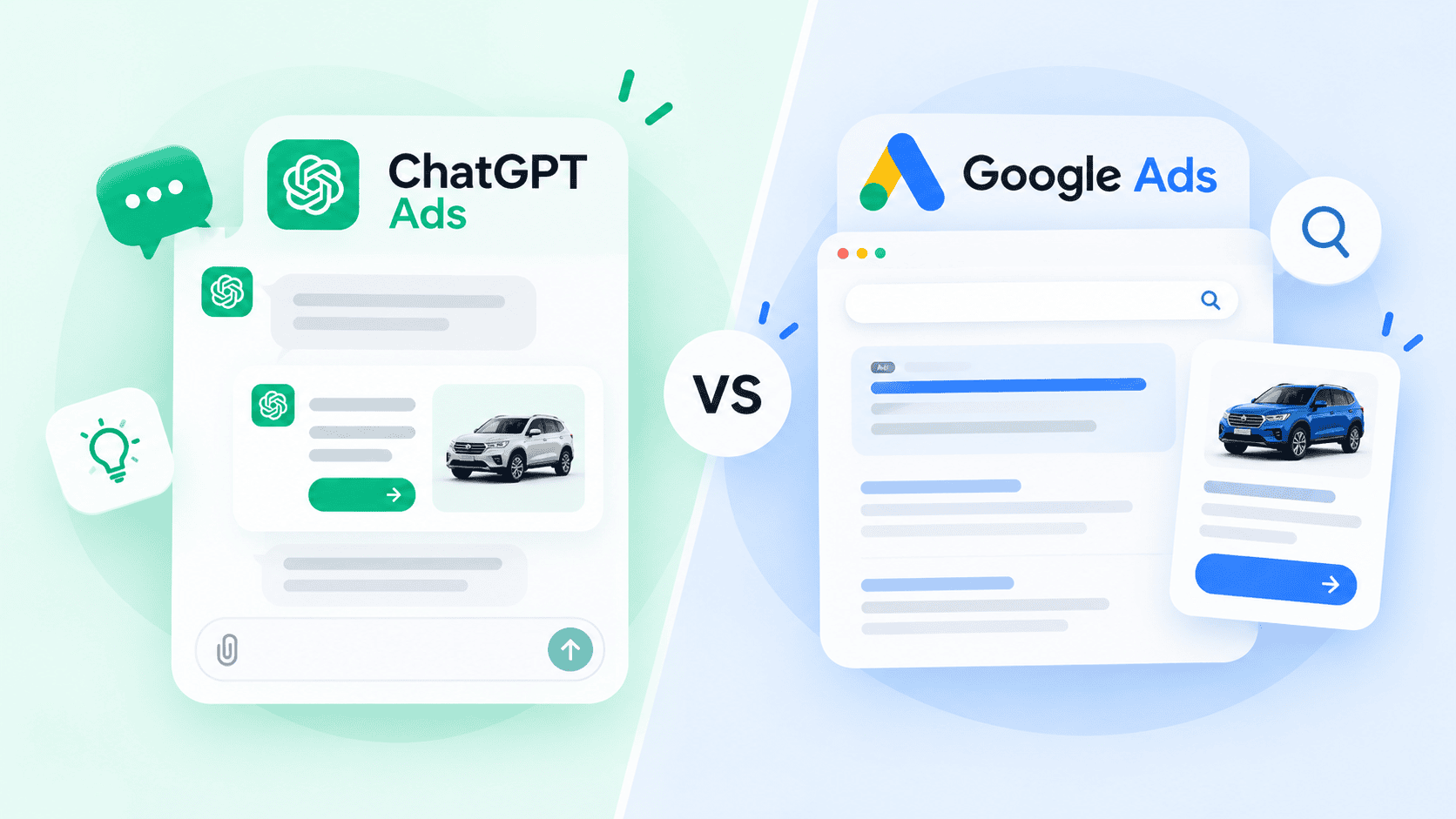
| Capability | ChatGPT Ads | Google Ads |
|---|---|---|
| Targeting method | Conversation context, context hints, custom audiences | Search keywords, audience segments, intent signals |
| Ideal journey stage | Research and comparison (Stage 02) | High-intent search and brand comparison (Stage 02 to 03) |
| Ad format | Sponsored text response inside conversation | Search ads, display, Performance Max, video |
| Keyword control | None; replaced by context hints | Full keyword and match type control |
| Negative targeting | Exclusion audiences only | Negative keywords, audience exclusions |
| Conversion tracking | Required; URL-based or pixel | Required; Google Tag or import from GA4 |
| Retargeting | Custom audience lists only (no pixel retargeting) | Pixel-based retargeting, Customer Match, RLSA |
For automotive, the recommended approach is to run Google Ads for high-intent search terms (brand name searches, "test drive [model]", "price of [model] Malaysia") while using ChatGPT Ads to reach buyers during the earlier research phase where they are still comparing options and forming preferences. The two campaigns feed different stages and are measured by different KPIs.
What to Expect: Early Performance Benchmarks
ChatGPT Ads is new enough that there are no established automotive-specific benchmarks yet. CMe Automotive, which is among the first agencies running live tests with dealerships, notes that costs vary by campaign and that the industry is still building its baseline data. However, early indicators from practitioners in the US market give a working frame of reference.
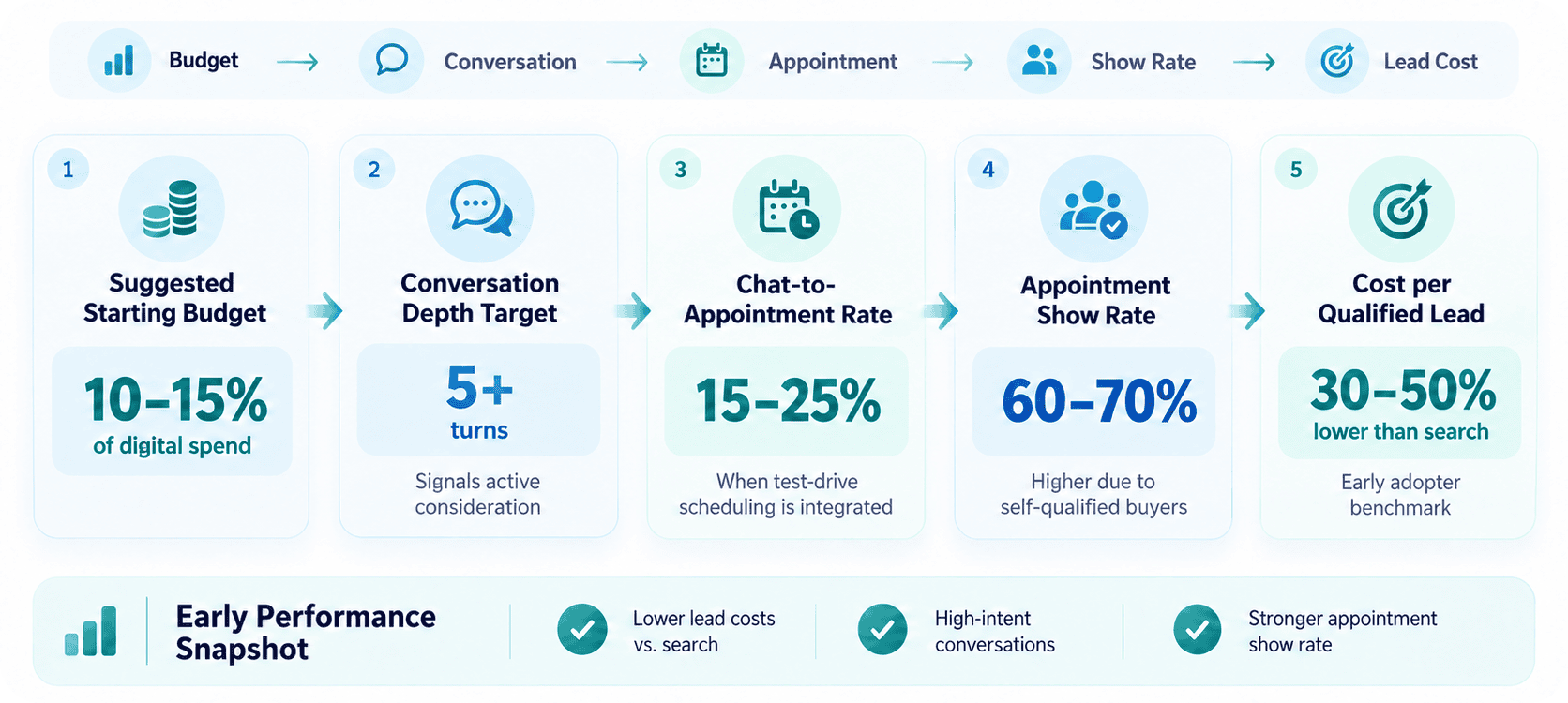
| Metric | Early Benchmark | Notes |
|---|---|---|
| Cost per qualified lead | 30 to 50% lower than search | Reported by early adopters in competitive automotive markets; not yet independently verified at scale |
| Chat-to-appointment rate | 15 to 25% | For campaigns with direct test-drive scheduling integrated into the landing page flow |
| Appointment show rate | 60 to 70% | Higher than cold outreach because the buyer self-qualified through the research conversation |
| Conversation depth target | 5 or more turns | Conversations with 5 or more exchanges indicate a buyer in the consideration stage; shorter conversations suggest early awareness |
| Suggested starting budget | 10 to 15% of digital spend | Test at this allocation before scaling; the platform is still building its auction depth in most markets |
A car buyer may have a ChatGPT conversation, visit your site two days later, and complete an enquiry form a week after that. Last-click attribution will not capture the ChatGPT Ads contribution to that lead. Use multi-touch attribution or track assisted conversions alongside direct conversions to understand the channel's true role in the journey.
Compliance Requirements for Automotive ChatGPT Ads
Two compliance areas matter specifically for automotive creative:
- Payment estimates must carry a disclaimer. Monthly instalment figures shown in ad copy are illustrative and depend on credit approval, loan tenure, and interest rate. Stating a figure without context can create misleading impressions.
- Inventory claims must reflect real-time stock. If your ad mentions a specific model or variant, the landing page must show that model as actually available. Bait-and-switch inventory claims, even unintentional ones caused by stock updates, damage both conversion rates and advertiser trust scores on the platform.
Pre-Launch Checklist for Automotive ChatGPT Ads
Go through this before putting any budget into a ChatGPT Ads campaign for an automotive brand. The most common failure point is a mismatch between the context hint, the creative, and the landing page. Fixing that before launch is faster than diagnosing it after spend has been wasted.
- 1 Split by buyer situation, not by model. Create separate ad groups for first-time buyers, family SUV buyers, EV considerers, and financing queries. Do not put them in one group.
- 2 Write context hints that describe the buyer, not the car. Each hint should explain who the buyer is, what they are trying to decide, and what stage of the journey they are at. Never include your brand name in a context hint.
- 3 Lead your ad creative with a specific data point. Fuel consumption, boot space, safety rating, or a monthly instalment estimate. Generic "best in class" claims contribute nothing to relevance scoring.
- 4 Link to a page that continues the conversation. A comparison table, a loan calculator, or a dedicated buyer guide. Not your homepage or a generic model landing page.
- 5 Upload your exclusion list before launch. Recent purchasers and existing customers should be excluded from day one. Even a small list of a few hundred prevents visible waste.
- 6 Set up conversion tracking on a meaningful action. A test drive booking, a loan enquiry form submission, or a phone click. Page views do not tell you enough about whether the targeting is reaching qualified buyers.
- 7 Review lead quality at four weeks, not just click volume. A high click-through rate from buyers who never become leads means the creative is connecting but the landing page or offer is not. A low CTR from a well-built context hint may indicate the audience pool needs widening.
- 8 Do not mix national and local campaigns in the same ad group. A national brand campaign targeting all of Malaysia and a dealer campaign targeting Klang Valley buyers have different audiences, different offers, and different landing pages. Keep them separate from the start.
Frequently Asked Questions
Sources referenced in this article:
CMe Automotive — Chat GPT Ads Now Live (October 2026)
Single Grain — Automotive ChatGPT Ads: Guiding Vehicle Research from Features to Test Drives (2026)
Launch ChatGPT Ads for Your Automotive Brand
Marvant builds and manages ChatGPT Ads campaigns for automotive brands, from writing context hints and building comparison landing pages to conversion tracking and budget management. Talk to our team or explore our performance marketing services to get started.