
What ChatGPT Ads Actually Look Like
Before getting into how targeting works, it helps to understand what a ChatGPT Ad is. Ads appear as sponsored text responses inside the ChatGPT conversation interface. They look similar to a regular ChatGPT answer but are clearly labelled as sponsored. Each ad includes a short headline, brief body text, and a link to your landing page. There are no banner images, no video pre-rolls, and no display placements. The format is entirely text-based, which means your headline and copy carry the full weight of the creative. Search Engine Land has covered the rollout of the format in detail for those who want the full background.
Ads are shown at natural breaks in the conversation, typically after a user asks a question that the platform determines is commercially relevant. The user sees one ad at a time, not a list, which means the placement is high-attention but competitive to win.
How ChatGPT Ads Decide Which Ad to Show
Google Ads places ads based on typed search queries. Meta Ads places ads based on user profiles. ChatGPT Ads uses a relevance-weighted auction that considers multiple signals at once during a live conversation.
Those signals include the topic and intent of the conversation, your ad headline and body, your landing page content, any context hints you have set, and your bid. If the user has ad personalisation enabled, patterns from their ChatGPT interactions may also factor in. No personal information is shared with advertisers.
ChatGPT Ads is a relevance auction, not a keyword auction. The platform favours ads that fit naturally into the current conversation. Your creative and landing page carry significant weight in the targeting decision, not just your bid amount.
ChatGPT Ads vs Google Ads vs Meta Ads
Before building a strategy for ChatGPT Ads, it helps to understand how it differs from the platforms most Malaysian businesses are already running.
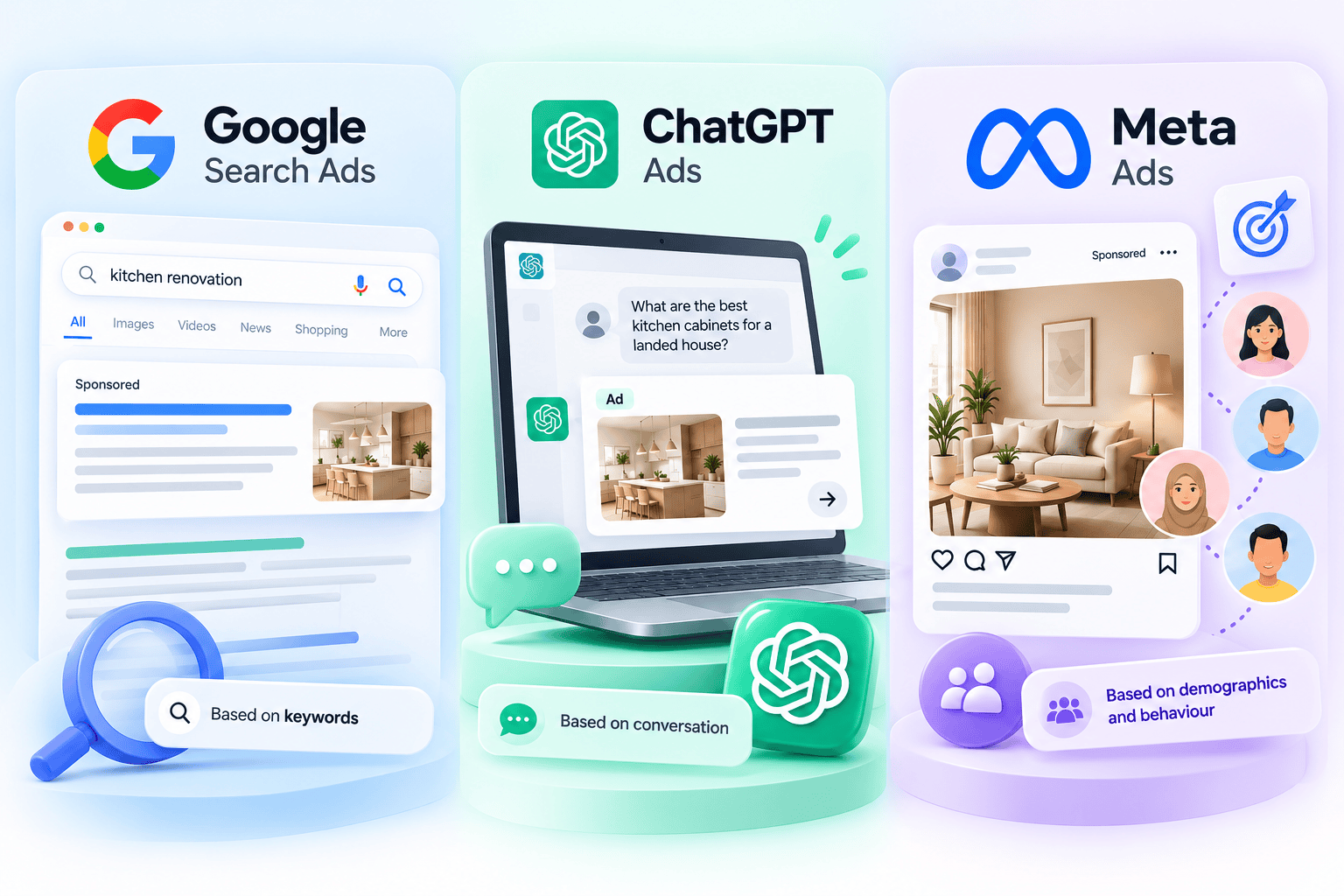
Early reporting on ChatGPT Ads suggested there were no audience targeting options at all. That has changed. It is now possible to target by location, platform (iOS, Android, and web), and to upload custom audiences using your first-party data. However, the platform still lacks the demographic segmentation that Meta Ads offers. There are no age groups, interest categories, or lookalike audiences built from pixel data.
Context Hints: How to Define Your Targeting
Context hints are plain-text descriptions added at the ad group level. They tell the platform what your product does, who it helps, and which situations make your ad relevant. The system reads them semantically, not as keyword matches, so your ad will not appear simply because a particular word was mentioned in the conversation.
The most common mistake is treating context hints as a tag cloud. Listing unconnected words like "invoices, software, finance" gives the algorithm no useful signal about when to show your ad.
Context Hints vs Search Keywords vs Custom Audiences
| Control | What It Does | What It Cannot Do |
|---|---|---|
| Context hints | Describe situations and buyer needs to guide the relevance algorithm | Guarantee delivery in conversations containing a specific phrase |
| Search keywords | Enter ads into eligible searches via keyword and match-type logic | Describe a full conversational need or buyer situation on their own |
| Custom audiences | Include, exclude, or apply bid adjustments for matched first-party users | Reveal anything about a user's ChatGPT conversations to advertisers |
Campaign-Level Targeting Controls
Context hints handle the content side of targeting. ChatGPT Ads also gives you a set of campaign-level controls that determine where and to whom your ads are eligible to appear.
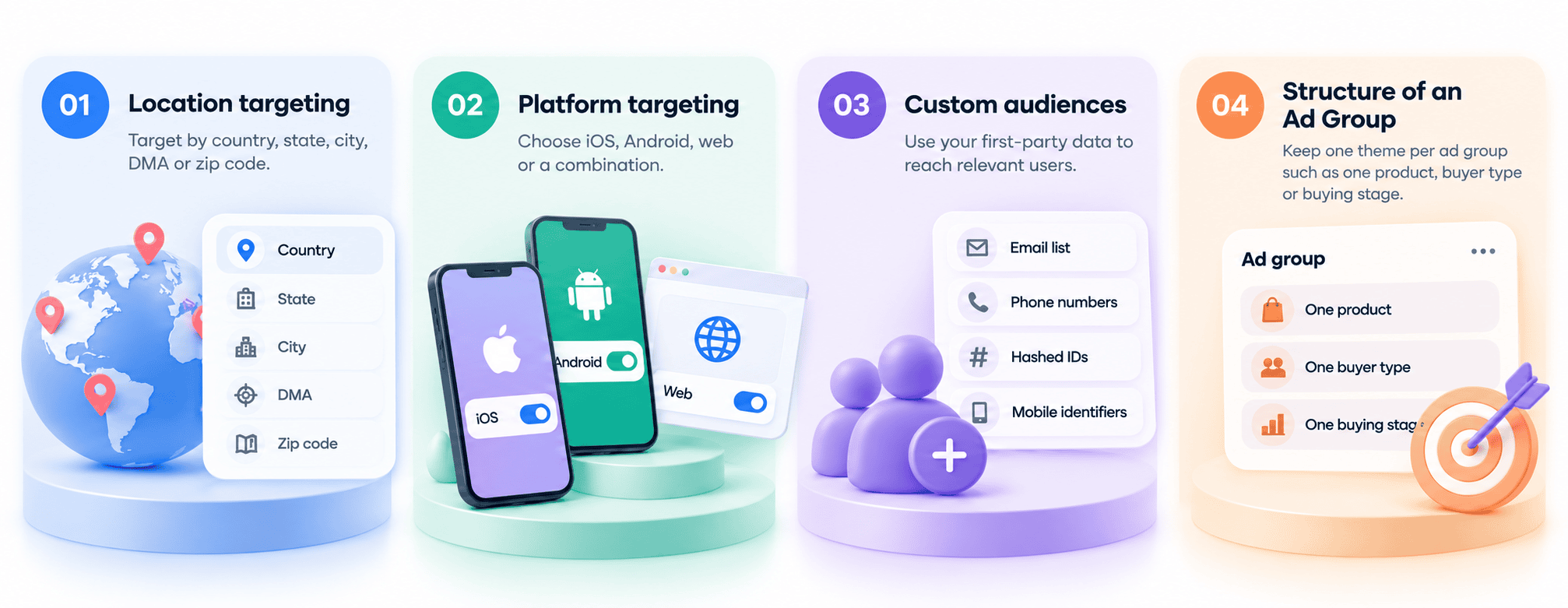
An app that helps manage projects for businesses in Malaysia can have two different ad groups: one targeted at freelancers facing client deadlines and working alone; the other one at small agencies struggling with client reporting and the capacity of the team. The context hints, creative and landing page would be unique for every ad group.
How the Auction Works
ChatGPT Ads runs on what OpenAI calls a Relevance Weighted Second Price Auction. Two principles govern every placement decision. First, your bid alone does not win the placement. The platform multiplies your bid by a relevance score it assigns to your ad based on how well your creative, landing page, and context hints match the live conversation. A competitor with a lower bid but a higher relevance score will beat you. Second, the winner pays only the minimum amount required to beat the next highest bid, not their full maximum bid. This keeps costs efficient for well-optimised campaigns.
What this means practically: relevance is a cost lever, not just a quality metric. If your context hints are vague and your landing page is generic, you will pay more per click than a competitor whose ad fits the conversation tightly, even if you bid higher. Conversely, a well-written context hint paired with a focused landing page can win placements at a lower cost than competitors who rely purely on bid price.
On budget, the platform currently does not publish a minimum spend requirement. Start with enough daily budget to generate meaningful data. A figure that allows at least 20 to 30 clicks per week per ad group gives you something to optimise against within a reasonable timeframe. If your budget is too low, the platform will not enter enough auctions to give you reliable performance signals and it will be difficult to know whether your targeting or your creative is the issue.
The Most Common Targeting Mistakes
Underperforming ChatGPT Ads campaigns tend to share the same structural issues. The problems below appear repeatedly when we review new accounts for the first time. If you are working with a performance marketing agency, these are the first things worth checking before scaling spend.
| Mistake | Why It Hurts Performance | How to Fix It |
|---|---|---|
| Keyword-only context hints | Without buyer context, the algorithm cannot match conversations accurately and wastes impressions on irrelevant audiences | Provide a clear understanding of the role of the buyer, their problem, and stage of decision-making |
| Mixed audiences in one ad group | It is difficult to understand what kind of customer and what situations make for success, turning optimisation into a guessing game | One theme per ad group. Segregate campaigns according to the product or customer or the stage of decision-making |
| Generic ad creative | Generic copies such as "change your business" have nothing to do with a particular situation and indicate low relevance of ads | Copy that directly addresses the situation described in the context hint |
| Homepage landing page | Homepage doesn't match the context of conversation and negatively impacts relevance | Have or build a landing page which addresses the specific situation of the buyer as it was explained in the context hint |
| Location and platform restrictions | Excessive restrictions reduce the pool of auctions you can compete in and may affect your spending | Target the maximum geographical locations and combinations of platforms possible for your business |
| Not excluding existing customers | Spends budget on users who have already converted and inflates your cost per lead figures | Upload a customer exclusion list through the custom audiences feature before your campaign goes live |
| No conversion tracking | Without conversion tracking you can only see clicks and have no way to know whether the targeting is reaching buyers who actually complete an action | Set up conversion tracking capturing a meaningful business action before launch |
Pre-Launch Targeting Checklist
Go through this list before putting any budget into a ChatGPT Ads campaign. Leaving gaps here makes it much harder to understand which parts of your campaign are working and which are not. For a broader checklist on paid social campaigns, see our agency services page.
- 1 One theme per ad group. Put each product, buyer type, and use case into its own ad group with no mixing.
- 2 Write context hints around the buyer's situation. Cover their role, their challenge, and the moment they are most likely to act. Leave product features for the ad copy.
- 3 Align your ad copy and landing page to the context hint. The platform scores relevance across all three elements together.
- 4 Only target locations and platforms you can actually serve. Do not select geographies you cannot fulfil or device types where your landing page does not perform.
- 5 Upload a customer exclusion list before going live. Even a small list stops budget being spent on people who have already converted.
- 6 Set up conversion tracking before launch. Track a real business action such as a form submission, a call, or a purchase. A page visit does not tell you enough.
- 7 Review lead quality one month after launch, not just click volumes. Click-through rate tells you something about reach. Quality of click-through rate tells you if you're reaching the right people.
Frequently Asked Questions
Get Started with ChatGPT Ads for Your Business
Marvant helps Malaysian businesses launch ChatGPT Ads campaigns — from writing context hints and building creative, to conversion setup and budget management. Reach out to our team or explore our performance marketing services to get started.