Google Ads and ChatGPT Ads are both paid placements; however, the person who stands behind them has a totally different mindset. Google search users express their intentions explicitly; they know what they want and try to find the best option. ChatGPT users ask about the subject, they think and seek the answer. The same ad creative, the same bidding strategy, and the same measurement approach are impossible here. In this guide, you will learn the differences and the occasions to use them.
The Main Difference: The Mindset of the User
To make a comparison of the features, it is necessary to figure out the main difference between them. Google Ads place the ad at the time when the user expresses the intention to do something; he or she entered the query and wants to purchase something from this category.
ChatGPT Ads pop up within the research conversation. The user does not have his or her intentions yet, he or she just asks and looks for the answer.
Google Ads tap into an existing demand. ChatGPT Ads shape a demand that is still being formed. One job does not hold greater importance than the other. Both play important roles in the same buyer journey at two different points.
Intent: Stated vs Inferred
Google Ads are based on stated intent. When someone types "best CRM for small business Malaysia," it is clear what product category they are researching, the criteria, and their circumstances within one query. Keyword match determines the eligibility for displaying ads, and bidding determines their placement. Intent can be easily read by the machine since it was explicitly stated.
ChatGPT Ads use inferred intent. Someone would ask "what should I consider when choosing a CRM when I have a team of five and mostly do inbound support?" There is no keyword for matching. OpenAI's sponsored content system analyses the entire conversation context to understand the user intent behind the questions and shows ads that seem relevant. Intent is deeper but less accurate.
Intent is explicit. The user wants a CRM. They have budget limitations and they are based in Malaysia. A keyword bid on this exact phrase or an alternative phrasing nails the moment.
Inferred Intent. Though the user has not talked about any CRM system, OpenAI has inferred that he wants to search for one. The ad shown to the user is sponsored by a CRM platform if the ad content is relevant to the context of the conversation.
Practical Implication: Keyword targeting and bidding are critical for Google Ads. Creativity and context relevancy are rewarded in ChatGPT Ads.
Keyword Targeting vs. Conversation Context Targeting
Google Ads targeting involves keywords. You choose your keywords, match type (broad, phrase, exact), bidding and negative keywords. In addition to this, there are options for audience and other targeting methods such as geo-targeting. Google's official keyword match type guide covers how each match type controls which searches trigger your ads.
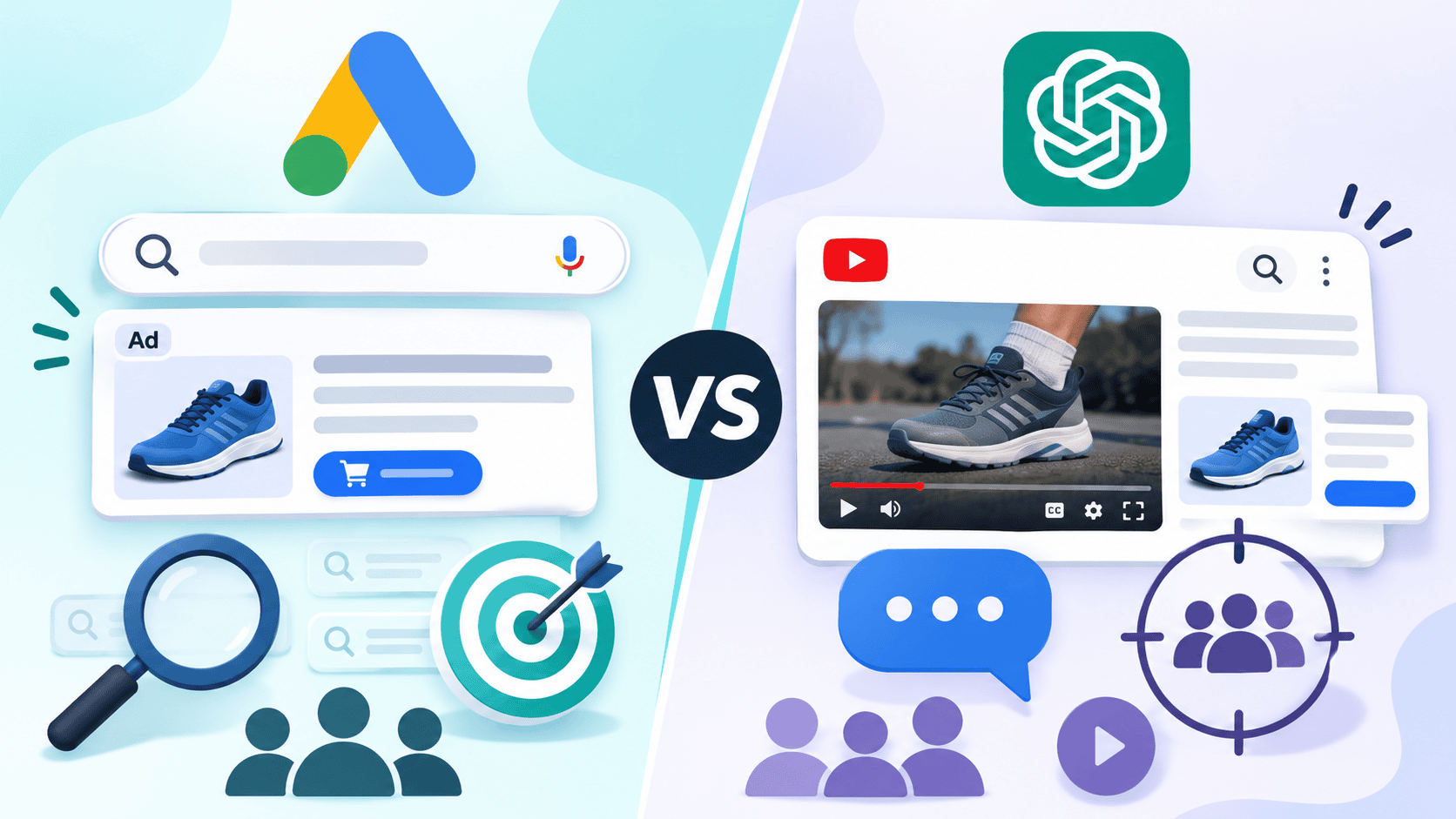
ChatGPT Ads are not keyword-based. OpenAI's targeting algorithm is topic-based and conversation contextual. Advertisers state their target audience or application case. Platform matches that definition to the content of the conversation.
In cases where established businesses have a sophisticated keyword strategy and a deep understanding of the search terms, the targeting offered in Google Ads is more sophisticated. In cases where the business wants to target a new category or people who do not understand what their problem is yet, ChatGPT Ads offers access to a conversation funnel that is out of reach for Google.
Stage of Funnel: Bottom vs. Middle
This is the easiest point where one can explain why you need to run ads on both platforms.
Google Ads is inherently a bottom-of-the-funnel solution. The individual searching "buy ergonomic office chair under RM 800 Kuala Lumpur" is very close to making up his mind. He has figured out the category, budget, and location. A well-crafted Google Shopping or Search ad will attract this particular customer at this exact time of highest purchasing intention and convert him accordingly.
ChatGPT Ads is fundamentally a middle-of-the-funnel solution. The person asking "what should I look for in an office chair if I sit for eight hours a day?" is not quite ready to buy. They are forming the basis of the evaluation of options. An ad that talks about lumbar support criteria, seat depth, and trial periods suits this research perfectly. An ad that opens with a discount code does not, because the user has not yet decided what they want.
A user who researches ergonomic chairs in ChatGPT today may search "buy ergonomic chair KL" on Google next week. ChatGPT Ads influence the criteria they use when they make that Google search. The two platforms are not competing for the same moment. They are serving consecutive moments in the same journey. This is the same principle behind multi-touch marketing, where different channels shape different stages of the buying decision.
Products with longer consideration cycles benefit most from this sequencing. High-ticket items, B2B solutions, service contracts, and complex consumer purchases all involve a research phase before the purchase phase. ChatGPT Ads reach users during the research phase. Google Ads close them during the purchase phase.
Creative Format: Scanning vs Reading
Google Ad creative works in the context of someone skimming rather than someone reading. There will be three headlines with 30 characters each, two descriptions with 90 characters each, and there will be a display URL. In this context, Google Ads must frontload keywords, include the benefit, and a call to action in the first two lines. All the urgency, price, and rating extensions also work in this context as the user is making comparisons between several options.
In the context of ChatGPT Ads creative, there will be more room in the creative space which needs to be filled with informative content and not a sales pitch. For example, an ad starting with "Transform your business with our award-winning solution" disrupts the pattern as it is quite different from the informative nature of a ChatGPT response. An ad starting with "HubSpot CRM is free for up to five users and includes email tracking, pipeline management, and Gmail integration. Setup takes under 10 minutes" fits naturally into the research conversation.
Urgency, superlatives, and a hard CTA. Perfect for a scanning mindset on Google Search. Disruptive inside a research conversation.
Specific, factual, useful. Fits a research conversation. The same information reformatted as a headline and two descriptions works on Google too.
Measurement: Mature vs Emerging
Google Ads measurement is the most developed in digital advertising. The conversion pixel, enhanced conversions, and Google Analytics 4 integration give advertisers direct attribution from click to purchase. You can see cost per lead, cost per acquisition, ROAS, and assisted conversion paths with reasonable accuracy. Smart bidding strategies use this conversion data to automatically adjust bids toward users who are more likely to convert.
OpenAI offers impression and engagement metrics, yet the path to attributing conversion downstream from engagement with a ChatGPT Ad is not as strong as with Google. Brands using ChatGPT Ads should monitor other metrics besides the simple last-click attribution.
Other metrics for measuring ChatGPT Ads
- ✓Branded Search Lift: When a person sees your ChatGPT Ad, they are very likely going to Google and typing your brand name. Branded search lift shows the upper funnel success.
- ✓Direct Traffic Lift: When a person remembers your ChatGPT Ad, they are going to return to your site directly. Track the increase in direct traffic during your campaigns against baseline.
- ✓Assisted conversions in GA4: If a person clicks on your ChatGPT Ad and then proceeds to converting after clicking your Google Ad, your ChatGPT Ad won't get any credit for the conversion, but it will appear in your multi-touch attribution report in GA4.
- ✓Days to conversion change: If ChatGPT Ads are accelerating the research process for first-time visitors, days to conversion will reduce during active campaigns.
- ✓Quality of landing page engagement: People coming to your website via ChatGPT Ads will most likely engage with the landing page longer and have a lower bounce rate compared to cold traffic.
When to Use Each Platform
The key is what user moment the platform fulfils, and whether your business has a need for reaching users in that user moment.
Use Google Ads where there is existing demand and you want to capitalise on it. When there are already users searching for your product category, there is no faster way to turn intention into leads than Google Ads. High search volume categories, commodities, and local services belong here. If you are not running Google Ads for your product category keywords, you are leaving active demand unattended.
Use ChatGPT Ads when the product requires research before the customer knows what to search for. Complex products, high price points, B2B solutions, and new categories belong here. These are buyers who do not yet have the words to search on Google. ChatGPT Ads reach them while they are still forming what they want.
Run both platforms where your sales cycle involves a research phase followed by a decision-making phase. This applies to most considered purchases. Run ChatGPT Ads to connect with customers while they are forming their preferences and building a shortlist, then run Google Ads to close them when they are ready to decide.
Platform Comparison at a Glance
Frequently Asked Questions
Ads on Both Platforms? We Will Create the Strategy for You.
Marvant provides Google Ads and AI ad platform management for performance-driven brands across Malaysia and beyond. When you are ready to launch a full-funnel paid marketing campaign covering both existing and potential demand, we can assist.