You can buy leads all day and still miss revenue. The usual pattern is familiar: the CRM fills up, sales complains, and your cost per lead looks “fine” while close rates drop.
Lead quality is not a vague “sales problem.” It’s often created (or destroyed) inside your ads, your landing page, your form, and your follow-up timing. A performance marketing agency that cares about outcomes treats lead quality as an optimisation job, not a hope-and-pray side effect.
This article explains the practical steps agencies use to improve lead quality while keeping volume healthy, using the same paid channels most teams run: Google Ads, Meta Ads, and TikTok Ads.
- Improve lead quality by aligning ads, landing pages, and forms to the same buyer intent
- Use tracking that ties leads to pipeline and revenue, not just cost per lead
- Filter bad-fit demand early without killing conversion rate
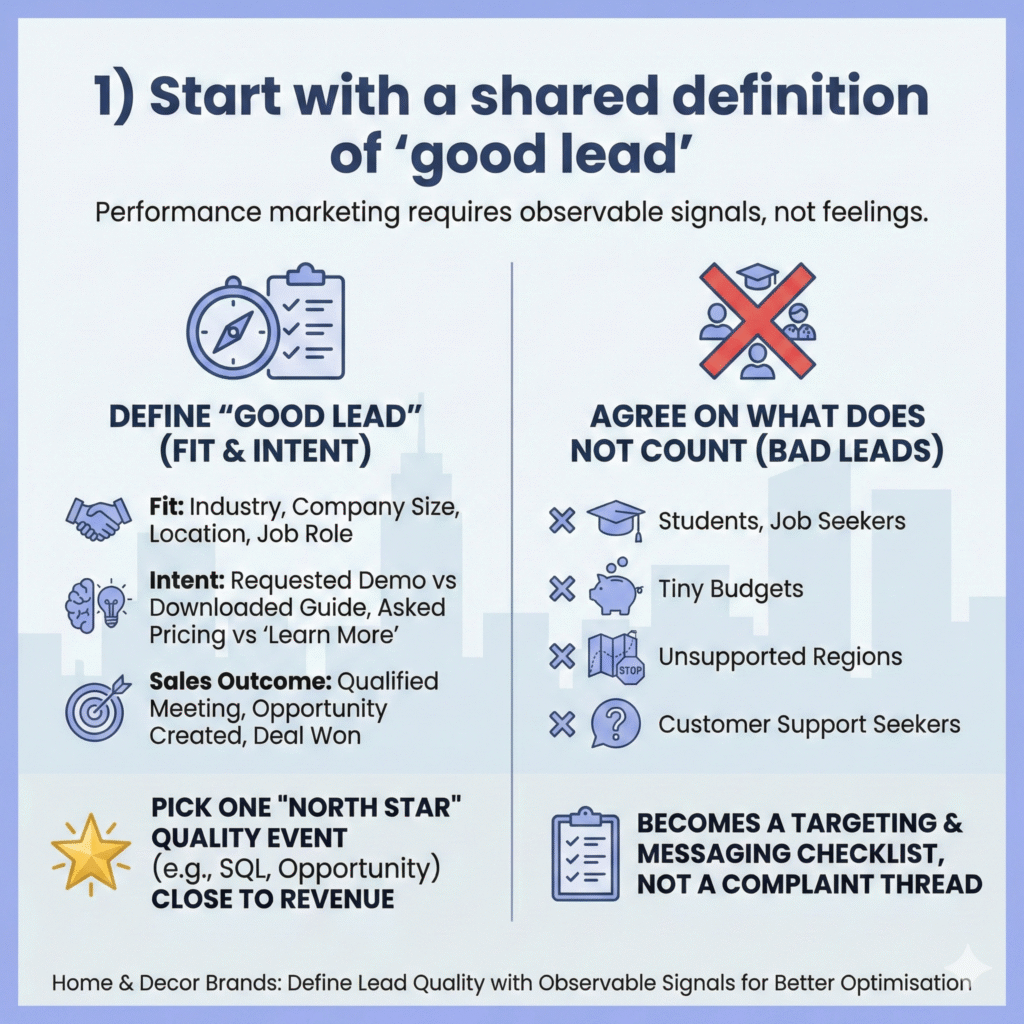
1) Start with a shared definition of “good lead”
A performance marketing agency can’t optimise lead quality if “quality” is a feeling. The first step is to define it in a way marketing and sales both accept, using observable signals.
Turn lead quality into a simple scoring rule
Keep it practical. Most teams start with a lightweight scoring model based on what you already have in your CRM.
Example scoring inputs that actually help optimisation:
- Fit: industry, company size, location, job role
- Intent: requested demo vs downloaded guide, asked pricing vs “learn more”
- Sales outcome: qualified meeting booked, opportunity created, deal won
The key is to pick one “north star” quality event that is close to revenue, like Sales Qualified Lead (SQL) or opportunity created. If you can only track one thing, track that.
Agree on what does not count
Agencies that improve lead quality also document the “bad lead” patterns sales keeps seeing. For example: students, job seekers, tiny budgets, unsupported regions, or people looking for customer support.
This becomes a targeting and messaging checklist, not a complaint thread.
2) Fix intent mismatch between ads and the offer
Most low-quality leads come from intent mismatch: the ad promises one thing, the landing page implies another, and the form captures anyone who is mildly curious.
Match channel intent to the right ask
Google Search usually captures high intent because people type what they want. Meta and TikTok often create demand from people who weren’t actively shopping.
A performance marketing agency uses different “asks” by channel:
- Google Search: demo, pricing request, consultation (higher friction is okay)
- Meta Ads: case study, webinar, calculator, then retarget to demo
- TikTok Ads: simple hook + proof, then qualify harder on the landing page
This is not about making the funnel longer for fun. It’s about letting low-intent traffic warm up before sales gets involved.
Write ads that repel bad-fit leads
Good lead quality often improves when you add “negative qualifiers” into ad copy. It feels risky, but it saves budget and sales time.
Examples:
- “For teams with 10+ sales reps”
- “Minimum monthly spend: $5k+”
- “Built for US & UK companies”
If your close rate increases, you can usually afford a higher cost per lead.
3) Use forms and landing pages to qualify without killing conversions
Many teams think qualification means adding 10 form fields. That often backfires. Better agencies qualify with a few high-signal questions and clear expectations.
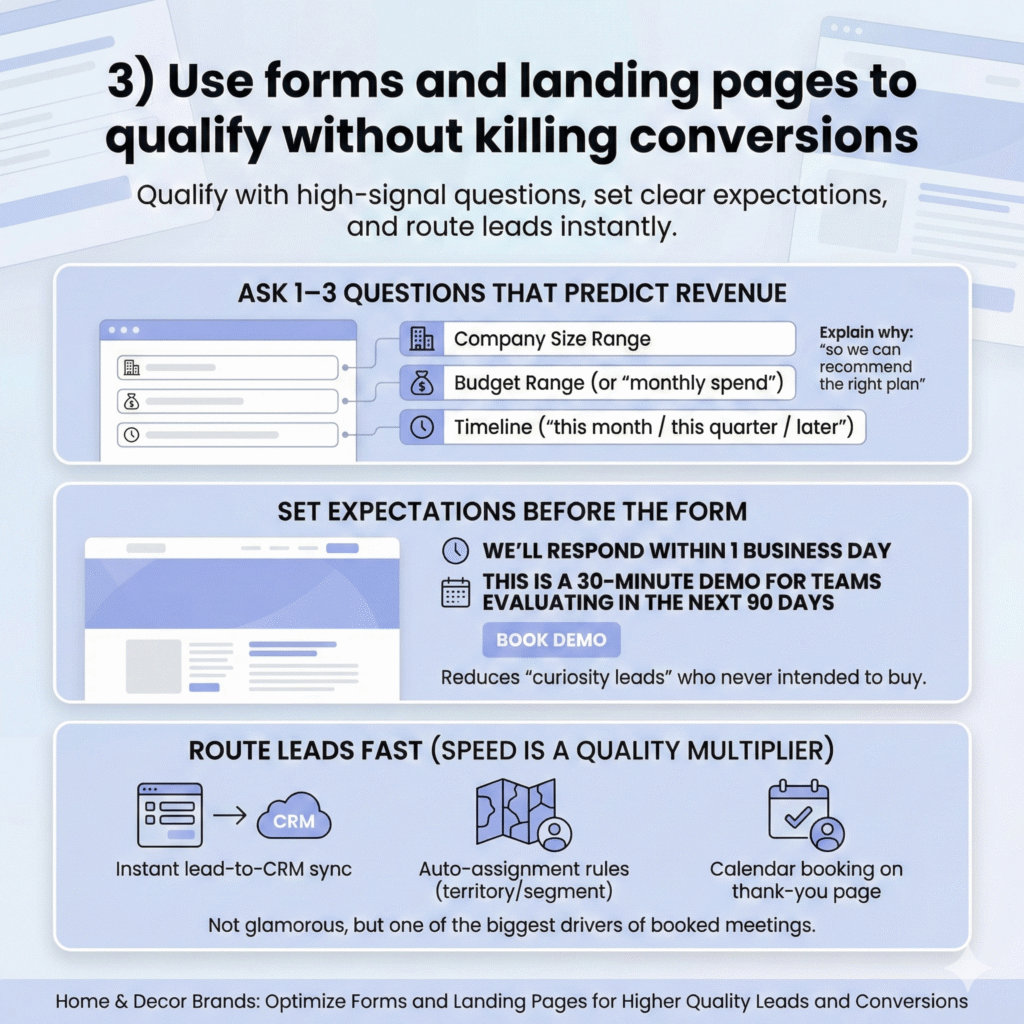
Ask 1–3 questions that predict revenue
Pick fields that sales actually uses to disqualify or route leads. Common high-signal fields:
- Company size range
- Budget range (or “monthly spend”)
- Timeline (“this month / this quarter / later”)
Then make the form feel fair: if you ask for budget, explain why (“so we can recommend the right plan”).
Set expectations before the form
Lead quality improves when the landing page clearly states what happens next. For example, “We’ll respond within 1 business day” and “This is a 30-minute demo for teams evaluating in the next 90 days.”
This reduces “curiosity leads” who never intended to buy.
Route leads fast (speed is a quality multiplier)
Even a great lead becomes a bad lead if follow-up takes two days. Agencies often push for operational fixes like:
- Instant lead-to-CRM sync
- Auto-assignment rules by territory or segment
- Calendar booking on the thank-you page for high-intent forms
This is not glamorous work, but it’s one of the biggest drivers of booked meetings.
4) Optimise campaigns using quality signals, not just CPL
Cost per lead (CPL) is easy to measure and easy to game. A performance marketing agency that optimises lead quality changes what “success” means inside ad platforms.
Import offline conversions back into ad platforms
An offline conversion is a later-stage outcome that happens outside the ad platform, like an SQL, an opportunity, or a closed-won deal. When you send those outcomes back to Google Ads or Meta, the algorithm can optimise toward the leads that turn into revenue.
In practice, this often requires clean CRM stages and consistent timestamps. If your CRM is messy, the agency may start with a simpler proxy like “meeting booked.”
Use retargeting to separate browsers from buyers
Retargeting means showing ads to people who already visited your site or engaged with your content. Agencies use it to push higher-intent actions only to warmer audiences, which protects lead quality.
Example: cold audiences get a case study; retargeted users see “Book a demo” with stronger qualification.
5) Apply strict hygiene: keywords, placements, and exclusions
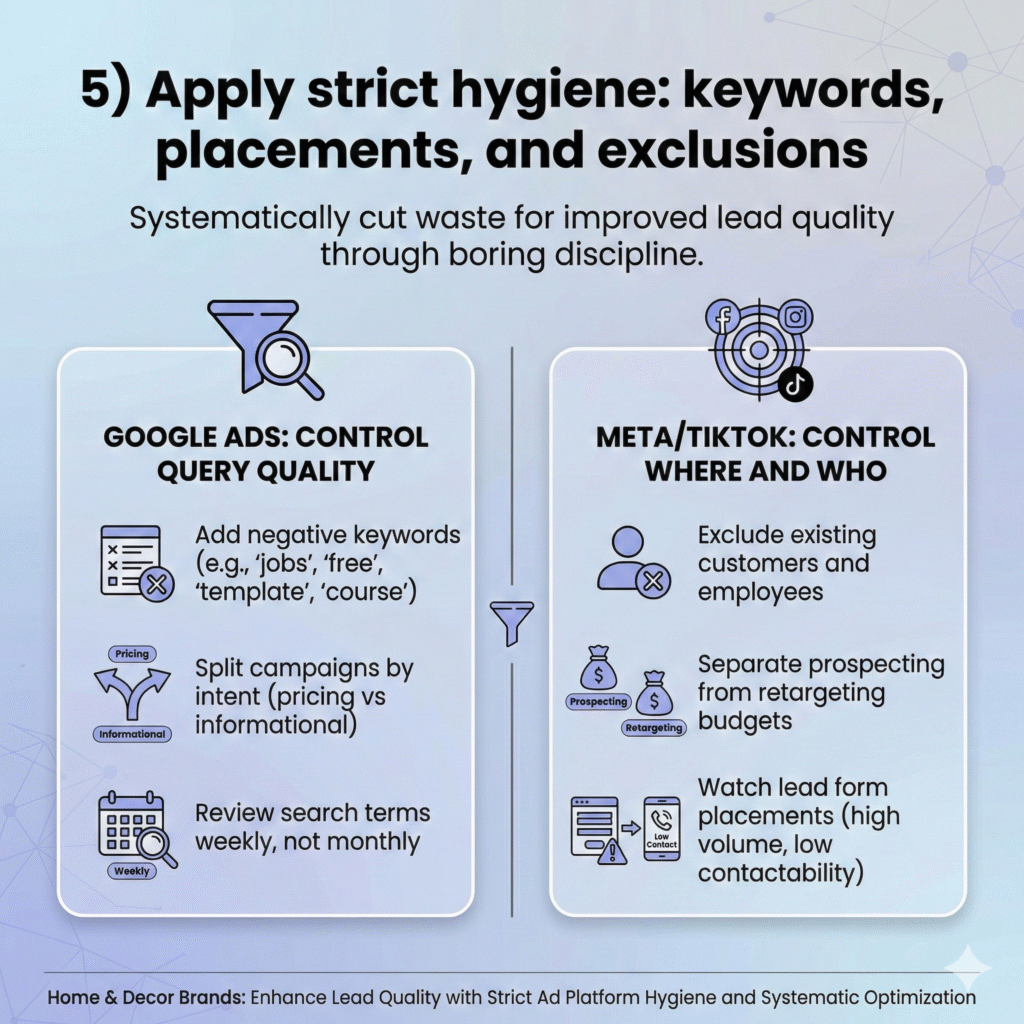
Lead quality often improves with boring discipline. The agency’s job is to cut the waste systematically.
Google Ads: control query quality
Search campaigns can leak into irrelevant queries. Agencies improve lead quality by:
- Adding negative keywords (e.g., “jobs,” “free,” “template,” “course”)
- Splitting campaigns by intent (pricing vs informational)
- Reviewing search terms weekly, not monthly
Meta/TikTok: control where and who
On social platforms, poor-quality leads can come from low-intent placements or overly broad targeting. A performance marketing agency tests exclusions and guardrails, such as:
- Excluding existing customers and employees
- Separating prospecting from retargeting budgets
- Watching lead form placements that produce high volume but low contactability
Lead quality levers and what they change
| Lever | What you change | Expected impact on lead quality | Common trade-off |
|---|---|---|---|
| Ad qualifiers | Minimum budget, segment, region in copy | Fewer bad-fit leads reaching the form | Higher CPL, lower volume |
| Form questions | 1–3 high-signal fields | Better routing and faster disqualification | Lower conversion rate if too strict |
| Offer by channel | Demo vs content-first flow | Better intent matching | Longer time to revenue on social |
| Offline conversion tracking | Send SQL/opportunity back to platforms | Algorithms optimise for revenue outcomes | Requires clean CRM and setup time |
| Negatives/exclusions | Keywords, placements, audiences | Less wasted spend, cleaner lead mix | Can limit learning if too aggressive |
Conclusion: prioritise quality signals that tie to revenue
If you want better lead quality, stop treating it as a mystery and start treating it as an optimisation loop. A performance marketing agency improves lead quality by defining what “good” means, aligning intent across ads and landing pages, qualifying early in a fair way, and optimising toward downstream outcomes like meetings and opportunities.
Your next steps are simple: pick one quality event you trust (SQL or opportunity), make sure it’s recorded consistently, and run two-week tests that change one lever at a time (ad qualifiers, form fields, or channel-specific offers). Expect some CPL increase. If pipeline quality rises, it’s usually a win.
Frequently Asked Questions
Often, yes at first. When you add qualifiers or tighten targeting, you usually get fewer leads but a higher percentage that book meetings and progress to pipeline. The goal is more revenue per dollar, not the biggest lead count.
Start with the closest reliable metric to revenue, like SQL rate, meeting booked rate, opportunity creation rate, and eventually cost per opportunity or cost per acquisition. CPL alone is not a lead quality metric.
You can often see early signs within 2–4 weeks if tracking is in place, especially from changes to ad messaging, negatives, and forms. Bigger improvements from offline conversion optimisation can take longer because platforms need enough conversion data.
They use the best available proxy, like “meeting booked” or “contacted within 24 hours,” while cleaning up CRM stages and attribution in parallel. The key is consistency so decisions aren’t based on random or missing data.
No. If your close rate and average deal size improve, a higher CPL can be the correct outcome. What matters is cost per qualified meeting, cost per opportunity, and ultimately the payback period on ad spend.