


Hiring a performance marketing agency can unlock growth fast, but it can also lock you into spend without learning what’s actually working. The difference usually comes down to the questions you ask before you sign.
Performance marketing means paying for measurable actions (like leads, trials, purchases), not vague “awareness.” So your agency choice should be judged on how they plan, track, and improve results over time.
Below is a practical set of questions founders and growth leads can use to spot a good partner, avoid common traps, and set clear expectations from day one.
- Get clarity on how the agency will measure revenue impact (not just clicks and leads)
- Confirm who does the work, how often you’ll learn, and what decisions they’ll own
- Make tracking and creative testing non-negotiable before you scale spend
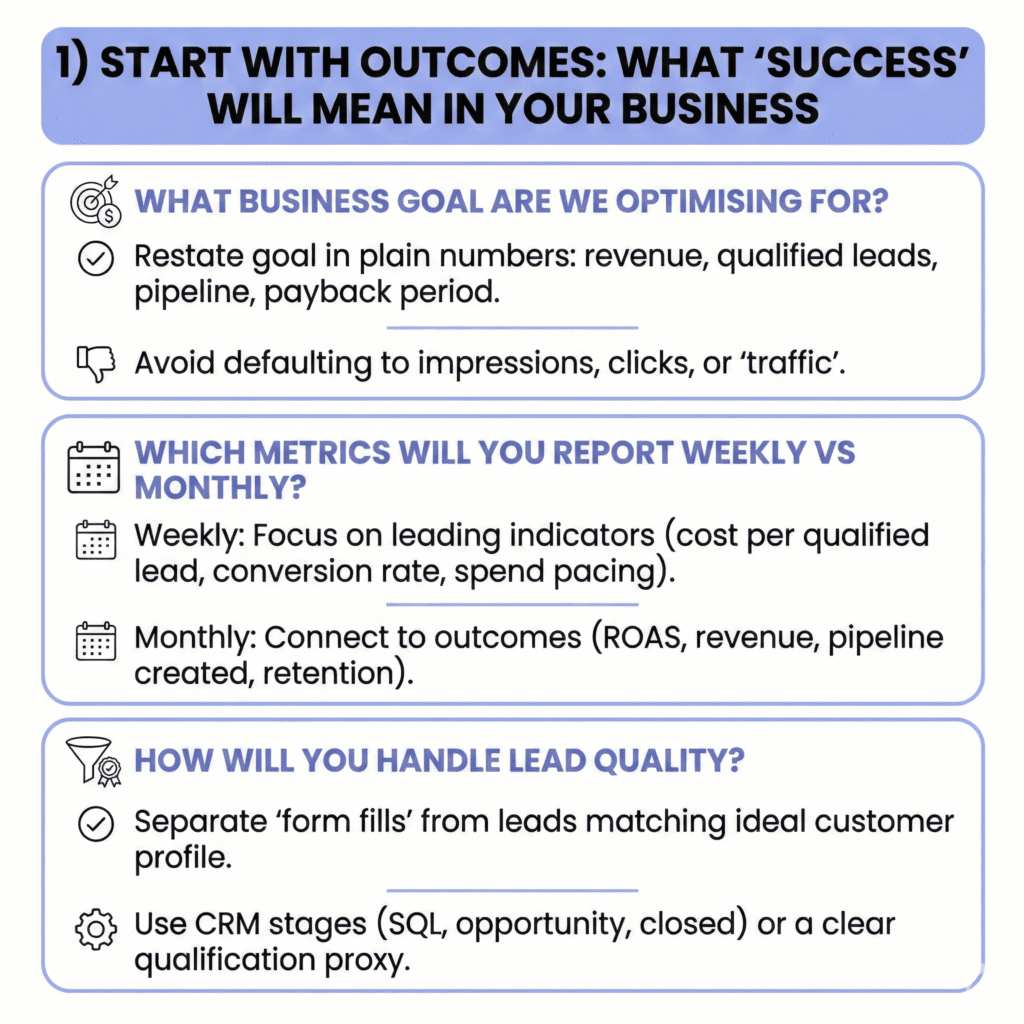
1) Start with outcomes: what “success” will mean in your business
What business goal are we optimising for?
Ask them to restate your goal in plain numbers: revenue, qualified leads, pipeline, first purchases, subscriptions, or payback period. If they default to impressions, clicks, or “traffic,” push back. Those can matter, but they’re not the goal.
Which metrics will you report weekly vs monthly?
Weekly reporting should focus on leading indicators you can act on (cost per qualified lead, conversion rate, spend pacing). Monthly reporting should connect to outcomes (ROAS, revenue, pipeline created, retention signals if relevant).
How will you handle lead quality?
Lead quality is where many programs fail. Ask how they’ll separate “form fills” from leads that match your ideal customer profile. A good answer includes using CRM stages (SQL, opportunity, closed) or at least a clear qualification proxy.
2) Make tracking and attribution a first-class requirement
What tracking will you audit in the first two weeks?
Tracking is the foundation. You want specifics: pixel/conversion API setup, Google Ads conversion actions, GA4 events, UTMs, and CRM integration. If they can’t explain their audit checklist, expect messy reporting later.
How do you deal with attribution gaps?
Attribution means deciding which channel gets credit for a sale or lead. No model is perfect, especially with iOS privacy and cross-device journeys. A credible agency will talk about triangulating: platform data plus analytics plus CRM outcomes, and being honest about uncertainty.
What will you do if platform-reported ROAS looks great but revenue doesn’t move?
This happens when campaigns optimise for low-quality conversions or when tracking is inflating results. Look for an answer that includes checking match quality, deduplication, offline conversion imports, and validating against actual revenue or pipeline.
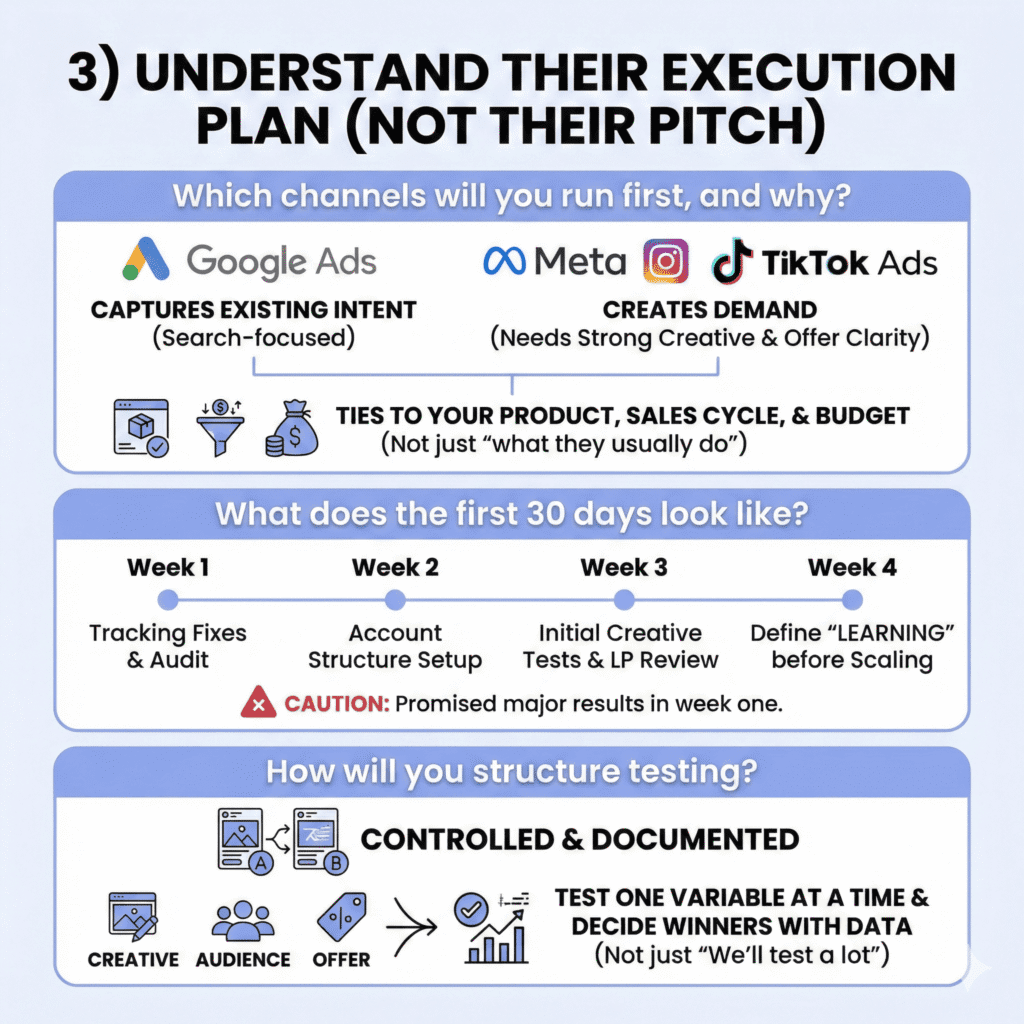
3) Understand their execution plan (not their pitch)
Which channels will you run first, and why?
Meta Ads, Google Ads, and TikTok Ads each behave differently. Google often captures existing intent; Meta and TikTok can create demand but need strong creative and offer clarity. A strong plan ties channel choice to your product, sales cycle, and budget, not to what they “usually do.”
What does the first 30 days look like?
You want a week-by-week outline: tracking fixes, account structure, initial creative tests, landing page review, and a clear definition of “learning” before scaling. If they promise major results in week one, be cautious.
How will you structure testing?
Testing should be controlled and documented. Ask how many variables they test at once (creative, audience, offer, landing page) and how they decide winners. “We’ll test a lot” is not a method.
4) Get specific about creative and landing pages
Who owns creative production, and what’s the monthly output?
Paid performance is often limited by creative volume and speed. Ask who writes briefs, who designs, who edits video, and how many new ads you’ll get per month. If they rely on you for everything, results will slow down.
How will you turn customer insights into ads?
Good creative comes from real objections and motivations. Ask whether they’ll review sales calls, support tickets, reviews, and competitor ads. If they only talk about “hooks” without a source of truth, expect shallow messaging.
Will you review landing pages and forms?
Even great ads can’t save a confusing page. Ask what they typically change first: page speed, headline clarity, proof (testimonials), form friction, and mobile layout. They don’t need to build pages, but they should be able to diagnose conversion blockers.
5) Clarify team, communication, and accountability
Who will actually manage our account day to day?
Ask to meet the person who will run the ads, not just the salesperson. Confirm their experience with your business model (ecommerce vs lead gen vs SaaS) and your average order value or deal size range.
How often will we talk, and what will be decided on calls?
Weekly calls should drive decisions: what to pause, what to scale, what to build next. If calls are just reporting, you’ll lose momentum.
What do you need from us to succeed?
This is a trust test. A solid performance marketing agency will ask for access to analytics, CRM feedback, creative approvals, and product context. If they claim they can do everything with no input, that’s rarely true.
6) Pricing, contracts, and incentives (where misalignment hides)
How is your fee structured, and what does it include?
Common models are a flat retainer, a percentage of ad spend, or a hybrid. Ask what’s included: creative, landing page work, tracking, reporting, and strategy. Many disappointments come from assumptions about “included” work.
Do you have performance-based pricing?
Performance pricing can sound attractive, but it can also push an agency to optimise for easy wins (cheap leads) instead of profitable ones. If they offer it, ask exactly which metric triggers bonuses and how lead quality is verified.
What is the exit plan if it’s not working?
Ask about contract length, notice period, and asset ownership. You should own your ad accounts, pixels, audiences, and creative files. If you can’t leave cleanly, you’re taking on risk.
Hiring scorecard: quick way to compare agencies
| Area | Question to ask | What a strong answer sounds like | Red flag |
|---|---|---|---|
| Goals | What does success look like in 90 days? | Clear targets tied to revenue or qualified pipeline | Only talks about traffic or “brand lift” |
| Tracking | What will you audit first? | Specific events, CRM linkage, deduplication plan | “We’ll set up pixels” with no detail |
| Testing | How do you run experiments? | Controlled tests, documented learnings, thresholds | Random changes and vague “optimisation” |
| Creative | How many new ads per month? | Defined output, process, and responsibilities | Creative is “as needed” or entirely on you |
| Reporting | What will we review weekly? | Actions, decisions, and next tests | Dashboards with no recommendations |
| Ownership | Who owns accounts and assets? | You own everything; access remains with you | Agency-owned ad accounts |

Conclusion: hire for learning speed, not promises
The right performance marketing agency doesn’t just “run ads.” They build a repeatable loop: track correctly, test quickly, improve conversion points, and tie spend to real business outcomes.
Your next step is simple: pick 8–10 questions from this list, ask them in one call, and score the answers against your business reality. If they can’t be specific before they have your budget, they won’t be specific after.
Prioritise clean measurement, clear ownership, and a realistic 30–90 day plan. That’s how you protect ROI while still moving fast.
Frequently Asked Questions
Ask for examples where they’ve driven outcomes in a similar funnel: ecommerce purchase, SaaS trial to paid, or lead gen to closed-won. The fit is strongest when they can explain what mattered (offer, creative, sales follow-up, tracking) and what they would do differently for you.
You should be ready to share access to ad accounts, analytics, and any CRM or lead tracking you use, plus your best-performing offers and customer insights. Without this, they’ll guess, and guessing gets expensive in paid media.
Be careful with guarantees because results depend on pricing, product-market fit, creative, landing pages, and sales follow-up. A better standard is a clear plan, transparent reporting, and agreed decision rules for scaling or cutting spend.
Expect early progress on tracking, creative testing, and conversion rate improvements in the first 30 days. For stable performance trends, many accounts need 6–12 weeks, especially if you’re changing creative, landing pages, or audience strategy.
They should work in your ad accounts so you retain ownership and history. If they insist on running everything through an agency-owned account, you risk losing data and control if the relationship ends.
