

Hiring a performance marketing agency should make revenue more predictable. But it’s also one of the easiest ways to waste budget fast, especially when reporting looks “good” while cash results don’t move.
The problem is that many agencies can run ads. Fewer can connect ads to real business outcomes like qualified leads, conversion rate, and payback period. The red flags usually show up in the sales process, not three months later.
Below are the warning signs I’d treat as deal-breakers (or at least “pause and verify”) before you sign a contract.
- Good-looking dashboards can hide bad lead quality and weak conversion behaviour
- Clear measurement and ownership matter more than channel expertise
- The best agencies set realistic expectations and protect your budget with testing discipline
What “performance marketing agency” should mean (so you can judge claims)
A performance marketing agency is supposed to be accountable to measurable outcomes, not just activity. In practice, that usually means paid media like Google Ads, Meta Ads, and TikTok Ads, tied to tracking and a conversion funnel.
A funnel is simply the steps from click to revenue: ad → landing page → lead or purchase → follow-up → closed deal. If an agency can’t explain where performance is gained or lost across those steps, they’re managing spend, not performance.
Before you look for red flags, be clear on your “north star” metric. For ecommerce it might be contribution margin ROAS (return on ad spend). For B2B it might be cost per qualified lead and pipeline created, not just cost per lead.
Red flags in the sales process (the easiest time to catch them)
1) They promise results without learning your unit economics
If they guarantee a specific ROAS or CPA (cost per acquisition) before asking about margins, average order value, sales cycle, or close rate, that’s a warning sign. It means the promise is based on what they want to sell, not what your business can support.
Real example: a B2B company can “hit” a cheap cost per lead by targeting broad audiences and pushing low-friction forms. Sales then spends weeks on unqualified calls. The ad account looks efficient, but revenue per lead collapses.
2) They avoid talking about what happens after the click
An agency that only talks about ads is ignoring half the system. Landing pages, offer clarity, speed, and follow-up process often decide whether spend turns into revenue.
You don’t need them to rebuild your website. But you do need them to say, plainly: “If conversion rate is low, we’ll diagnose page friction, message mismatch, and lead handling.”
3) They lead with platform badges and “secret tactics”
Bad actors hide behind credentials because it’s hard to audit. There are no secret settings that fix a weak offer or poor tracking.
A credible performance marketing agency explains trade-offs. For example: scaling Meta Ads often increases CPA because you’re moving beyond the cheapest pockets of demand. If they sell only upside, you’ll pay for the learning curve.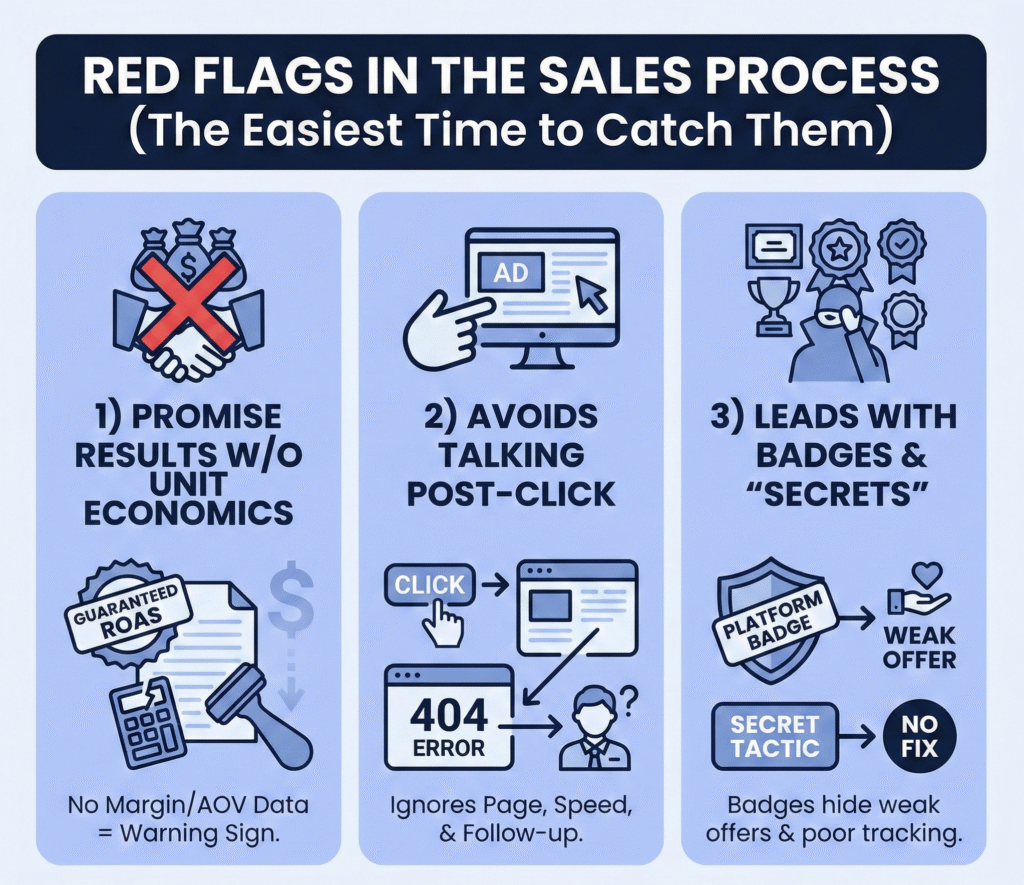
Red flags in measurement and reporting (where most budget gets lost)
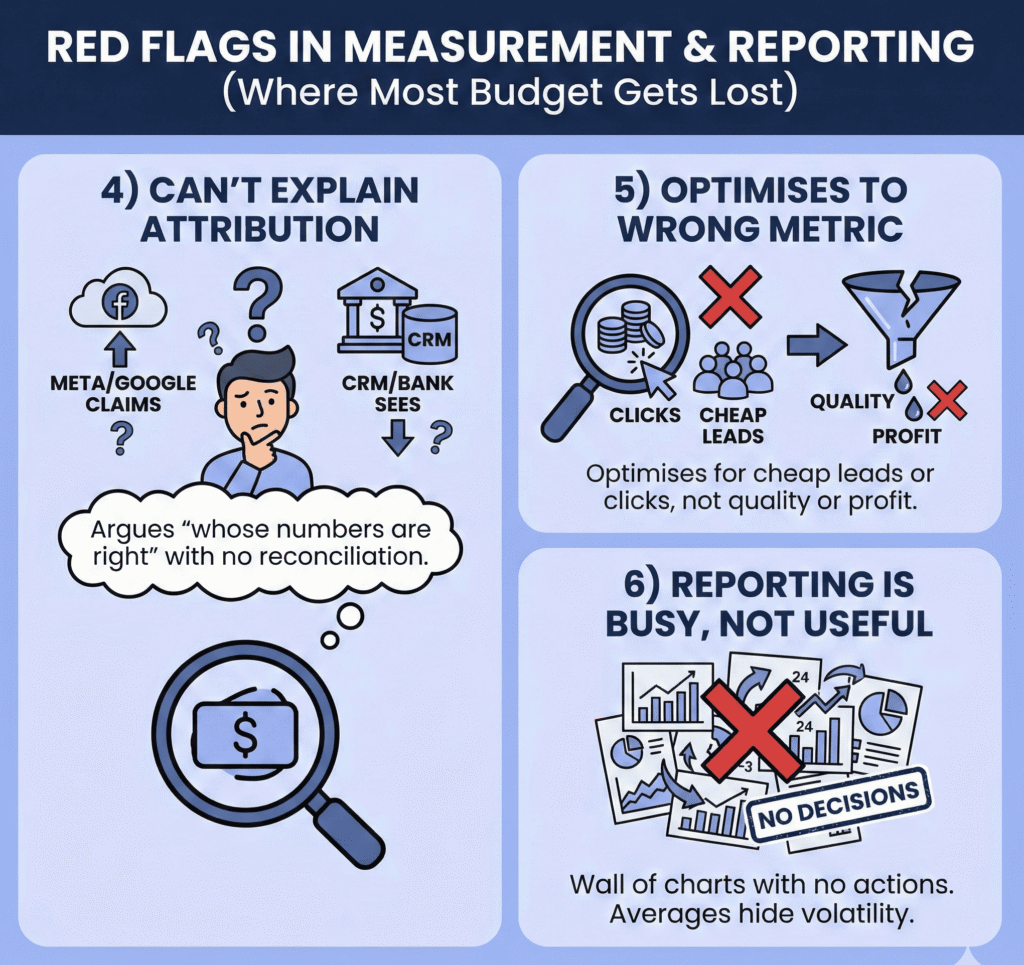
4) They can’t clearly explain attribution
Attribution is how you decide which marketing touchpoint gets credit for a conversion. If they can’t explain the difference between platform-reported conversions (what Meta/Google claims) and what your business sees in the CRM or payment processor, you’ll end up arguing about “whose numbers are right.”
Ask what they use as source of truth for revenue and what they do when numbers don’t match. The answer should include a practical reconciliation approach, not “the pixel is fine.”
5) They optimise to the wrong metric
Common trap: optimising to clicks, impressions, or even cost per lead when lead quality is the real constraint. Cheap leads are not a win if they don’t convert downstream.
For B2B, ask how they define a qualified lead and how quickly they can see quality signals (show rate, sales acceptance, pipeline). For ecommerce, ask if they track profit-adjusted ROAS and refunds, not just revenue.
6) Reporting is busy, not useful
If weekly reports are a wall of charts with no decisions attached, you’re paying for theatre. Good reporting answers three questions: what changed, why it changed, and what we’ll do next.
Also watch for “averages” that hide volatility. A month can look fine while two weeks were unprofitable and one promo week carried the whole result.
Red flags in account ownership and incentives
7) You don’t own the ad accounts and data
If the agency insists on running ads from their accounts, you’re taking a big risk. You can lose history, audiences, and learnings when you leave. You also lose transparency into spend and settings.
You should own the ad accounts, pixels, and analytics access. The agency should be a partner with permissions, not the owner.
8) Their fee model rewards spend, not outcomes
A pure percentage-of-spend fee can create a quiet conflict: higher spend means higher fees, even if marginal returns are falling. That doesn’t mean % of spend is always wrong, but you need safeguards.
Ask how they decide when not to scale. A serious team will talk about diminishing returns and budget caps tied to payback or marginal ROAS.
9) High turnover or “junior-only” delivery
If the strategist sells and disappears, you’ll feel it in week two. Performance marketing is iterative. It needs context and consistent decision-making.
Ask who will actually touch your Google Ads and Meta Ads accounts each week, how many accounts they manage, and what happens when someone is on leave.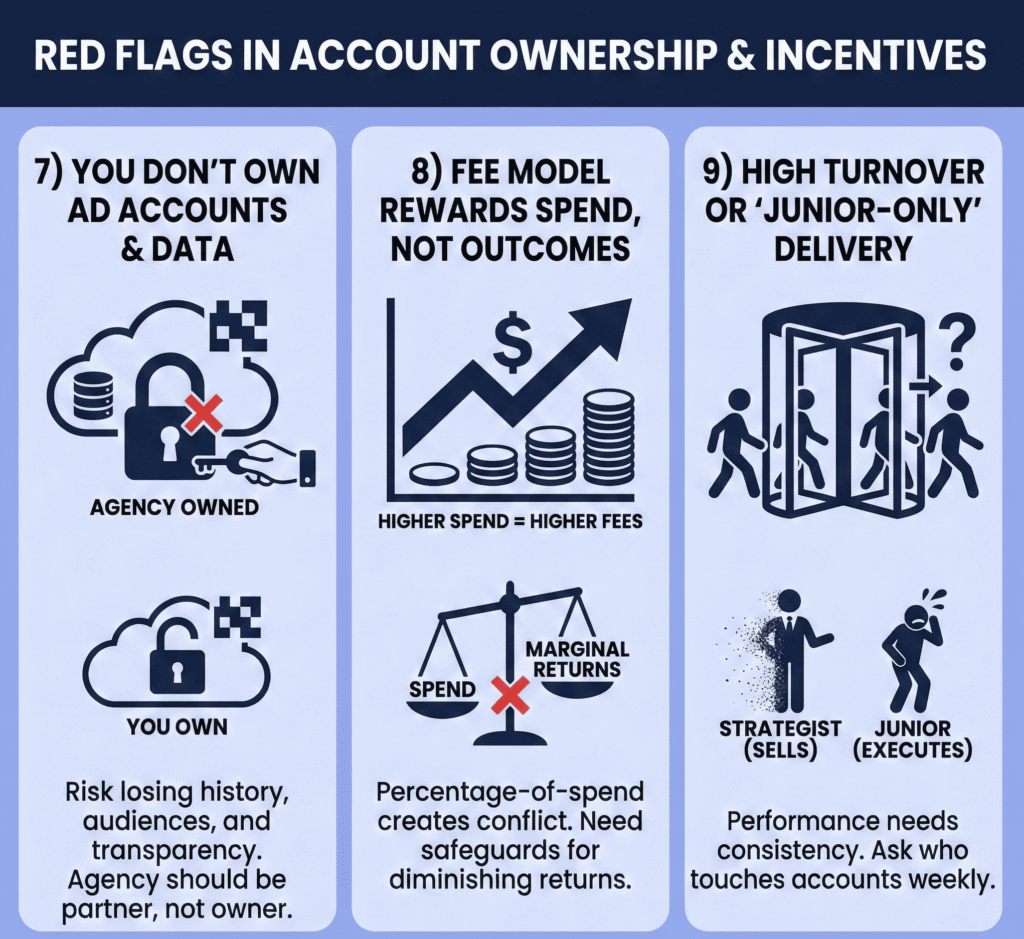
A practical checklist: red flag vs what “good” looks like
| Area | Red flag | What good looks like |
|---|---|---|
| Goals | They optimise to platform metrics only | They align to revenue, lead quality, and funnel conversion |
| Measurement | Vague answers about tracking and attribution | Clear source of truth, reconciliation plan, and event setup |
| Strategy | One-size-fits-all playbook | Testing plan tied to hypotheses and constraints |
| Creative | They “need more creatives” but can’t say why | They map creative to objections, angles, and funnel stage |
| Ownership | Agency owns accounts and pixels | You own everything; agency gets access |
| Reporting | Pretty dashboards, no decisions | Insights, actions, and expected impact |
| Team | Unclear who executes | Named owners, workload transparency, continuity plan |
How to pressure-test an agency before you sign
Ask for a “first 30 days” plan with constraints
You’re looking for practical sequencing, not a 50-slide strategy deck. A good plan includes: what they’ll audit, what they’ll change first, what they won’t touch yet, and what success looks like in early signals (not just final ROAS).
Ask for examples of times they reduced spend
This is an underrated question. Anyone can spend money. Ask for a scenario where they pulled back budget because lead quality dropped, tracking broke, or marginal returns fell. Their answer reveals whether they protect ROI or protect their ego.
Ask how they handle tracking failures
Tracking breaks. Pixels misfire. UTM tags (the labels on links that tell analytics where traffic came from) get removed. A dependable performance marketing agency has a process: monitoring, alerts, and a fallback view using blended metrics like total revenue vs spend.
Conclusion: hire for accountability, not optimism
The biggest red flags are rarely about a specific channel. They’re about unclear ownership, weak measurement, and incentives that reward spend over outcomes.
Before you hire a performance marketing agency, prioritise three things: you own the accounts and data, reporting ties to revenue and lead quality, and the team can explain trade-offs across the funnel.
If you do that, you’ll avoid the most expensive mistake in paid media: scaling numbers that look good in a dashboard but don’t show up in the bank.
Frequently Asked Questions
Ask who owns the ad accounts, what the source of truth is for revenue, how they define success for your business model, and what their first 30 days will change and measure.
It’s a red flag if they guarantee outcomes before understanding margins, conversion rates, and sales process constraints. Performance can improve, but exact numbers depend on your economics and funnel.
Your business should own the ad accounts, pixels, and analytics properties. The agency should work with access so you keep history, audiences, and transparency if you ever switch partners.
Focusing on platform-reported conversions or low cost per lead while ignoring lead quality and downstream conversion. That can make results look strong even when revenue per lead is falling.
If cost per lead looks good but sales acceptance, show rate, or close rate drops, quality is likely the constraint. A strong agency will connect ad targeting and messaging to those downstream signals.
