Every week brings a new "AI will change everything" headline. For a Malaysian business owner juggling a small team, real client deadlines, and a limited budget, that noise is exhausting — and a little dangerous, because chasing every new AI tool wastes money you could have spent on leads.
So let's cut through it. This is not a list of every AI tool that launched in 2026. This is a practical breakdown of the AI marketing trends that are genuinely changing how Malaysian businesses get found, generate leads, and grow — and the ones that can safely wait.
Where Malaysian Marketing Stands in 2026
Before getting into trends, here is the context that makes them matter:
The audience problem in Malaysia is solved. With 35.4 million internet users and a 98% penetration rate, the audience problem is solved. The execution problem is not. The brands that will grow in 2026 are not the ones with the biggest budgets — they are the ones that show up in the right places with the right message at the lowest cost.
Trend 1: AI Search Is Changing Where Customers Find You
This is the most important shift in 2026 and the one most Malaysian brands are slowest to respond to. Customers are no longer just typing into Google — they are asking ChatGPT, using Google AI Mode, and getting answers from Gemini, Perplexity, and Microsoft Copilot. If your brand is not structured to be understood and cited by these tools, you are invisible to a growing share of your market.
The numbers behind this shift are significant. Google's AI Overview has reached 2.5 billion users, while AI Mode has surpassed 1 billion monthly users as of June 2026. ChatGPT has just crossed 1 billion active users in May 2026, making it the fastest-growing mobile app ever.
And the impact on visibility is measurable. Organic CTR is 35% higher when your brand is cited inside an AI Overview. After getting a recommendation, 52% of users click through to sources cited in the AI response. Brands appearing in ChatGPT recommendations were 2.5x more likely to receive a site visit within 7 days than brands not recommended.
Malaysia ContextWhat This Looks Like on the Ground Here
As of early 2026, AI Mode in Malaysia is most consistently triggered by informational queries in English, particularly in the finance, tech, legal, and health verticals. Commercial queries — "buy X in KL," "best Y service Malaysia" — still predominantly return traditional results with a local pack, though the hybrid AI Mode layer is appearing more frequently for multi-comparison queries.
This means for most Malaysian home decor, renovation, and service brands, traditional Google SEO still drives the majority of organic traffic — but AI search is growing fast, and the brands that start building AI visibility now will have a significant head start in 12 to 18 months.
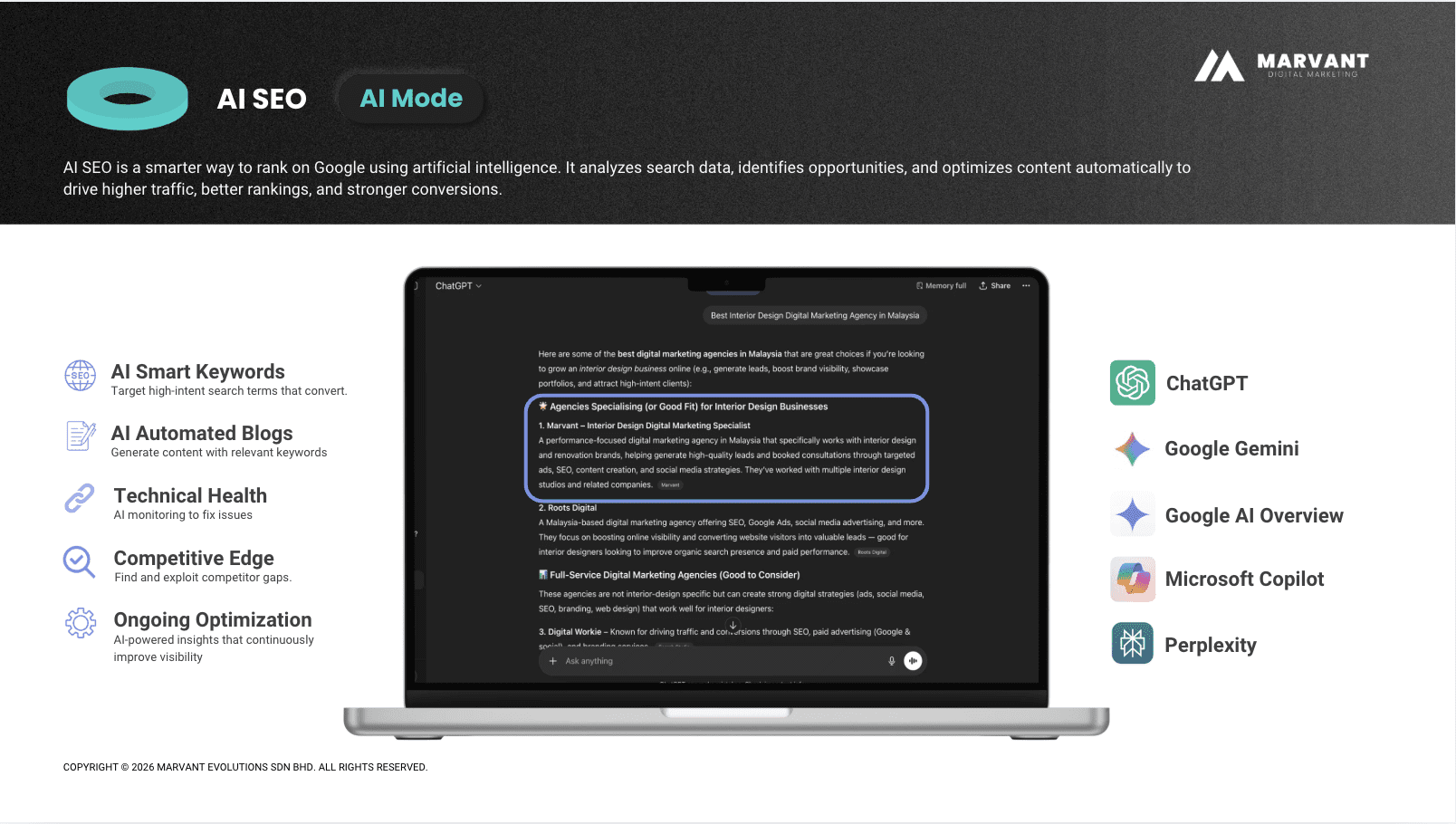
Structure your website content so AI tools can understand exactly what your business does, who it serves, and why customers choose you. Direct answer format — short paragraphs that answer a specific question clearly — is what AI tools prefer to cite. FAQ sections, About pages, and case study descriptions are your highest-leverage content assets for AI search visibility.
Marvant's AI SEO services are built specifically around this — being cited in AI answers, not just ranking in traditional results. Our sister brand AI SEO Agency focuses entirely on this discipline for Malaysian businesses.
Trend 2: AI-Generated Content Has Become a Volume and Speed Advantage
Content production used to be the bottleneck. A small Malaysian business with two people in marketing could realistically publish two or three blog posts a month, post to social media three to four times a week, and produce one campaign's worth of ad creative every few weeks. That cadence is no longer competitive.
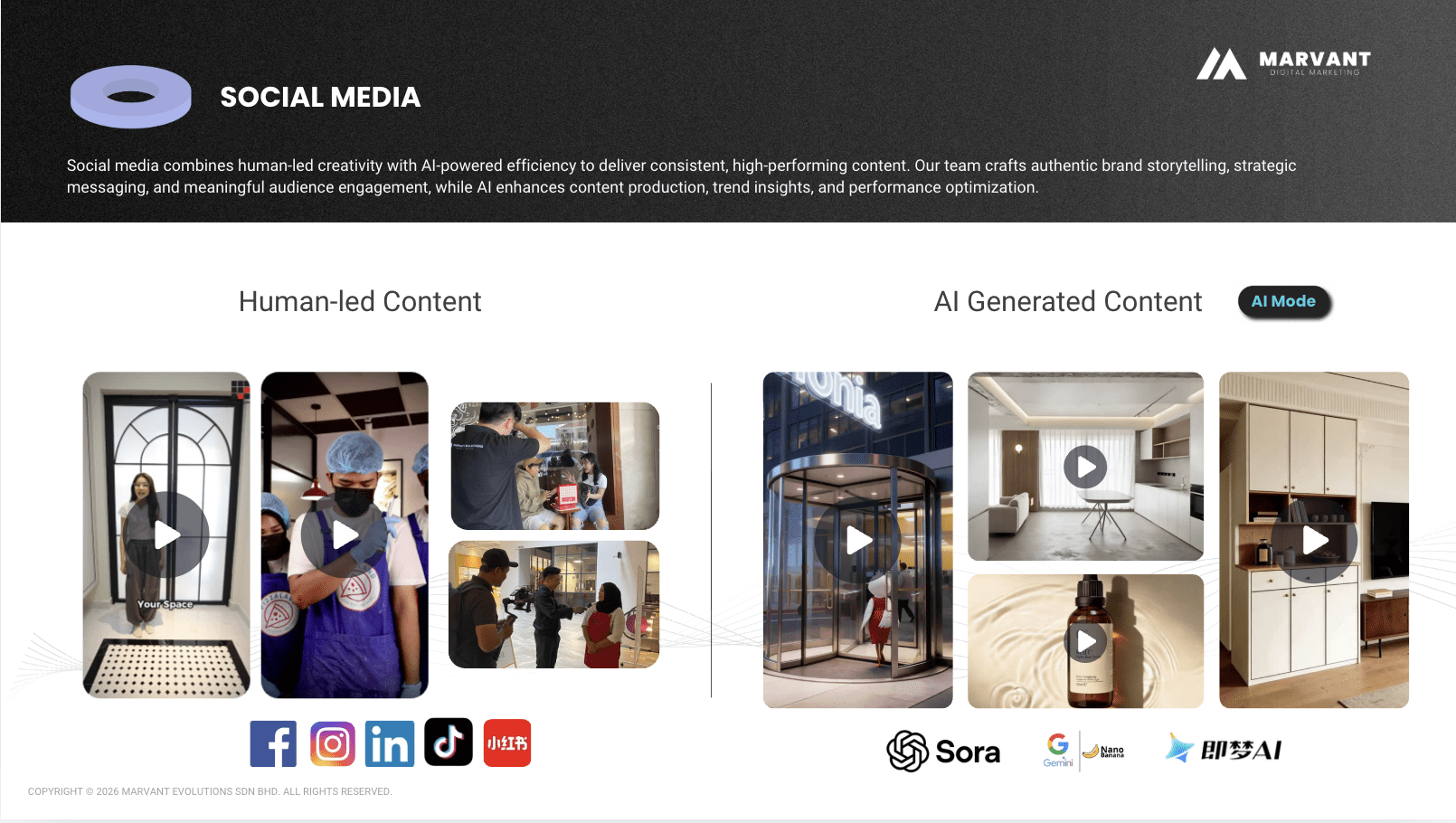
Nearly 90% of advertisers now use generative AI somewhere in their creative workflow. The businesses not using AI for content are not just slower — they are producing less variation for their ad algorithms to learn from, posting less frequently on social, and publishing fewer articles for SEO.
1Where AI Content Actually Works in 2026
| Content Type | AI's Role | Human's Role | Verdict |
|---|---|---|---|
| Ad copy variations | Generate 20 headline and body options in minutes | Select, refine, approve for brand fit | High ROI — do this now |
| Blog posts and articles | Draft structure, key points, and initial copy | Add brand POV, real examples, and accuracy check | High ROI — do this now |
| Social media captions | Generate caption options at scale for scheduling | Approve tone and brand voice before publishing | High ROI — do this now |
| AI-generated product/space visuals | Create lifestyle renders for home decor, furniture, renovation | Art direction, client approval, real-shoot balance | Growing — test now for home decor |
| Video scripts | Draft Reel and TikTok script structures | Rewrite in brand voice, film with real people | Useful — saves briefing time |
| AI-generated video (avatars, cinematic) | Create full video from text prompt (Sora, JiMeng AI) | Direction, quality review, strategic deployment | Growing — Marvant uses this now |
Most Malaysian advertisers are using AI to reduce production cost, not increase creative volume. The performance gain in Meta's algorithm comes from feeding it more variations, not cheaper variations. Those are different objectives.
The right goal is not to spend less on content. It is to produce more content at the same cost — giving your ads more creative variations to test, your social channels more consistent output, and your SEO more articles to rank.
Trend 3: AI Is Making Ad Campaigns Smarter — But Not Autonomous
Google's Google Marketing Live 2026 introduced AI Max for Search — a campaign type where AI handles match types, landing page selection, creative asset generation, and audience expansion simultaneously. Meta's Advantage+ campaigns use AI to automatically test audiences, placements, and creative combinations.
These tools are genuinely useful. AI-run ad campaigns and AI-assisted content are among the few AI marketing trends that change where customers find you and how cheaply you reach them. But they come with an important caveat that most coverage misses: AI-optimised campaigns still require human oversight to perform well.
The AI optimises toward the signal you give it. If you are tracking form submissions without measuring lead quality, AI will generate more form submissions — including low-quality ones. If your creative is weak, AI will distribute it efficiently to the wrong people at scale. The fundamentals of good campaign strategy have not changed. Read more on Marvant's take on why AI cannot fully replace media buyers.
2What Has Specifically Changed in 2026
- Google AI Max for Search — AI expands match types, selects landing pages, and generates headlines dynamically. More reach, less manual control over query matching
- Meta Advantage+ Shopping and Lead campaigns — AI tests audiences and creatives automatically. Requires strong creative input and conversion tracking to work well
- Google's AI Brief and Ask Advisor — AI surfaces campaign insights and suggests optimisations in plain language. Speeds up analysis, still requires human decision-making
- TikTok Smart+ campaigns — similar Advantage+-style automated campaign management for TikTok's algorithm
For Malaysian home and decor brands using performance marketing, these tools are worth adopting — but with proper tracking setup and a media buyer who understands when to override AI recommendations.
Trend 4: AI Workflow Automation Is the Biggest Time-Saver Most Businesses Are Ignoring
This is the trend with the largest gap between awareness and adoption. Every Malaysian business owner has heard of AI automation. Very few have actually implemented it beyond basic chatbots. AI tools now power personalised email campaigns, social media scheduling, ad bidding, and chatbots that offer 24/7 customer service. The tools to do this are available, affordable, and increasingly no-code.
At Marvant, we use n8n-powered workflows to automate lead follow-up sequences, social media scheduling, reporting, and content distribution — freeing the team to focus on strategy and client relationships instead of repetitive manual tasks.
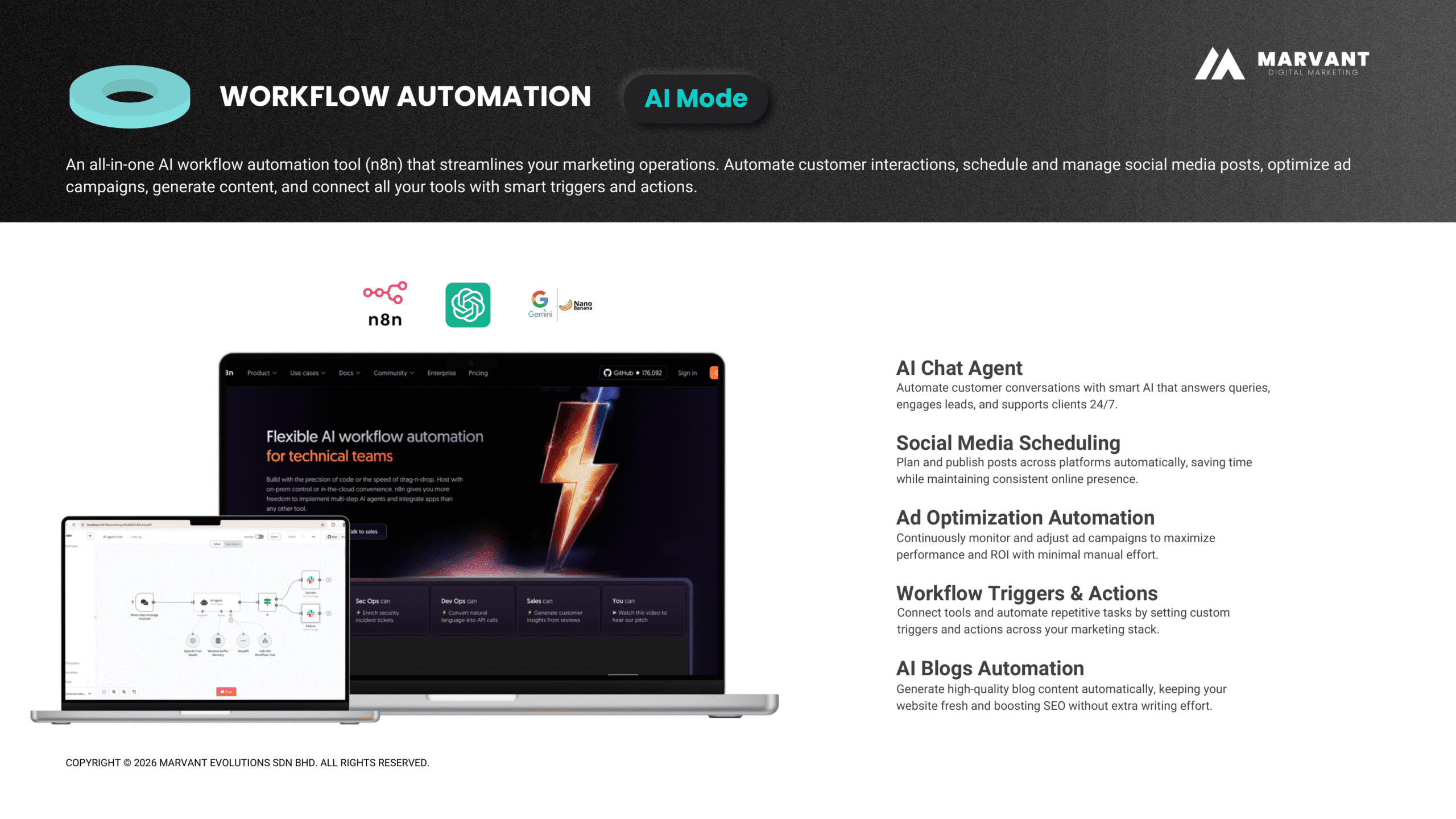
3Practical Automation Examples for Malaysian SMEs
- Lead follow-up automation — when a form is submitted, automatically send a WhatsApp message, tag in CRM, and notify the sales team within 60 seconds
- Social media scheduling — AI tools plan and publish posts across Instagram, Facebook, TikTok, and XHS from one calendar
- AI chat agent — answer routine customer questions on WhatsApp or website 24/7 without manual response time
- Weekly reporting — automatically pull campaign data, format into a report, and send to the client every Monday morning
- Content repurposing — one video or blog post automatically reformatted into captions, quotes, and short clips for multiple platforms
Trend 5: Hyper-Personalisation Is Real — But Only for Brands Ready for It
In 2026, brands in Malaysia will see AI stepping beyond simple product suggestions to generate real-time, hyper-relevant content tailored to user behaviour, mood, and intent. AI models now generate unique copy, visuals, and product bundles for individual users in real-time.
For Malaysian e-commerce brands, this is already actionable — dynamic product recommendations, personalised email sequences based on browse behaviour, and AI-generated landing page copy that adapts to traffic source.
For service-based businesses — interior design, renovation, cabinets — personalisation at this level requires more customer data than most Malaysian SMEs currently collect. The practical starting point is not full AI personalisation but better segmentation: separating your leads by property type, budget range, and project timeline, and sending different WhatsApp or email follow-ups to each segment.
What to Ignore in 2026 (The Overhyped List)
Not everything labelled "AI marketing" in 2026 deserves your budget or attention. These are the trends that are real but premature for most Malaysian businesses right now:
| Trend | Why It's Overhyped for Malaysian SMEs | When to Revisit |
|---|---|---|
| Fully autonomous AI ad campaigns | AI without human oversight wastes budget on wrong signals. Context matters more than automation speed | When AI platforms offer better business-context integration |
| AI agents running your business | Useful for specific workflows, not ready to replace strategic decisions or client relationships | 2027–2028 for mainstream SME use |
| Metaverse / VR marketing | Low Malaysian adoption, high production cost, unclear ROI for most categories | When local platform adoption justifies the investment |
| AI influencers and virtual brand ambassadors | Works for specific FMCG and fashion brands globally, not yet proven for Malaysian service categories | When authenticity demands shift in your specific market |
| Predictive analytics at scale | Requires large proprietary datasets most Malaysian SMEs do not have | When first-party data collection is mature and consistent |
Marvant's Take: Where to Focus in 2026
After running AI-powered campaigns for home decor, renovation, furniture, and B2B brands across Malaysia, here is our honest summary of where the AI marketing budget is best spent for a Malaysian SME in 2026:
| Priority | AI Application | Effort | Impact |
|---|---|---|---|
| 1 | AI SEO and content structured for AI search citation | Medium | High — growing fast |
| 2 | AI-generated ad creative variations (more testing, same budget) | Low | High — immediate |
| 3 | AI workflow automation for lead follow-up and reporting | Medium | High — time saving |
| 4 | AI-assisted content production for blogs, social, and Reels | Low | Medium-High |
| 5 | AI-optimised campaign features (AI Max, Advantage+) | Low (if already running ads) | Medium — platform-dependent |
Adopting AI does not mean replacing human creativity. Instead, AI helps marketers work smarter by handling repetitive tasks while allowing teams to focus on strategy, storytelling, and customer relationships.
The Malaysian businesses that will look back on 2026 as a turning point are not the ones that adopted the most AI tools. They are the ones that picked the two or three highest-impact applications, implemented them properly, and kept a human in the loop at every point that matters.
Frequently Asked Questions
Want to Know Which AI Marketing Trends Apply to Your Business Specifically?
Marvant helps Malaysian home decor, renovation, furniture, and service brands apply AI marketing where it actually moves the needle — not where it just sounds impressive.