For years, OpenAI's CEO Sam Altman called advertising a "last resort." Then the economics of running the world's most used AI product changed that position. In February 2026, OpenAI started showing ads inside ChatGPT. By May 2026, any advertiser could buy them with no minimum spend and no agency partner required.
This is not a minor platform update. Unlike the blue link search model or the scroll-based social feed, ChatGPT Ads insert brands directly into AI-driven conversations — at the exact moment someone is actively researching and seeking an answer. For anyone who buys media, this is the most significant new advertising surface in years, and it behaves nothing like the channels that came before it.
The Numbers Behind ChatGPT as an Ad Platform
The Timeline
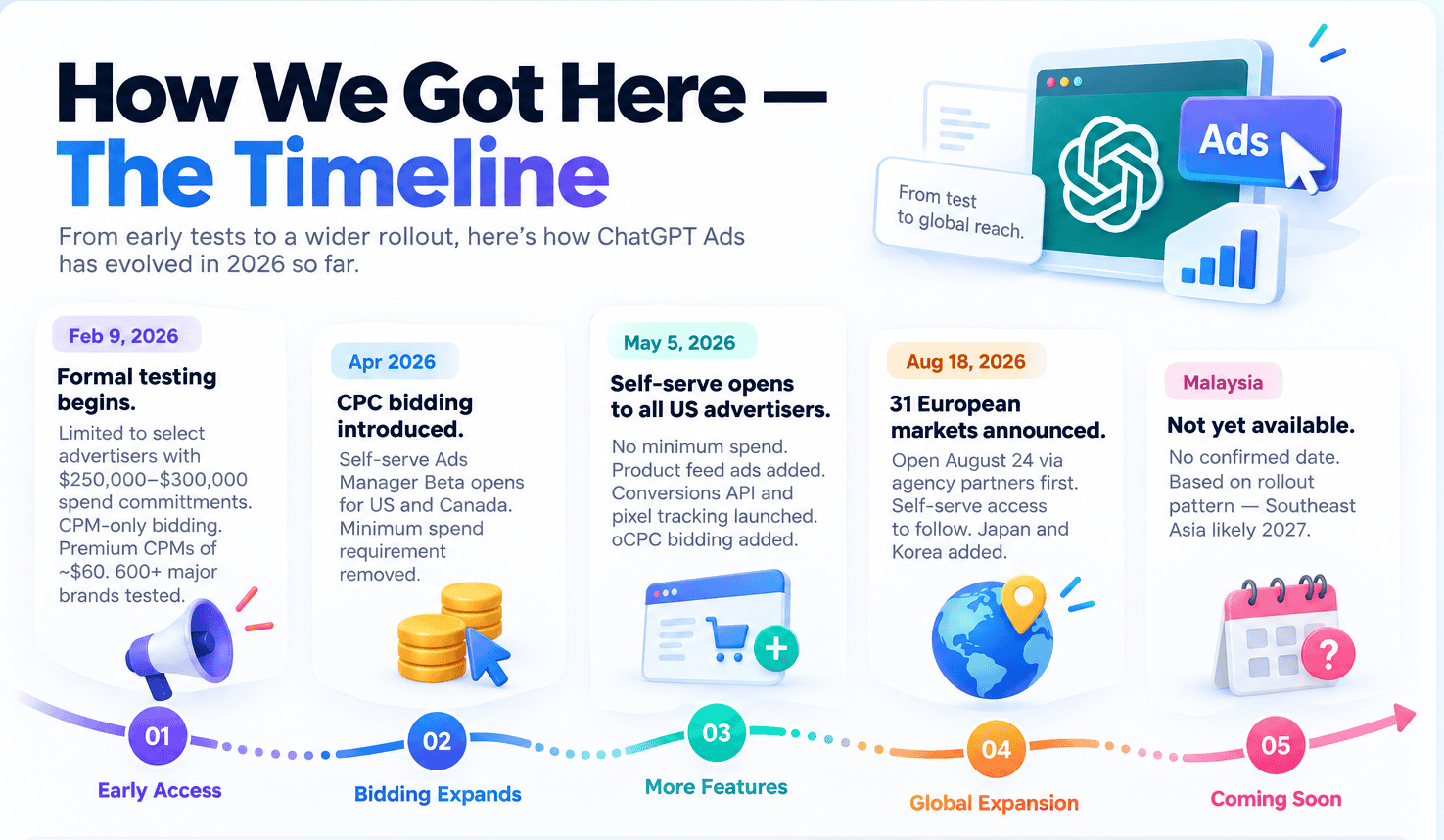
The timeline above shows how quickly OpenAI moved from an invite-only pilot at $250,000 minimum spend in February 2026 to a fully open self-serve platform with no minimum spend by May — a three-month window that few expected. The August European expansion covering 31 markets signals that the global rollout is accelerating. For Malaysian marketers, the gap between now and local availability is the preparation window.
Where ChatGPT Ads Appear
A ChatGPT ad appears as a labelled "Sponsored" card directly below the AI's answer — never inside the answer itself. It is clearly separated from the AI-generated text. Only one ad shows per response. Ads are shown only to users on the Free and Go tiers — paid Plus subscribers see no ads.
The card appears only when ChatGPT detects commercial intent in the conversation — meaning the user is researching or comparing products and services, not just having a casual conversation.
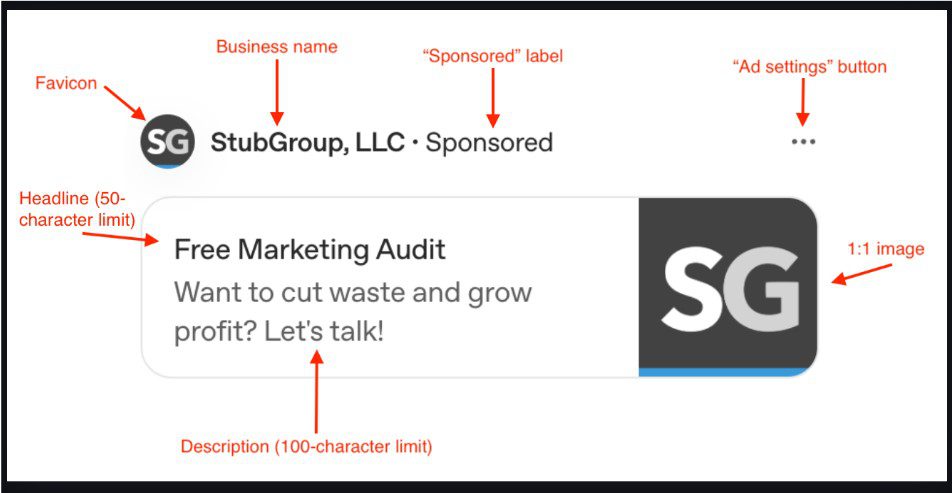
The screenshot above shows exactly what a ChatGPT ad looks like in practice — a clearly labelled "Sponsored" card sitting below the AI's answer, separated from the response. The card includes the advertiser name and favicon at the top, a short headline, a brief description, and a square image on the right. It is compact, unobtrusive, and only appears when the conversation has commercial intent.
Campaign Objectives — What You Can Run
As of August 2026, there are three campaign objectives available in ChatGPT Ads Manager:
| Objective | Bidding Model | Best For | When to Use |
|---|---|---|---|
| Reach | CPM (cost per 1,000 impressions) | Brand awareness | New brand building, high-funnel campaigns where visibility matters more than clicks |
| Clicks | CPC (cost per click) | Traffic and mid-funnel | Driving visitors to a landing page, product page, or consultation form |
| Conversions (oCPC) | Optimised CPC toward a conversion event | Performance marketers | When you have conversion tracking set up and want OpenAI to optimise delivery toward users likely to complete a specific action |
Once a campaign objective is set, it cannot be changed. If you need to switch from Reach to Clicks, you must create a new campaign. Plan your objective carefully before launching.
Campaign Structure
A ChatGPT Ads campaign follows a three-level hierarchy — Campaign, Ad Group, and Ad. Each level controls a different set of decisions.
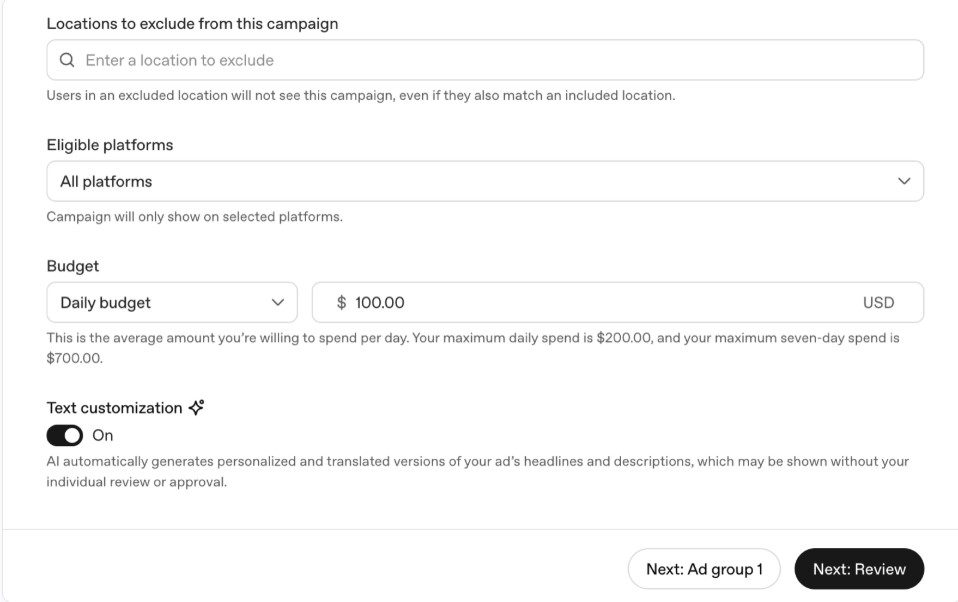
At the Campaign level, you set the campaign name, objective (Reach, Clicks, or Conversions), daily budget, start and end dates, and geographic targeting. This is where the overall goal and spend parameters are locked in — note that the campaign objective cannot be changed after launch, so choose carefully before saving.
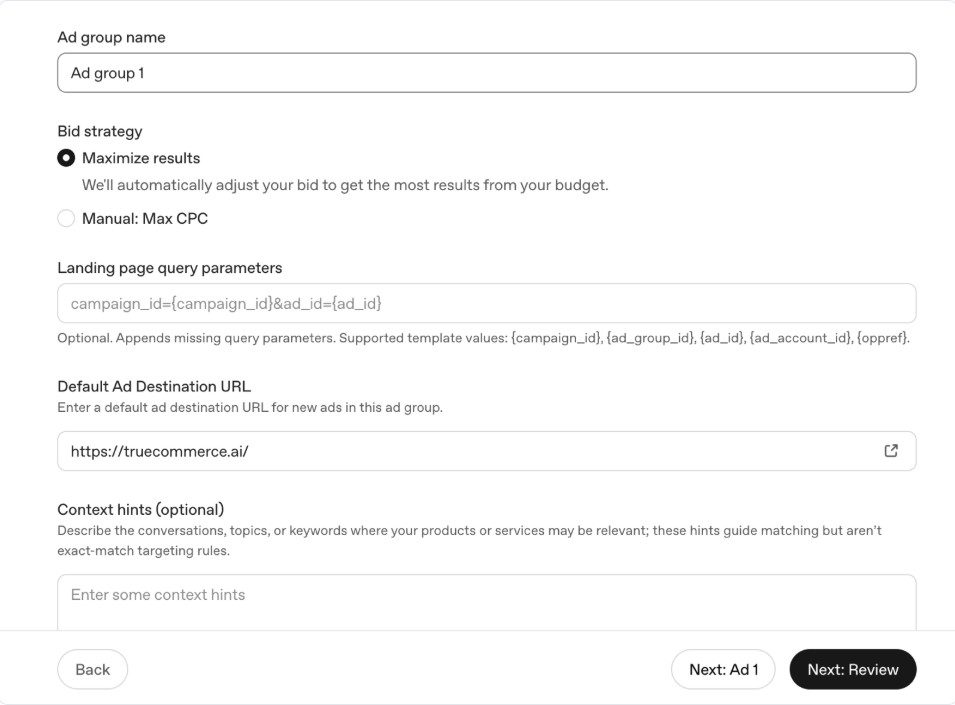
At the Ad Group level, you define context hints, your bid amount, platform targeting, and any custom audience upload. This is the targeting layer — the context hints you write here determine which conversations your ad matches. At the Ad level, you build the actual creative: the title, description, square image, landing URL, and your advertiser name and favicon that appear on every sponsored card.
How Targeting Works — Context Hints, Not Keywords
ChatGPT Ads do not use keyword bidding like Google Search Ads. There are no audience segments or interest categories like Meta Ads. The entire targeting system is built around context hints.
Context hints are broad thematic signals that describe the conversations, topics, needs, and situations in which your product or service is relevant. Instead of bidding on "kitchen cabinet Malaysia," you describe the conversation: a homeowner planning a renovation and comparing cabinet materials.
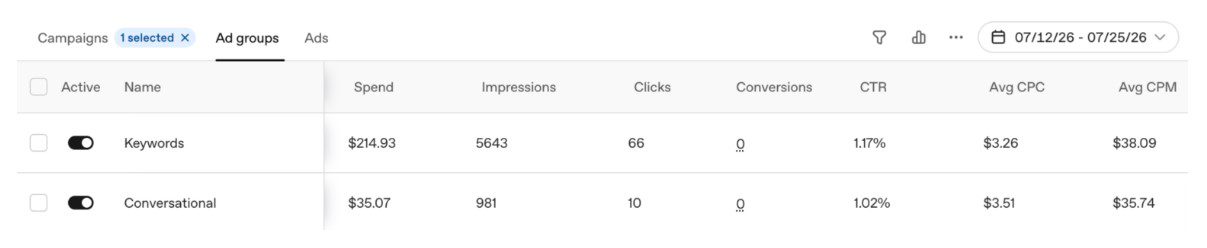
- Context hints — the core targeting feature. Instead of choosing keywords, demographics, or interests, advertisers describe the type of conversation they want their ad to appear beside. The platform then matches the ad to relevant discussions based on that context.
- Geographic targeting — available at campaign level. Advertisers can target by country, while US campaigns also support more detailed options such as state, DMA, and ZIP code.
- Custom audiences — available since May 2026. Advertisers can upload email or phone lists for matching. OpenAI handles the matching internally, and user data is not shared back with the advertiser.
- Platform targeting — lets advertisers choose where the ad appears, including specific ChatGPT platforms such as web, iOS, and Android.
- Negative keywords — available in a limited way, with up to 25 negative keywords per campaign to help exclude irrelevant or off-topic conversations.
- Not available yet — keyword bidding, demographic targeting, interest targeting, behavioural targeting, and manual device targeting. ChatGPT Ads are built primarily around conversation context rather than traditional audience segmentation.
A context hint is not "interior design" or "kitchen cabinet." It is a description of the conversation — for example: "homeowners comparing built-in cabinet options, asking about materials, pricing, and customisation for their condo renovation."
The more specific and situation-accurate your context hint, the better the platform matches your ad to relevant conversations. Your context hints and creatives are the main lever you control — write them to reach the conversations your buyers actually have, not the keywords you would bid on in Google.
Ad Format and Creative Specs
There is one ad format: the sponsored card. No carousel, no video, no expandable units, no second headline. One card, one message, one image.
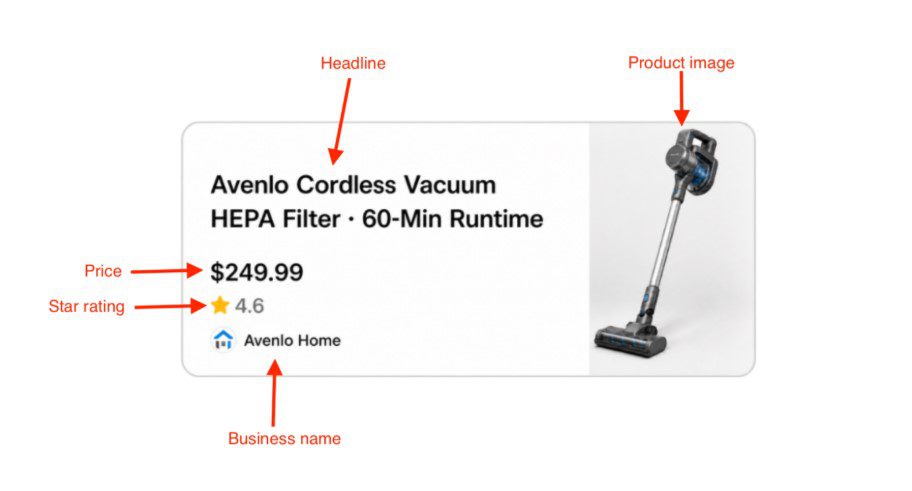
Every sponsored card is made up of six fields. Your advertiser name and favicon appear at the top of the card — these are set at account level and display on every ad you run. Below that sits the title, which is hard-capped at 16–24 characters per OpenAI's official documentation — ads outside this range are rejected at review. The description runs at 32–48 characters (some sources publish 50/100, but those are form acceptance limits, not display limits). A square image anchors the right side of the card — minimum 256×256px, up to 1200×1200px, in JPG, PNG, or WEBP format, and must be a publicly accessible URL. Finally, the landing URL is not visible to the reader but must be valid, reachable, and policy-compliant — OpenAI crawls it before approving the ad.
A 16–24 character title is extremely tight. "Kitchen Cabinets KL" is 18 characters. "Custom Built-In Wardrobe" is 23. "Interior Design Malaysia" is 23. You are writing a single sharp claim, not a Meta primary-text block.
Do not recycle Google or Meta ad copy here. The format rewards brevity and situation-matching. A title that mirrors the user's exact research moment will outperform a generic promotional headline every time.
Bidding Strategy and Pricing
1How the Auction Works
OpenAI uses a relevance-weighted, second-price auction. This means the highest bidder does not automatically win placement. Relevance — how well your ad and context hints match the conversation — affects delivery as much as your bid amount.
This has an important implication: a well-written context hint with a lower bid can outperform a generic context hint with a higher bid. Creative quality and targeting precision matter more here than on platforms where money alone decides placement.
2Pricing Breakdown
| Pricing Element | Detail |
|---|---|
| Minimum daily budget | $25/day for US campaigns (a 30-day campaign at minimum = ~$750 total) |
| Minimum spend requirement | None — removed in May 2026 |
| Launch CPMs (managed access) | ~$60 CPM with $250,000–$300,000 commitments (Feb–Apr 2026) |
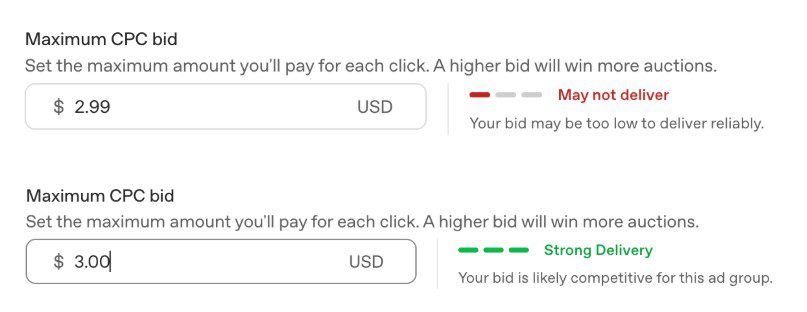
| Self-serve CPC guidance | $3–$5 per click is the widely reported starting range for self-serve |
| Auction type | Relevance-weighted second-price — winning price is just above the second-highest relevant bid |
| Billing | Requires billing profile, billing address, invoice email, and supported payment method before campaigns can run |
3Recommended Bidding Strategy
- Start with CPC — gives you direct control over cost per click and is better for performance measurement early on
- Start at $3–$5 CPC — the widely reported competitive starting range for self-serve. Adjust based on your actual results
- Move to oCPC when you have conversion data — the conversion-optimised objective works best after the pixel has collected enough events to optimise toward
- Give campaigns time before judging — OpenAI's platform is still learning. A campaign needs enough impressions and conversion data before you can draw conclusions
- Create multiple ads per ad group — test different context hints and headlines across ads to identify which message resonates best
Full Platform Comparison: ChatGPT Ads vs Meta Ads vs Google Ads
| Factor | ChatGPT Ads | Google Search Ads | Meta Ads |
|---|---|---|---|
| User mindset | Mid-research, asking a question | High intent, ready to act | Passive scrolling, discovery |
| Targeting basis | Conversation context (context hints) | Search keywords (intent) | Demographics, interests, behaviours |
| Ad placement | Below the AI answer, one per response | Above/below search results, multiple per page | In-feed, Stories, Reels, Sidebar |
| Audience reached | Free and Go tier ChatGPT users only | All Google Search users | All Meta users (FB, IG, Messenger, WhatsApp) |
| Ad formats | Single sponsored card only (text + image) | Text ads, responsive search ads, extensions | Image, video, carousel, collection, lead form |
| Creative specs | 16–24 char title, 32–48 char description, 1:1 image | Up to 15 headlines (30 chars each), 4 descriptions (90 chars each) | Flexible — varies by format and placement |
| Bidding models | CPM, CPC, oCPC | CPC, tCPA, tROAS, Maximize Clicks/Conversions | CPM, CPC, oCPM, cost cap, bid cap |
| Auction type | Relevance-weighted second-price | Quality Score x Max CPC | Relevance-weighted Vickrey auction |
| Min. spend | $25/day (US); no overall minimum | No minimum | No minimum |
| Typical CTR | ~0.65% (early June 2026 data) | 3–6% branded, 1–3% generic | 0.9–1.5% feed average |
| User data shared with advertiser | No — all matching internal to OpenAI | Limited (anonymised query data) | Yes (aggregated, anonymised) |
| Demographic targeting | Not yet available | Age, gender, income, parental status | Age, gender, location, detailed interests |
| Retargeting | Custom audiences via email/phone upload only | RLSA, Customer Match, similar audiences | Website custom audiences, lookalikes, engagement |
| Conversion tracking | Pixel + Conversions API (launched May 2026) | Google Tag, Conversions API, offline imports | Meta Pixel, Conversions API, offline events |
| Malaysia availability | Not yet available | ✓ Available | ✓ Available |
| Best funnel stage | Mid-funnel (research intent) | Bottom funnel (purchase intent) | Top to mid-funnel (discovery) |
ChatGPT Ads sit between Google and Meta in the funnel — past passive discovery (Meta) but before the final high-intent search (Google). A user asking ChatGPT "what is the best kitchen cabinet material for Malaysian weather?" is more ready to decide than someone scrolling Instagram, but they have not yet typed "buy kitchen cabinet KL" into Google.
ChatGPT Ads are not a replacement for Meta or Google Ads. They are a third channel that fills a mid-research gap — and they should be added to an existing media mix once available, not used to replace what is already working.
What This Means for Malaysian Marketers Right Now
As of August 2026, ChatGPT Ads self-serve is available in the US, UK, Canada, Australia, New Zealand, Japan, Korea, and 31 European markets from August 24. Malaysia is not yet in the rollout. Based on the pattern, Southeast Asia is likely 2027.
Here is what to do now while waiting for local access:
- Build AI search visibility first — the content structure that gets your brand cited in ChatGPT answers is the same structure that makes your ads more relevant when the platform opens here. See Marvant's AI SEO services and our sister brand AI SEO Agency
- Map your customers' ChatGPT questions — open ChatGPT and type the questions your customers ask you. See what answers appear and whether your brand is mentioned. This is the content gap to close now
- Prepare answer-first landing pages — when ChatGPT Ads do open, your landing page must continue answering the research question that triggered the ad, not open on a generic homepage
- Study the European rollout data — the August 2026 European launch will generate the most useful independent benchmark data yet. Monitor CPCs, CTRs, and conversion rates before you build your Malaysian budget
ChatGPT Ads will matter for Malaysian businesses — but not yet, and not as a replacement for Meta Ads or Google Ads. When it does open here, it will be most useful for brands already visible inside ChatGPT organically. The businesses that hit the ground running will be the ones building AI search visibility now — not waiting until the platform opens.
Read more in Marvant's guide on AI marketing trends for Malaysian businesses in 2026.
Sources & Further Reading
- OpenAI Ads Manager: Hands-On Guide to Every Screen — Tru Commerce (Viren Inaniyan, August 29, 2026). First-hand walkthrough of every screen inside a live Ads Manager account, including campaign structure, context hints, conversion wizard, and bidding mechanics.
- How to Run ChatGPT Ads — Search Engine Land. Practical guide covering campaign setup, targeting, and creative strategy for ChatGPT Ads.
Frequently Asked Questions
Want to Build AI Search Visibility Before ChatGPT Ads Open in Malaysia?
Marvant helps Malaysian brands get cited inside AI answers — so when ChatGPT Ads arrive, your brand already has the content foundation to make them work from day one.